



Protomelas annectens
The scientific name for this fish species is Protomelas annectens. There is no common name for this species. The species was first described in 1922 by Charles Tate Regan. Protomelas annectens belongs to the family of cichlids (Cichlidae).
The genus name Protomelas comes from Greek, where ‘protos’ means ‘first’ and ‘melas’ or ‘melanos’ means ‘black’. This refers to the original melanin pattern of the species. The species name annectens means ‘connecting’ or ‘joining’. This refers to the way in which this species Cyrtocara venusta (now Nimbochromis venustus) connects with Cyrtocara moorii, which were considered related species at the time.
Relevant scientific synonyms for Protomelas annectens are Cyrtocara annectens and Haplochromis annectens. The species was originally described under the protonym Cyrtocara annectens by Regan in 1922.
Description
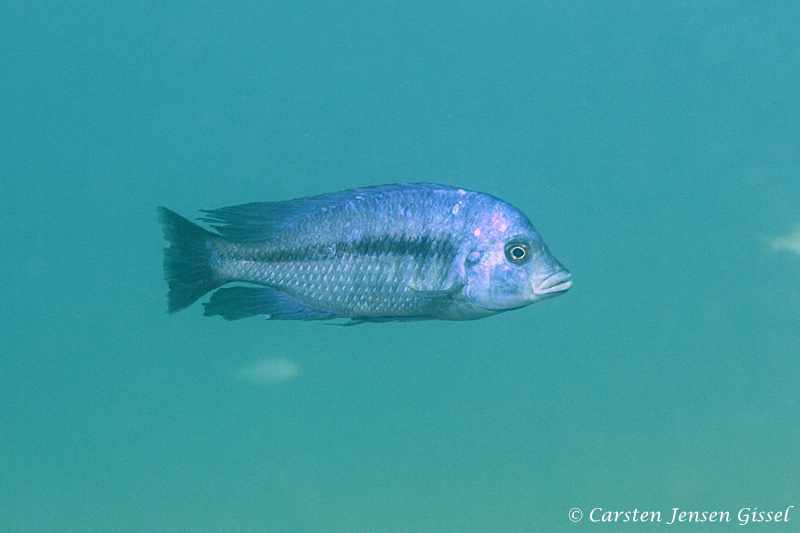
Protomelas annectens males can reach a total length of up to 23 centimeters. Females remain somewhat smaller, with a maximum total length of 17 centimeters.
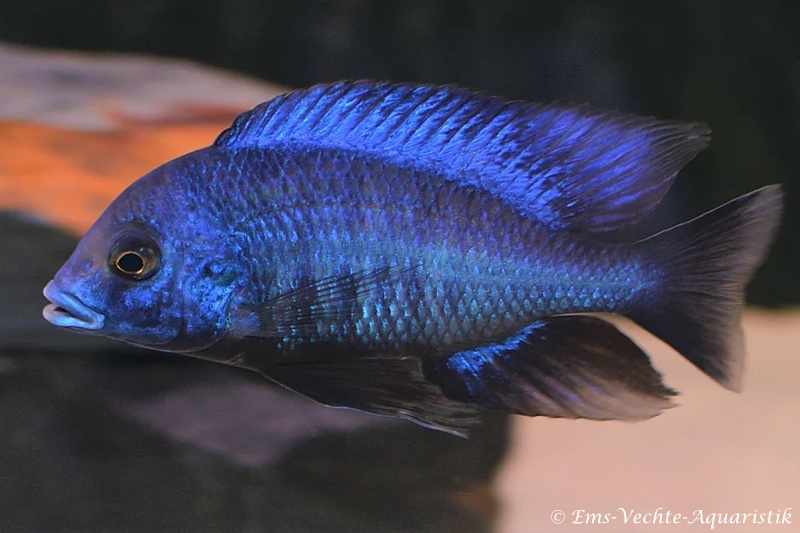
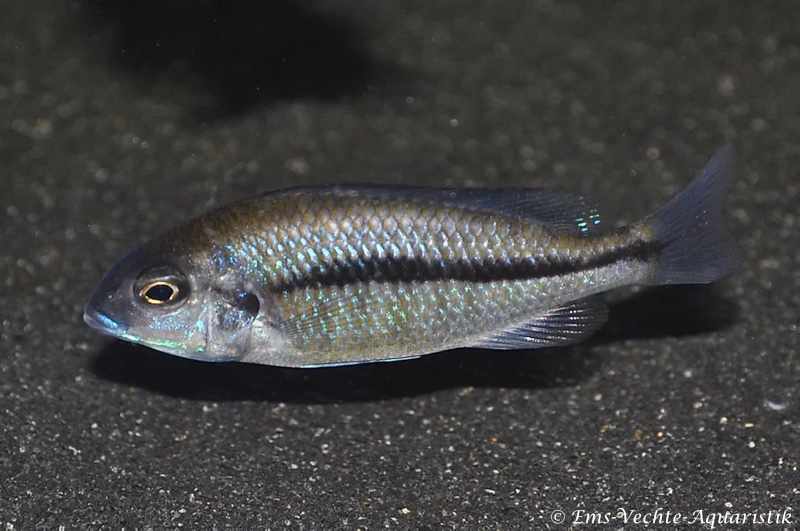
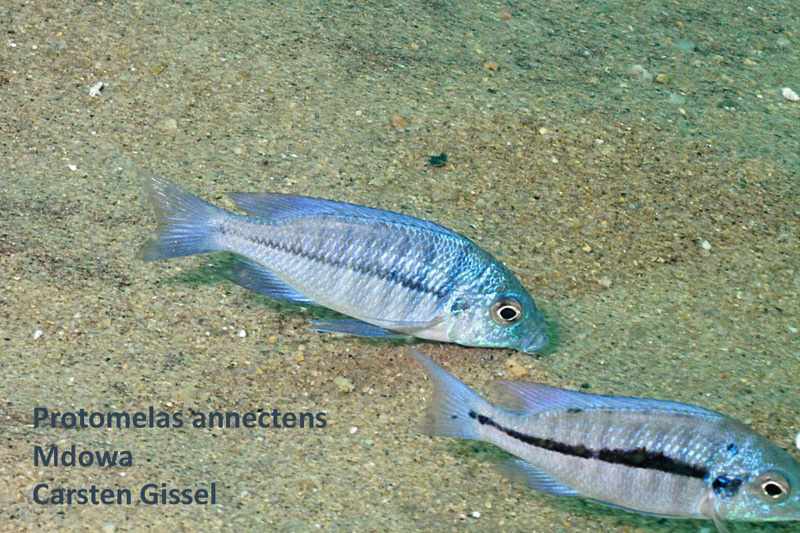
Dominant males turn a light blue color. This color becomes more intense during the mating season. Outside of the mating season, a horizontal stripe can often be seen running from behind the gill cover to the base of the tail. Females, juveniles, and non-dominant males are usually silver-gray in color. They have a distinct horizontal stripe across the flank. There are also vertical bands that are somewhat light in color.
Character
The temperament and behavior of Protomelas annectens can be described as opportunistic. They follow other cichlids in the lake and eat food particles that end up in the water column when the preceding cichlid searches for food in the sand. They are attracted to moving objects that stir up sediment. In nature, they are micro-predators, which means they hunt small prey. In general, they are a somewhat calm species when kept together with species of similar size.
These fish probably swim mainly in the lower and middle water layers, especially where sediment is stirred up and food becomes available.
Biotope
Protomelas annectens is found throughout Lake Malawi. They are commonly found at shallow depths, up to about 10 meters deep.
In their natural environment, these fish mainly live above sandy bottoms. They are often found in the vicinity of other cichlids that burrow in the bottom. This is because Protomelas annectens feeds on sediment stirred up by these burrowing fish. They are attracted to moving objects that stir up sediment.
The habitat characteristics in Lake Malawi include hard and alkaline water, with a general hardness (GH) of more than 10 and a pH value of more than 7.5. The water temperature in their natural environment is tropical and ranges between 22 and 26 °C.
Diet
In their natural habitat in Lake Malawi, Protomelas annectens have an opportunistic diet. They swim behind other large cichlids that root around in the sand and eat the food particles that end up in the water column. They are attracted to moving objects that stir up sediment. These fish are naturally micro-predators and scavengers, which means they feed on small invertebrates and other food debris left behind after larger, sand-digging cichlids have churned up the bottom.
In the aquarium, Protomelas annectens are easy eaters and will accept almost anything you offer them. Suitable aquarium food includes dry food, cyclops, artemia, mysis, and shrimp mix. It is advisable to base their diet mainly on live and frozen food, such as brine shrimp (artemia), black and white mosquito larvae, and small pieces of shrim
The Aquarium
Protomelas annectens is a relatively large cichlid. Males can reach a length of about 23 centimeters in the aquarium, while females grow to about 17 centimeters. Because of their size and need for enough space to move around, a spacious aquarium with plenty of swimming room is important. An aquarium with a length of about 200 centimeters is suitable, which corresponds to an aquarium with a capacity of 720 liters or more. This species is best kept in a harem, with each male having 2 to 3 females.
Aquarium setup
The aquarium setup should mimic the natural habitat of Protomelas annectens. This means that a sandy substrate is preferable, as these fish mainly live above sandy bottoms in Lake Malawi and feed on food particles stirred up by digging fish. The aquarium should also be equipped with several hiding places, for example formed by stones or rocks. In addition to hiding places, it is important to create sufficient open swimming space so that the fish can exhibit their natural behavior and follow other fish that stir up sediment. Although they mainly prefer sandy bottoms, they can also be found in rocky areas in nature.
Water parameters
The water values in the aquarium must be stable and correspond to those of Lake Malawi. This means that the water must be hard and alkaline. The general hardness (GH) of the water should be more than 10 and the pH value higher than 7.5 to around 8.5. The ideal water temperature for Protomelas annectens is between 22 and 26 °C.
Suitabel and Unsuitable Tank mates
Protomelas annectens are generally quite peaceful inhabitants of the aquarium. They are best kept in a group with several females per male. If the aquarium is large enough, it is also possible to keep several males together. It is important not to keep this species together with Mbuna cichlids, as these can often be too aggressive for the more peaceful Protomelas annectens. In general, they can coexist well with most other Malawi cichlids that have similar water values and dietary preferences and are not too territorial or aggressive.
Breeding Aquarium and Conditioning
Protomelas annectens is a mouthbrooder, which means that the female carries and cares for the eggs and later the young fish in her mouth. Males are reproductively active throughout the year and are polygamous, meaning that a male mates with multiple females.
A breeding aquarium is not necessary for breeding this species. They can simply reproduce in a mixed aquarium. However, it is important that a mouthbrooding female can retreat between some rocks. In a crowded or stressful community aquarium, a mouthbrooding female may release her eggs or young prematurely.
Setting up the breeding aquarium
The layout of the breeding tank (or mixed aquarium) should mimic the natural spawning site. The male digs a spawning site among the rocks in the sand. It is therefore important to place sufficient rocks or stones in the aquarium so that the male can create a suitable spot. Provide sufficient hiding places for the females, especially after they have laid their eggs, to reduce stress.
Conditioning of the parent fish
To get the parent fish in top shape for breeding, a varied and nutritious diet is super important. Protomelas annectens are micro-predators and scavengers in the wild. In the aquarium, they will eat almost any food offered. To condition the parent fish, their diet should consist mainly of live and frozen food, such as brine shrimp (artemia), black and white mosquito larvae, and pieces of shrimp, for example. This helps the fish build up sufficient energy and nutrients for reproduction.
The Spawn
During the breeding season, the males of Protomelas annectens exhibit territorial behavior around their chosen spawning site. They chase away all other fish from their chosen spawning site. During this period, the males become more intensely colored and take on a darker blue hue.
The male prepares the spawning site by digging a pit between the rocks on the sandy bottom. This serves as the place where the eggs are deposited. He tries to lure the female to his spawning site. He does this by swimming past her. With his fins spread wide and vibrating movements, he shows off his most beautiful colors.
The eggs are laid in the pit that the male has prepared between the rocks. Turning around each other, the female lays an egg in the sand. The pair continues to circle, and the male fertilizes the egg. The female then takes the egg into her mouth. This process is repeated until all the eggs have been taken into the female’s mouth. An experienced female can incubate around 40 eggs in her mouth.
After laying the eggs, the male’s task is complete. The female now incubates the eggs. She usually retreats between or near the rocks. During incubation, the female eats little or nothing.
Raising the Young Fish
The eggs of Protomelas annectens hatch after an incubation period of a few days. The female does not release the young yet. They continue to grow in the female’s mouth, feeding on their yolk sac. The female releases the young fish about 18 to 21 days after laying them.
In a mixed aquarium, the released young fish often fall prey to the adult fish. They see the young fish as a tasty snack. In an aquarium with many hiding places, only a few young survive. If you want to raise an entire brood, move the female to a breeding aquarium on day 15 or 16 after spawning. Make sure the breeding aquarium has sand on the bottom and a hiding place for the female. After releasing the young fish, she will not eat them immediately. You will have enough time to return the female to the main aquarium.
You can feed the newly released youngster with finely ground flake food and small live or frozen food.
Particularities
Protomelas annectens is an interesting cichlid from Lake Malawi with some specific characteristics and behaviors.
Status and Protection: Protomelas annectens is currently not threatened in its natural habitat. This means that populations in Lake Malawi appear to be stable.
Unique Behaviors and Feeding Strategy: A striking feature of Protomelas annectens is their unique feeding strategy. They are considered opportunistic micro-predators and scavengers. In Lake Malawi, they follow other large cichlids that burrow in the sand. When these digging fish stir up sediment, Protomelas annectens feeds on the small invertebrates and food particles that are released into the water column. They are specifically attracted to moving objects that stir up sediment. This behavior shows a clever adaptation to their environment in order to obtain food.
Reproduction and Color Patterns: In terms of reproduction, Protomelas annectens males are sexually active throughout the year. They are polygamous, meaning that a male mates with multiple females. During the mating season, the males become more intensely colored and take on a darker blue hue. Females, young fish, and males that have not yet fully developed their coloration have a more brownish to light blue color and can be recognized by a dark longitudinal band on their body. This color difference is an important characteristic for distinguishing between the sexes and stages of development.
Temperament: Protomelas annectens is generally a relatively peaceful cichlid. They are not very dominant and can have a hard time when kept together with very lively and bossy fish. This makes them suitable for a community aquarium with other calmer Malawi cichlids.
Discovery history: The species was first scientifically described in 1922 by Charles Tate Regan. The species name annectens means “connecting” or “joining,” referring to the way this species connects Cyrtocara venusta (now Nimbochromis venustus) with C. moorii, which were considered related genera at the time.
Conclusion
Protomelas annectens is an impressive cichlid from Lake Malawi that requires a spacious aquarium, preferably 800 liters for an advanced aquarist, with plenty of swimming space and a sandy bottom. These fish are relatively calm and thrive best in hard, alkaline water with a temperature between 22 and 26 °C. They are opportunistic eaters and accept a wide range of foods, with a diet of live and frozen foods recommended. It is important not to keep them with aggressive Mbuna cichlids, but rather with other peaceful Malawi cichlids.
Protomelas annectens can be bred in the aquarium, with the female being a maternal mouthbrooder that carries the eggs and young in her mouth for about 3 weeks. Males dig a spawning site among the rocks. For successful breeding, a harem setup with multiple females per male is recommended, as well as a nutritious diet for the parent fish. Due to their size and specific needs, these fish are best suited for experienced aquarium enthusiasts who can provide a large, stable Lake Malawi biotope.
Video

Frequently asked questions – FAQ
How large does Protomelas annectens grow?
In the aquarium, males can reach a total length of approximately 23 centimeters, while females grow to around 17 centimeters.
What is the minimum aquarium size for Protomelas annectens?
The aquarium must have a minimum length of approximately 200 centimeters, which equates to approximately 720 liters. Due to their size, a spacious aquarium with plenty of swimming space is important.
Are Protomelas annectens aggressive?
No, Protomelas annectens is generally considered to be a relatively peaceful and calm cichlid. They are not very dominant and may struggle when kept with overly aggressive fish.
Which tank mates are suitable for Protomelas annectens?
They can coexist well with most other peaceful Malawi cichlids that have similar water values and dietary preferences. Combining them with other large, non-territorial species is often successful.
What does a Protomelas annectens eat?
In nature, they are opportunistic micro-predators and scavengers that eat small invertebrates. In the aquarium, they are easy feeders that accept dry food, cyclops, artemia, mysis, and shrimp mix. A diet consisting mainly of live and frozen food is recommended.
How do you breed Protomelas annectens?
It is a maternal mouthbrooder. The male digs a pit between the rocks as a spawning site. It is recommended to keep one male with several females (harem). The parent animals must be well fed with live and frozen food. The eggs hatch after about 3 weeks at a water temperature of 25°C.
What are the ideal water values for Protomelas annectens?
The water values must mimic those of Lake Malawi: hard and alkaline water. The ideal water temperature is between 22 and 26 °C, with a pH value preferably between 7.5 and 8.5.
What is the life expectancy of a Protomelas annectens?
The life expectancy of Protomelas annectens is between 10 and 12 years.
Can you keep Protomelas annectens together with Mbuna?
No, it is strongly advised not to keep Protomelas annectens together with Mbuna cichlids. Mbuna are generally too aggressive and territorial for the more peaceful Protomelas annectens.
Author

Since I bought my first second-hand aquarium when I was twelve, I have always had one or more aquariums. I even converted a garage into a breeding room where I had 50 aquariums containing around 10,000 liters of water. At the moment, I have two aquariums: a 1,250-liter Tanganyika aquarium and a 250-liter community aquarium with plants. For the past 10 years, I have been working on this website as a writer and photographer.
Copyright images


