Lake Malawi Lakes
Imported outline. See the source for coverage.
Source: GSHHG shoreline/lake data (Wessel & Smith), via basemap-data. · LGPL-3.0-or-later

 Madimba Bay Likoma
Lake Malawi in East Africa is one of the best-known freshwater lakes in the world. The lake is particularly remarkable for its enormous diversity of cichlids. Hundreds of species have adapted to different habitats, food sources and conditions. Many of these fish are found nowhere else in the world.
However, Lake Malawi is not made up of just one type of habitat. Along its shores, you will find rocky coasts, sandy bottoms, transitional zones and sheltered bays. Farther from the coast are open water and deep parts of the lake. Each biotope has its own characteristics and attracts different fish species.
On this page, we explore Lake Malawi as a complete ecosystem. You can read more about its different habitats, the fish found there and the conditions in which they live in the wild.
At the bottom of the page, you will also find all the species from Lake Malawi that are currently included in the AquaInfo database. From this species list, you can click through directly to the available species descriptions.
Are you mainly interested in where certain Malawi cichlids are found? Then use our interactive map of Lake Malawi. You can search by species and location.
Explore the location, map coverage, and species linked to this ecosystem on AquaInfo.
Background: Natural Earth · country borders and coastlines
The map shows the location of the ecosystem. The species list is not a complete inventory and does not imply that each species inhabits every highlighted area.
Imported outline. See the source for coverage.
Source: GSHHG shoreline/lake data (Wessel & Smith), via basemap-data. · LGPL-3.0-or-later
Lake Malawi lies in the East African Rift and is surrounded by Malawi, Mozambique and Tanzania. It is a large, deep freshwater lake with a long, narrow shape. The combination of its depth, size and widely varying coastal zones has created many different habitats alongside one another.
Along the shores, rocks, sandy beaches, bays and transitional zones alternate. Farther from the coast lies open water, and at greater depths, light, temperature and food availability change. As a result, conditions are not the same throughout the lake.
This variety is important for the animals that live there. Some fish are closely associated with rocks, while others live over sandy bottoms or stay in open water. The way species search for food also varies greatly between habitats.
Lake Malawi is best known for its large number of cichlids, but other groups of fish also live there. Together, all these species form a complex ecosystem in which predators, plankton feeders, algae eaters, bottom dwellers and other specialized fish each occupy their own niche.
The wide variety of habitats also plays an important role in the development of local populations and species. For a more detailed explanation of evolution and speciation, see Lake Malawi – Darwin’s Playground.
Lake Malawi has several habitats that can differ greatly from one another. Some parts of the coast consist almost entirely of rocks, while elsewhere there are large sandy expanses, sheltered bays or open water.
This makes a big difference to fish. A species that scrapes food from rocks has different needs from a fish that searches for small animals in the sand or feeds on plankton in open water. The biotope therefore largely determines which species can live in a particular area.
Rocky areas are among the best-known biotopes of Lake Malawi. Many Mbuna and other cichlids that are closely associated with rocks live here.
The stones provide hiding places, territories and food. A layer of algae, microorganisms and organic matter grows on the rocks. Many species search for food in this layer.
Fish can retreat into crevices and caves to escape other fish and predators. Territorial species in particular make extensive use of the rocky structure.
Transitional zones lie between rocky areas and open sandy bottoms. Both structures occur here: scattered stones and boulders alternate with sand.
This makes the transitional zone suitable for species that use both the shelter among the rocks and food sources on or in the sandy bottom.
This variety is precisely what gives transitional zones their own species composition. Some cichlids are closely associated with this type of habitat.
Large parts of Lake Malawi consist of open sandy bottoms. These areas may seem barren, but they are an important habitat for many fish.
Various species search here for small invertebrates in the sand. Others sift sand through their mouths and gills to find food particles.
Sand also often plays a role in reproduction. Males of some species make pits or other conspicuous nesting sites to attract females.
More vegetation can grow in shallow, sheltered parts of the lake. These areas differ clearly from open rocky coasts and deep sandy expanses.
Plants and other structures provide shelter for young fish and small animals. They can therefore also be an important food source for larger fish.
Not all parts of Lake Malawi are rich in aquatic plants, but wherever vegetation is present, it creates a distinctly different habitat.
Beyond the immediate coastal zone lies open water. There are few fixed structures here, and species that are less closely associated with the bottom live in this area.
Some fish search for plankton or other small organisms in the water column. Other species hunt free-swimming prey.
As a result, the behavior of fish in open water differs greatly from that of species that live permanently among rocks or just above the bottom.
As depth increases, conditions in Lake Malawi change. There is less light, the temperature may differ, and the amount of available food also changes.
As a result, different species live in the deeper parts of the lake than in shallow coastal areas. Some fish are highly adapted to these conditions and are rarely found in shallower water.
The great variety of biotopes is one reason Lake Malawi has such a rich fish fauna. If you would like to learn more about the exact distribution of species across these habitats, you can use the interactive map of Lake Malawi.
Lake Malawi is best known for its cichlids, but its fish fauna is more diverse than that. The lake is home to species with very different ways of life, from rock dwellers and sand sifters to plankton feeders and predatory fish.
The different groups each use their own part of the ecosystem. This is reflected in their body shape, behavior, food preferences and reproduction.
Cichlids are by far the best-known group of fish in Lake Malawi. Many species are endemic, meaning they are found only in this lake.
There are major differences among Malawi cichlids. Some species live almost exclusively among rocks, while others are found over sandy bottoms or in open water. Their diets can also vary greatly.
The wide variety of lifestyles makes Lake Malawi’s cichlids interesting to both biologists and aquarium enthusiasts.
Mbuna are cichlids that are mainly associated with rocky habitats. They use crevices and caves for shelter and as territories.
Many Mbuna forage on the rocks. They feed on algae, microorganisms and other material in the layer that grows on the rock surface.
Because they are so closely associated with rocky areas, local populations can remain separated from one another for a long time. As a result, distinct geographic color variations have developed in various species.
You can find more information about this group under Mbuna.
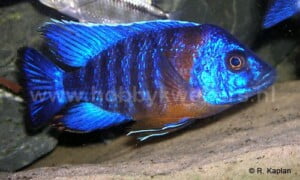
Peacock cichlids of the genus Aulonocara often live over sandy bottoms and in transitional zones.
They are specialized in locating small prey animals in the sand. Enlarged sensory canals on their heads allow them to detect movements in the substrate. They then dive down to retrieve the prey from the sand.
Many Aulonocara species and local populations have striking colors. The males in particular are popular in the aquarium hobby.
You can find more information under Peacock cichlids – Aulonocara.
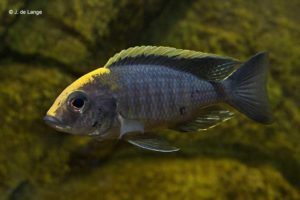
Utaka are generally less closely associated with rocks than Mbuna. Many species swim above rocks, over sandy bottoms or in open water.
Some of these fish feed mainly on plankton and other small organisms in the water column. Other species search for food closer to the bottom.
Because they swim more freely, some Utaka may have a larger range than typical rock dwellers.
You can find more information about this group under Utaka.
Not every cichlid from Lake Malawi fits neatly into the familiar groups of Mbuna, peacock cichlids or Utaka.
For example, some species specialize in eating snails, insect larvae, scales or other fish. There are also cichlids in deeper zones that are rarely seen in shallow coastal areas.
These specializations show just how many different food sources and habitats are available within the ecosystem.
Fish from other families also live in Lake Malawi, alongside cichlids.
These include catfish and other species with completely different lifestyles from the familiar Malawi cichlids. Some live mainly on or just above the bottom, while others are found in open water.
These species often receive less attention in the aquarium hobby, but they are part of the lake’s natural ecosystem.
At the bottom of this page, you will find all the species from Lake Malawi that are currently included in the AquaInfo database.
Fish in Lake Malawi use a wide variety of feeding strategies. Some scrape food from rocks, while others sift sand, eat plankton or hunt other fish.
These differences allow many species to live alongside one another without all competing for exactly the same food. Each species effectively uses its own portion of the available food supply.
A thin layer of algae, bacteria, small organisms and organic matter grows on rocks. This layer is often referred to as aufwuchs.
Many Mbuna get a large part of their food here. Depending on the species, they scrape, pick or comb the material off the rocks.
The shape of their mouths and teeth can vary considerably. This is related to the way each species gathers food from the rocks.
Sandy bottoms also contain plenty of food. Small crustaceans, insect larvae and other invertebrates can be found in or among the grains of sand.
Some cichlids take mouthfuls of sand and sift out the edible material. Other species, such as many Aulonocara, use their senses to detect movements of prey animals in the sand.
After locating prey, they dive to the bottom to retrieve it from the sand.
Plankton floats in open water and above the bottom. It consists of very small organisms carried along by currents and the movement of the water.
Plankton is an important food source for various fish. Some species swim actively through the water column and take in small organisms directly from the water.
Young fish of various species may also depend heavily on small food items in the water column during the first stage of their lives.
Snails, crustaceans, insect larvae and other small animals are food for various fish in Lake Malawi.
Some cichlids are highly specialized in finding or processing this type of prey. Such specializations reduce direct competition with species that mainly eat algae, plankton or other foods.
Lake Malawi is also home to many predatory fish. Some hunt small fish, while others specialize in prey such as fry, eggs or scales.
Predatory fish play an important role in the ecosystem. They affect the numbers and behavior of their prey and are therefore part of the natural food chain.
Algae and plankton form the basis of many food chains in Lake Malawi. They are eaten by smaller animals and fish, which in turn become food for larger species.
The ecosystem therefore consists of many interconnected feeding relationships. The great variety of food sources has helped give rise to all kinds of specialized lifestyles among the fish of Lake Malawi.
You can read more about how such specializations contributed to the development of the enormous diversity of species in Lake Malawi – Darwin’s Playground.
The fish of Lake Malawi display many different forms of behavior. Territoriality, courtship and parental care play a major role, especially among cichlids.
Many species stay close to a fixed location, while others swim around more freely. Behavior is closely related to habitat, feeding strategy and the way a species reproduces.
Males in particular may defend a territory during the breeding season. That territory may consist of a rock, a cave, a patch of sandy bottom or a pit they have made themselves.
The size of such an area varies by species. In rocky areas, territories are sometimes close together, while species on open sandy bottoms use more space.
Territorial behavior helps males keep rivals at a distance and attract females.
During courtship, males try to attract females with color, movement and behavior. In many Malawi cichlids, males become more brightly colored during the breeding season.
Some species court among the rocks, while others use an open area or a sandy pit. The surroundings in which courtship takes place therefore vary by biotope.
Many cichlids from Lake Malawi are mouthbrooders. After fertilization, the female takes the eggs into her mouth. She protects them there until the fry have developed enough to swim independently. During this period, the female often eats little or nothing at all.
Mouthbrooding protects the fry from predators and unfavorable conditions. It is one of the best-known reproductive strategies among Malawi cichlids.
Even after the fry have been released, some species may continue to provide a degree of protection. When danger threatens, young fish sometimes seek the female’s company again. In other species, parental care ends as soon as the fry can swim independently. The intensity and duration of parental care therefore vary by species.
Behavior is closely linked to the surroundings. Rock dwellers use caves and crevices for shelter and as territories, while sand-dwelling species often make much greater use of open space.
Group formation also varies. Some species live mostly solitary or territorial lives, while others occur in loose groups outside the breeding season.
Knowing about these natural differences helps explain why species from the same lake can nevertheless have very different environmental requirements.
The water in Lake Malawi is generally clear, mineral-rich and alkaline. However, conditions are not exactly the same everywhere or at all times. Depth, wind, rainfall, temperature and local conditions affect the water and the animals that live in it.
The surface water is fairly warm for most of the year. Temperatures can change more quickly in shallow coastal areas than in deeper parts of the lake.
At greater depths, the water is generally cooler and more stable. As a result, species that live in deep water may be found under different conditions from fish in shallow rocky and sandy zones.
Lake Malawi has alkaline water with relatively high levels of dissolved minerals. As a result, its pH is well above neutral.
For the fish, the stability of these conditions is especially important. Many species are adapted to the lake’s mineral-rich water and do less well when conditions change significantly or suddenly.
The water is remarkably clear in many places. This allows sunlight to penetrate deeply, especially in shallow coastal zones.
However, clarity can vary locally. Wind, waves, rain and stirred-up sediment can temporarily make the water murkier. This effect can be especially noticeable over sandy bottoms and in shallow bays.
Wind has a major influence on Lake Malawi. Strong waves can develop along exposed coasts.
This movement of the water affects, among other things, oxygen levels, the transport of food particles and the growth of algae on rocks. For fish living in shallow coastal zones, waves are therefore a normal part of their natural environment.
The area around Lake Malawi has distinct wet and dry periods. During the rainy season, more water flows into the lake from rivers and the surrounding land.
This can locally affect water clarity, food availability and the amount of sediment. During the dry season, less rainwater flows into the lake, and conditions in many coastal zones are more stable.
These seasonal changes gradually alter the character of the ecosystem, but the enormous volume of water in Lake Malawi also means that large parts of the lake remain relatively stable.
Lake Malawi is an exceptionally rich ecosystem, but it is also under pressure. Changes along the shores, fishing, pollution and climate change can affect the lake’s habitats and fish populations.
Species with a small distribution range are particularly vulnerable. If a species occurs only around one reef, island or short stretch of coastline, damage to that location can have major consequences for the entire population.
Fish are an important source of food and income for many people around Lake Malawi. Fishing is therefore an integral part of life around the lake.
When fishing pressure becomes too high, populations can decline. This is especially true when many adult fish are caught before they have had sufficient opportunity to reproduce.
Good fisheries management is therefore important to protect both the local population’s food supply and the natural ecosystem over the long term.
Villages, towns and agricultural areas lie along Lake Malawi. Wastewater, waste and nutrients from agriculture can eventually end up in the lake.
Deforestation and changes to the landscape can also have an impact. When the soil is less well retained, heavy rain can carry more sediment into the water. This can change water clarity and bottom structure, especially in shallow coastal areas.
Such changes can be significant for species that depend heavily on a particular type of rocky or sandy biotope.
Changes in temperature, rainfall and wind can have consequences for a large lake such as Lake Malawi.
This can affect water mixing, nutrient availability and plankton production. Such changes then have knock-on effects throughout the food chain.
The effects are not the same for every species. Some fish can adapt relatively easily, while species with a small distribution range or a highly specialized lifestyle may be more vulnerable.
The very local diversity that makes Lake Malawi so special can also be a weak point.
A cichlid found along large parts of the lake has multiple populations. A species that lives only around one small reef or island does not have that option. If its habitat deteriorates, there is little room to move elsewhere.
That is why knowledge of locations and distribution is important for conservation. The interactive map of Lake Malawi clearly shows how limited or extensive the range of different species can be.
Protecting Lake Malawi is not just about individual fish species. The habitats themselves must also be preserved.
Healthy rocky coasts, sandy bottoms, transitional zones, bays and open water together form the ecosystem on which the fish depend. By managing fisheries sustainably, limiting pollution and protecting important habitats, these natural communities can be preserved.
For aquarium enthusiasts, the responsible sourcing of fish is also important. By avoiding unnecessary pressure on natural populations and carefully keeping local variants separate, the aquarium hobby can also contribute to preserving Lake Malawi’s remarkable diversity.
Text alone can only show part of how varied Lake Malawi is. That is why AquaInfo also lets you explore the natural biotopes and follow the distribution of species on an interactive map.
With the interactive map of Lake Malawi, you can search by location and fish species.
For example, you can see whether a species occurs at only a few locations or is spread across a larger part of the lake. This is especially interesting for cichlids with distinct local color variations.
The map thus complements this ecosystem page: here, you can read about how the different habitats fit together, while the map mainly shows where species and populations occur.
Would you like to see what rocky bottoms, sandy zones and transitional areas actually look like? Then watch the videos on Lake Malawi – Great Rift Valley – Africa.
There you will find underwater footage from various locations in Lake Malawi. Among other things, you can see how cichlids move through their natural habitat, how much open space some species use and how rocky and sandy areas alternate.
The footage provides additional context for the biotopes described on this page and can also help you better understand the natural behavior of Malawi cichlids.
Many fish species from Lake Malawi are now included on AquaInfo. These include not only well-known Malawi cichlids, but also other fish that are part of the same ecosystem.
In the overview below, you will find all the species linked to Lake Malawi in the AquaInfo database. From this list, you can click through to the available species descriptions, which include information on appearance, behavior, diet, aquarium setup, water parameters and reproduction, among other things.
The list is updated whenever new species are added to AquaInfo. This page therefore grows along with the information in the database.
Would you like not only to look up a species, but also to see where it occurs in the lake? Then use the interactive map of Lake Malawi. You can search by species and location.
Would you like to learn more about the natural behavior of these fish and the conditions in which they live? Then also watch the videos of biotopes in Lake Malawi.
This list uses explicit ecosystem links on published AquaInfo species pages in this language. A missing species or translation does not imply absence from the ecosystem.
Showing 1–12 of 133 results





Showing 1–12 of 133 results


