
Cyprichromis leptosoma
Cyprichromis leptosoma was first described by George Albert Boulenger in 1898. In common, the fishes in this genus are called Herring cichlids (so several species are included).
The genus name Cyprichromis consists of two parts: Cypri and chromis. Cypri- refers to the morphological (external) similarity (slender body shape) to the killifish family Cyprinodontidae (which at the time included almost all killifish, including slender ones, but is now limited to the sturdily built pupfish). “chromis” is a name that goes back to Aristotle, possibly derived from chroemo (to neigh), referring to a drumfish (Sciaenidae) and its ability to make sound. Later, the meaning was extended to cichlids, damselfish, dwarf perch, and wrasse (all perch-like fish once thought to be related), often used in the names of African cichlid genera after Chromis (now Oreochromis) mossambicus. The species name leptosoma means thin; soma means body, referring to the elongated body.
So, in summary, the name Cyprichromis leptosoma means something like “slender, perch-like fish with a body similar to that of a killifish.”
Synonyms: Paratilapia leptosoma, Limnochromis leptosoma
Appearance, Behavior and Life expectancy of Cyprichromis leptosoma
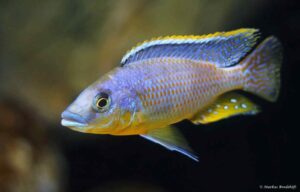
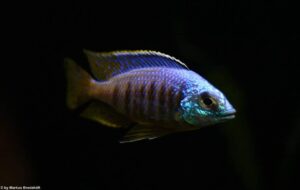
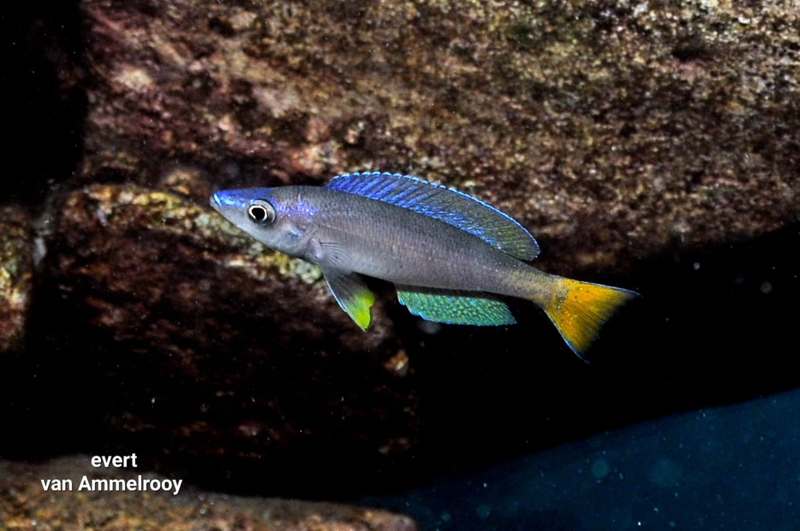
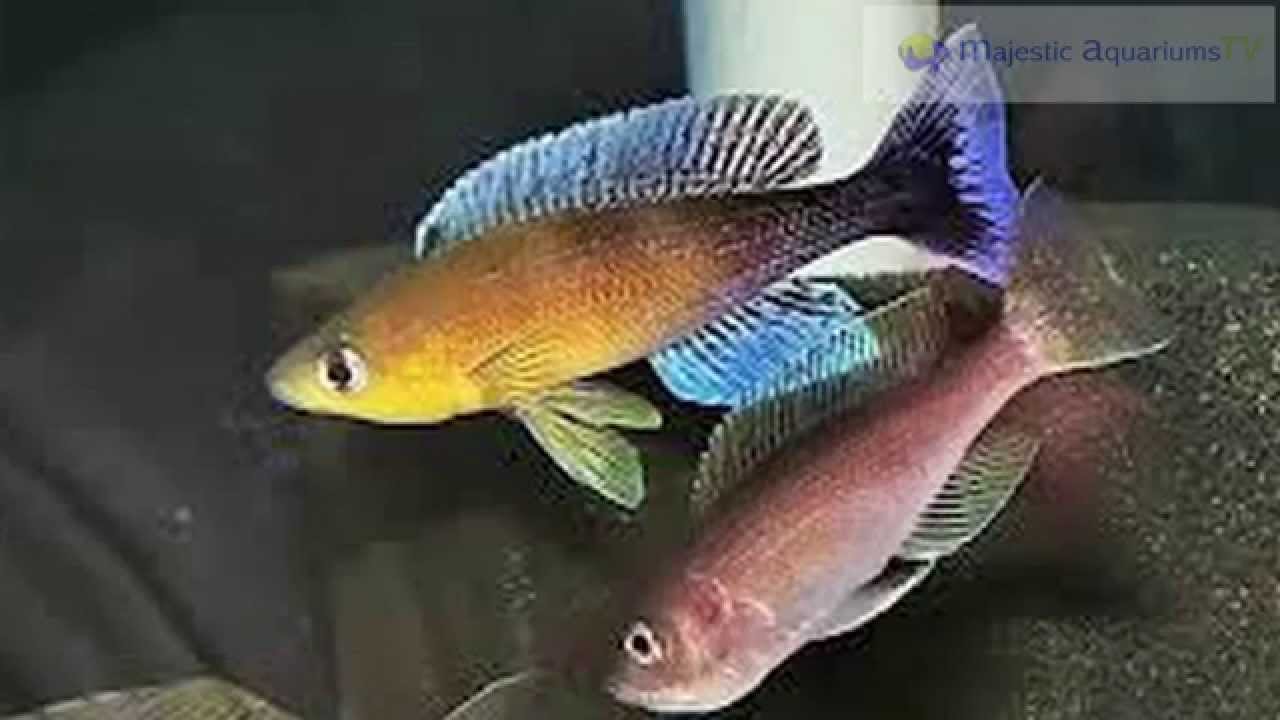
Cyprichromis leptosoma has a slender, streamlined body similar to a herring, hence the nickname “Herring Cichlid.” Its body length is about 8 inches, although specimens up to 11 inches have been observed in the wild. This is the standard length, including tail that is a total length of 11 to 14 centimeters. The basic body color is silvery to bluish gray, with a brownish-gray tinge. Males show a striking color variation, with yellow or blue-violet tail fins, and sometimes yellow or blue colors on the dorsal fin . The dorsal fin can be light blue with dark spots, or blue with a black band at the base. Females are generally less colorful, with inconspicuous fins and a brown to beige color.

The main differences between males and females are in color and size. Males are larger (up to 14 centimeters) and much more colorful than the females (up to 11 centimeters). Males show greater variation in color patterns than females. Behaviorally, males form three-dimensional territories in the open water, where they chase away other males, while females can pass through these territories. Reproduction takes place in the open water, with the male fertilizing the eggs, which the female then collects in her mouth.
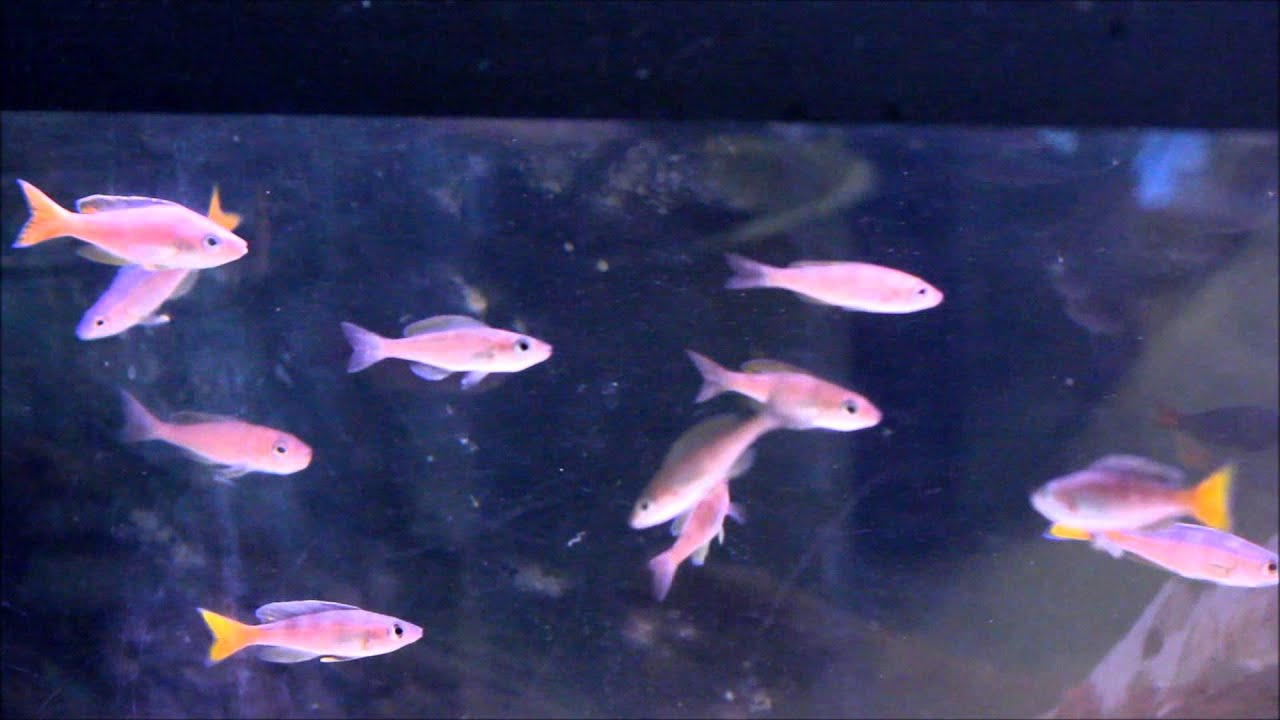
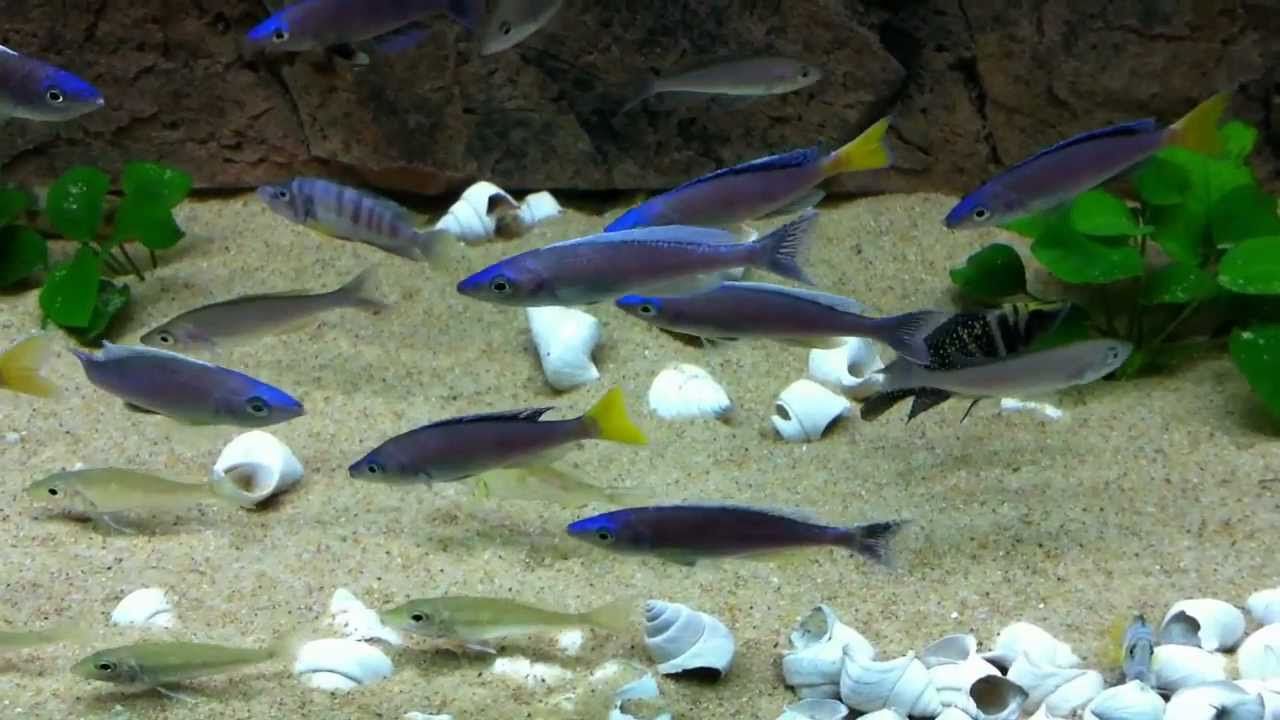
Cyprichromis leptosoma is a peaceful, schooling fish that lives in large groups (more than 12 individuals). They are active swimmers that spend most of their time in the upper water layers , and are not bound to the bottom. Although they are generally peaceful, males can be aggressive toward each other, especially during reproduction. They are relatively shy, but a large school reduces this shyness. The fish are good jumpers, so a well-enclosed aquarium is essential.
Life expectancy in the wild is not mentioned in the documents. In an aquarium they can live about 5 years.
yprichromis leptosoma is not to be confused with Cyprichromis sp. “leptosoma jumbo” , a yet undescribed species that grows considerably larger.
Cyprichromis leptosoma comes in many varieties, including:
- Malasa
- Utinta
- Kitumba
- Tri-color
- Bulu-point
- Mpimbwe
The natural habitat of Cyprichromis leptosoma
Cyprichromis leptosoma is endemic to Lake Tanganyika and is native to Zambia and Tanzania. In Zambia they are found in the southern part of the lake, and in Tanzania along the eastern shoreline. The distribution extends more than 482 kilometers along the eastern coastline, from Kigoma in Tanzania to Mpulungu in Zambia.
The natural habitat of Cyprichromis leptosoma consists of the deeper, open water areas of Lake Tanganyika, especially near rocky shores. Little to no underwater vegetation is present in these areas. The bottom consists mainly of rocky substrate.
Cyprichromis leptosoma is eaten by larger predatory fish, such as Lepidiolamprologus profundicola and L. elongatus. The juvenile fish are particularly vulnerable to predation.

Diet
Diet in the wild
In their natural habitat in Lake Tanganyika, Cyprichromis leptosoma feed mainly on plankton, small suspended organisms in the water column, such as small crustaceans and insect larvae. They are specialized hunters with an adaptable mouth that allows them to suck up food directly.
Diet in the aquarium
In an aquarium, it is important to provide a varied diet that mimics their natural diet. Although they eat plankton in the wild, in captivity they can be fed a variety of high-quality dry foods (flakes, pellets) interspersed with live or frozen foods such as artemia (brine shrimp), daphnia (water fleas) and cyclops. It is important to make sure the food does not sink too fast, as they eat mainly suspended or slow-sinking food. Small portions several times a day are better than one large meal to avoid water pollution.
The Aquarium
For a school of 12 Cyprichromis leptosoma (4 males and 8 females), an aquarium at least 180 centimeters in length is recommended. A larger group requires an even larger aquarium. The setup should focus on sufficient free swimming space, as they are active swimmers that inhabit the upper water layers. Although rocks can be used to create small outcroppings or steep walls, an open arrangement is more important than extensive planting or rockeries. Plants can be added, but they are not essential. Avoid sharp objects on the bottom to avoid injury, as fish will shoot to the bottom if startled. A tightly sealed lid is essential, as they are good jumpers.
The ideal water values are a temperature between 24 and 26°C, a pH of 8.5 to 9.0 and a hardness (GH) of 8 to 25°dH.
Cyprichromis leptosoma is a peaceful species that coexists well with other peaceful Lake Tanganyika cichlids that inhabit different parts of the aquarium, such as Julidochromis or Altolamprologus (rock dwellers) and shell dwelling species Examples of suitable tank mates include Tanganicodus irsacae, Synodontis petricola, Telmatochromis vittatus, Neolamprologus leleupi, Julidochromis ornatus, Xenotilapia ochrygenys, Eretmodus cyanostictus, Julidochromis transcriptus, Chalinochromis brichardi, Lamprologus ocellatus, Neolamprologus brichardi, and Neolamprologus multifasciatus .
Breeding Cyprichromis leptosoma
The breeding of the Cyprichromis leptosoma is not too difficult. The male occupies a three-dimensional territory in the open water. With their heads down they lure the female into their territory. They The deposit the eggs close to the surface of the water. The female catches the eggs in her mouth, after this the male fertilizes them. The number of eggs is relatively small, depending on the experience of the female about 5 to 20.

The eggs hatch after a few days. The young fish then still feed on their yolk sac. Only 3 weeks after the eggs are laid, the young leave the mother’s mouth and are left to fend for themselves. The young remain in the upper water layers and are left alone by the parents.
In an aquarium with other fish species, most young Cyprichromis leptosoma usually end up as food. If you want to raise larger numbers of this species, a dedicated aquarium without other fish species is recommended.
You can feed the fry with newly hatched brine shrimp and other small live food. They will also take crushed flakes.
Particularities
- Color Variants: There are several geographical color variants of Cyprichromis leptosoma, such as ‘Ikola’, ‘Karilani’, ‘Kigoma’, ‘Mpulungu’, and ‘Utinta/Malasa’. Within these varieties, both blue-tailed and yellow-tailed males can be found. The males of the “blue flash” variants show a distinctive blue or purple stripe on the top of their bodies. The “jumbo” variants can grow up to 15 cm in length.
- Food specialization: The mouth of Cyprichromis leptosoma is specially adapted to suck up small food particles directly. They use a powerful sucking mechanism, with the rapid expansion of the mouth cavity creating a vacuum. Their outside teeth are not very strong, but they do have throat teeth to grind the food. They are very efficient hunters and can detect even the smallest food particles in the water column.
- Community Behavior: In the wild, they live in schools of thousands of individuals. In an aquarium, they thrive best in groups of at least twelve or more. A larger group reduces their shyness. Males form three-dimensional territories in the open water, but females can pass through them. The presence of Cyprichromis leptosoma may encourage other cichlids to spend more time in the open water rather than hiding in rocks or shells.
- Breeding behavior (additional information): Reproduction occurs in the open water, with the male performing a “headstand” during the courting ritual. The female deposits one egg at a time, which she then collects in her mouth. The yellow tips of the male’s pelvic fins could guide the females to the reproductive opening. The females synchronize their spawning, causing several females to deposit their eggs at the same time. After about three weeks, the young are released. The mother offers no further protection to the young, but neither she nor other adult fish try to eat the young.
- Safe zone for young fish:Young Cyprichromis leptosoma seek in the Lake Tanganyika often shelter in the nests of the a14> predatory fish Lepidiolamprologus profundicola. The female L. profundicola actively defends her nest against other predatory fish, causing the young C. leptosoma protection against predation. This relationship is considered as commensalism: the C. leptosoma benefit from the protection, while the L. profundicola there no advantage or disadvantage from experiences. As soon as the female L. profundicola leaves the nest leaves, takes the risk of predation for the young C. leptosoma significantly . The young C. leptosoma use the breeding territory of L. profundicola thus as a83> a safe zone against potential predators.
- Moon cycle when spawning: In the wild, spawning occurs simultaneously, they follow the cycle of the moon.
- Other details: They are good jumpers, so a well-sealed aquarium is essential. They are sensitive to poor water quality, but relatively robust compared to other Lake Tanganyika cichlids. They are not bound to the bottom and live in the middle and upper water layers.

Conclusion
Cyprichromis leptosoma, also known as the Herring Cichlid, is a fascinating and relatively easy to keep Tanganyika cichlid, provided some specific requirements are met. Their peaceful nature and shoaling behavior make them suitable for a community aquarium, but a spacious aquarium with sufficient open swimming space is essential. A large group (at least 12 specimens) is recommended to encourage their natural behavior and reduce shyness. Proper water parameters (hard, alkaline water) and a varied diet are crucial for their well-being and reproduction. Although breeding is relatively easy, it does require knowledge of their specific reproductive behavior.
Despite their relatively easy care, they are not absolute beginner fish. Their need for specific water values and a spacious aquarium, combined with their sensitivity to poor water quality, requires some experience in aquarium keeping. The most notable behavior is their open-water reproduction and lack of parental care after the young swim free. My experience with this species is generally positive; they are relatively robust and reward the aquarist with their beautiful colors and active behavior, provided their needs are met.
Cyprichromis leptosoma Variants
Cyprichromis leptosoma “Bulu Point”
The Cyprichromis Leptosoma ‘Bulu Point’ is slowly beginning to gain a lot of interest among Tanganyika fanciers, partly because the ‘bulu point’ is a somewhat smaller species within the leptosoma family and is already good to keep in aquariums from 120 cm, but above all because of the many color markings in the school.In the male Bulu Points we can already distinguish 2 variants, namely;
- Blue males (Blue flash), these are completely blue
- Yellow males (Yellow tale), identified by a yellow tail
The specimens pictured below are a “Yellow male” and a “Blue male”


Cyprichromis leptosoma ‘Cape Mpimbwe’


Cyprichromis leptosoma ‘Kekese’

Cyprichromis leptosoma ‘Mahale Mountains NP’

Cyprichromis leptosoma ‘Mbita Island’

Cyprichromis leptosoma ‘Miyako Point’

Cyprichromis leptosoma ‘Utinta’
The Cyprichromis leptosoma ‘Utinta’ is the most widely kept leptosoma species. It also has the largest distribution of all cyprichromis species in the wild. It is found from Utinta Bay to Samazi in Tanzania. As with the other leptosoma variants, the Utinta has per colony, two differently colored males:
- BlueFlash: all-blue males (only the pelvic fins are colored yellow)
- Yellow Flash: blue body with a yellow tail (again with yellow pelvic fins)


Video
Author
John de Lange
Copyright images
J. de Lange
Matthijs Meindertsma
Sue – Suephotos.com (original website no longer available)
AfricanDivingLtd.com – African Diving
M. Kwolek-Mirek – Suephoto (original website no longer online)
Evert from Ammelrooy
Mattia Matarrese
References
Watanabe, Takeshi. (2000). “The nesting site of a piscivorous cichlid Lepidiolamprologus profundicola as a safety zone for juveniles of a zooplanktivorous cichlid Cyprichromis leptosoma in Lake Tanganyika”.
Watanabe, Takeshi. (2000). “Lunar cyclic spawning of a mouthbrooding cichlid, Cyprichromis teptosoma, in Lake Tanganyika”.