
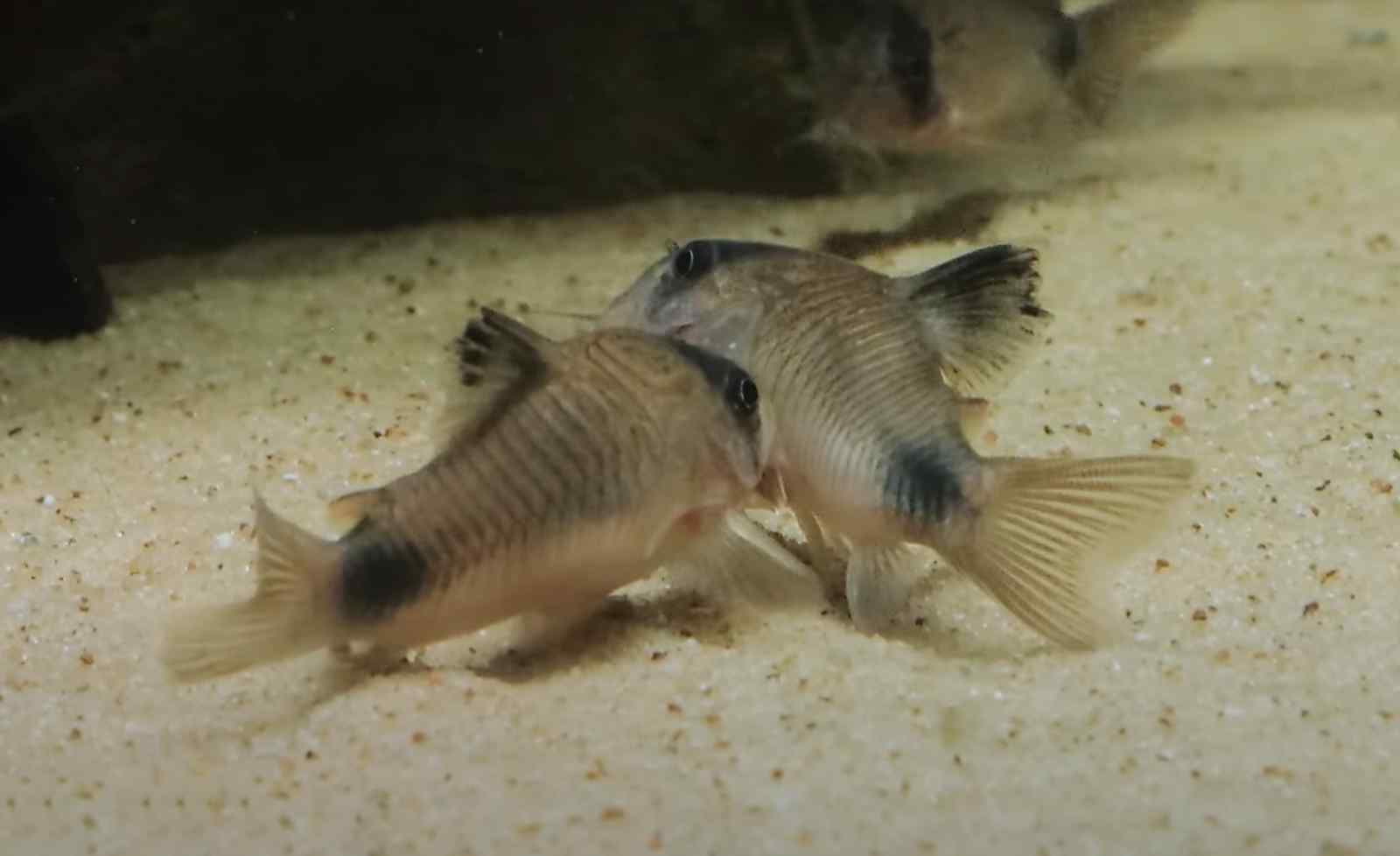
The T-position in Corydoras: a unique reproductive strategy
Corydoras species, popular aquarium fish from South America, exhibit a remarkable reproductive behavior known as the “T-position. This behavior, in which the female fish positions itself opposite the male in a T-shape, has long been known to aquarists. However, recent research has brought new insights into the exact workings of this reproductive strategy.
Although this behavior has become known primarily through observations in Corydoras species, recent studies show that this unique method of fertilization is widespread throughout the entire family Callichthyidae. In addition to Corydoras, this family includes other genera such as Callichthys and Hoplosternum, which exhibit a similar reproductive strategy.
What is the T position?
During reproduction, the male approaches the female Corydoras and presents his ventral side to her. The female fish responds by placing her mouth against the male’s anal opening, creating a T-shaped position. During this position, which lasts about 6 seconds on average, the female fish closes her gill lids and absorbs the male’s sperm through her mouth. She then forms a kind of “pouch” with her ventral fins in which she collects the eggs. After absorbing the sperm and laying the eggs in the pouch, the female fish swims to a suitable place to deposit the fertilized eggs.
What does recent research say about fertilization in Callichthyidae?
Researchers recently discovered exactly how “sperm drinking” works in Osteogaster aeneus and other armored catfish. They looked at a special fluid that males produce during mating: seminal vesicle fluid, abbreviated SVF. This fluid comes from the male’s seminal vesicles, an organ not found in many fish, but so it does in Callichthyidae.
As it turned out, this fluid is very viscous (thick) and packed with proteins. Remarkably , this SVF causes sperm to hardly move. This seems strange, because you would think that sperm should be active to fertilize eggs. But this “brake” turns out to be important: the sperm must travel an unusual route, via the female ‘ s mouth through her digestive tract, before reaching the eggs. Without this protection , the sperm would likely be damaged or broken off along the way.
What substances are in that protective liquid?
The researchers found three major proteins in the SVF of Corydoras aeneus:
- Alpha-2-macroglobulin (A2M)
This protein protects sperm from being broken down by digestive enzymes. It acts as a kind of shield that helps the sperm survive during its journey through the female’s body. - Carbonic anhydrase 12 (CA12)
This enzyme keeps the sperm “switched off” until it reaches the eggs. As a result, the sperm does not waste energy along the way. Only when it reaches the right place does it become active again to fertilize the eggs. - Ly6 protein
This substance is probably involved in protecting the sperm from the female’s immune system. This is because the body sees foreign sperm as an invader and would want to break it down normally.
How exactly does ‘sperm drinking’ work?
Mating in Corydoras – and other species within the Callichthyidae family – occurs via the so-called T-position. The female absorbs the male’s sperm through her mouth. That sounds strange, but it is now well-documented behavior.
During this particular form of fertilization, the following happens:
- The sperm enters the female’s mouth along with the viscous SVF.
- The viscosity keeps the sperm together and protects it during its journey through the digestive tract.
- Along the way, proteins (such as A2M and CA12) keep the sperm from breaking down and being active yet.
- Once the sperm reach the eggs, the inhibitory proteins disappear and the sperm become motile again. Only then does actual fertilization take place.
Advantages of this reproductive strategy
This method of reproduction offers several advantages:
- Directed fertilization: Taking the sperm directly and excreting it along with the eggs increases the chances of successful fertilization.
- Protection against predation: Carrying the eggs in the pouch allows the female fish to seek a safe place to deposit the eggs, increasing the survival rate of the offspring.
- Efficiency: This method minimizes wastage of sperm and eggs as they are in direct contact during deposition.
Conclusion
The T-position in Corydoras species is a fascinating example of the diversity of reproductive strategies in fish. Recent research provides deep insight into this unique behavior and emphasizes the importance of detailed observation and study. For aquarists , this knowledge provides valuable tools to support and optimize the breeding of these popular fish.
References:
- Maulana, Fachryan & Carman, Odang & Putra, A. (2022). Reproduction performance of corydoras fish Corydoras paleatus spawned with different male to female ratio. IOP Conference Series: Earth and Environmental Science. 1033. 012006. 10.1088/1755-1315/1033/1/012006.
- Sperm drinking by female catfishes: a novel mode of insemination. Masanori Kohda et al.
- Nakajima, J. et al. (2024). Seminal vesicle fluid is essential for the fertilisation mechanism of the sperm-drinking catfish, Corydoras aeneus. Journal of Experimental Biology. https://doi.org/10.1242/jeb.250293

Since I bought my first second-hand aquarium when I was twelve, I have always had one or more aquariums. I even converted a garage into a breeding room where I had 50 aquariums containing around 10,000 liters of water. At the moment, I have two aquariums: a 1,250-liter Tanganyika aquarium and a 250-liter community aquarium with plants. For the past 10 years, I have been working on this website as a writer and photographer.


