
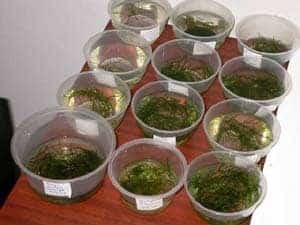
Incubated in water, the eggs of the Lyretails tend to fungus easily. Hatching period is about 10 days and during this time, unfertilised eggs will definitely fungus while good eggs quite often turn bad when attacked by bacteria in the water.
Adding diluted acriflavine and methylene blue to the water can help prevent fungus but getting the dosages right can be quite tricky. Too heavy a dosage will kill the eggs; too light and it won’t be effective.

Many thanks to Tyrone Genade for the information on his website at “http://tgenade.freeshell.org” and Wright Huntley’s post contained therein, I discovered a good method of incubating Non-annual eggs.
The method is simple and has a very high success rate. It involves using Java Moss and a Ghost Shrimp.

First, I pick the eggs from the spawning mops using an egg-picker, a tool fashioned from a straw.

I spray painted the egg-picker black as it’s easier to see the eggs when they are contrasted against a dark background.

I put some Java Moss into a plastic container with water from the breeding tanks. I try not to let the eggs drop to the bottom of the container but place them on the fronds of the moss.
The moss helps to keep the water clear and free from bacteria.

After all the eggs have been placed into the container, I introduce a Ghost Shrimp. These shrimp are scavengers. They also eat algae. They are inexpensive and are sold in some local fish shops. In heavily planted tanks, they breed and multiply rapidly. They are also sometimes known as Malayan shrimp.
The shrimp is different from those long-arm shrimp commonly sold in local fish shops as food for big fishes.

Once introduced into the container, the Ghost Shrimp goes to work almost immediately. It will pick up the eggs and *clean* them.
It doesn’t actually *clean* the eggs though. Being a scavenger, it will however eat up the tiny particles that are attached to the eggs.

Another picture of the Ghost Shrimp cleaning 2 eggs at one go. The Java Moss, besides keeping the water clear, also makes the shrimp feels safe.

Day 2 – 24 hours after picking the eggs, unfertilised eggs turn white. Under normal circumstances, such eggs will start to fungus but with the Ghost Shrimp around, the eggs remain clean. The shrimp eats the fungus. It also cleans good eggs regularly, thereby preventing them from turning bad.

Day 3 – Due to the movements of the Ghost Shrimp, most of the eggs have dropped to the bottom of the container. The unfertilised eggs are clear from fungus.

Day 4 – The good eggs are beginning to eye up while the 2 unfertilised eggs are still free from fungus. They look like tiny ping pong balls.
The shrimp’s droppings are all over the bottom of the container. Obviously, it’s getting a lot of food inspite of the small container.

Day 5 – For some strange reason, the 2 unfertilised eggs in the container have disappeared. It could be the shrimp ate them; I’m not sure.
The eyes on the good eggs have become darker.

Day 6 – Eggs are still developing. There’s no sign of fungus.

Day 7 – Eggs still looking good.

Day 8 – Eggs are close to hatching. Everything’s looking good.

Day 9 – Fry at last!!

Not all eggs will hatch at the same time. If eggs are clearly well-developed but won’t hatch, force-hatch them.
The shrimp will not eat the fry as it’s incapable of catching live fish. It will not eat the good eggs either so don’t worry about it having a “caviar festival”. The shrimp is a scavenger, not a predator.
Photos: Loh Kwek Leong
Source: www.Killies.com

Ever since I became a hobbyist more than 30 years ago, I have often wondered about a particular group of fish. These fish, although often featured in books, are rarely available in the fish shops of Singapore. They were better known as “Egg-Laying Toothcarps” in the old days. The fish were very colourful and had an aura of mystery around them. People say they are the most beautiful of all tropical fishes and that their eggs can be sent across nations and still remain alive.
In November 2001, I received my first few bags of killifish eggs from friends living in the US of A. Since then, many more have arrived. Now I have a good collection of killifish and have managed to breed quite a few of them. They are indeed the most beautiful of all tropical fishes.
Everything they say about killifish is true and more……
Killies.com


