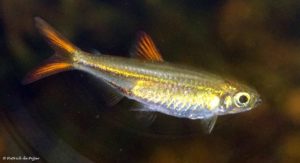
Trichopodus leerii – Pearl Gourami
The Pearl Gourami, with the scientific name Trichopodus leerii, was first officially described in 1852 by the Dutch physician and zoologist Pieter Bleeker. The genus name Trichopodus is derived from the Ancient Greek “θρίξ” (thrix), meaning “hair” or “ray,” and “πούς” (pous), meaning “foot.” This name refers to the fish’s pectoral fins, which have been transformed into long, thread-like structures. The fish uses these “antennae” to explore and feel its surroundings.
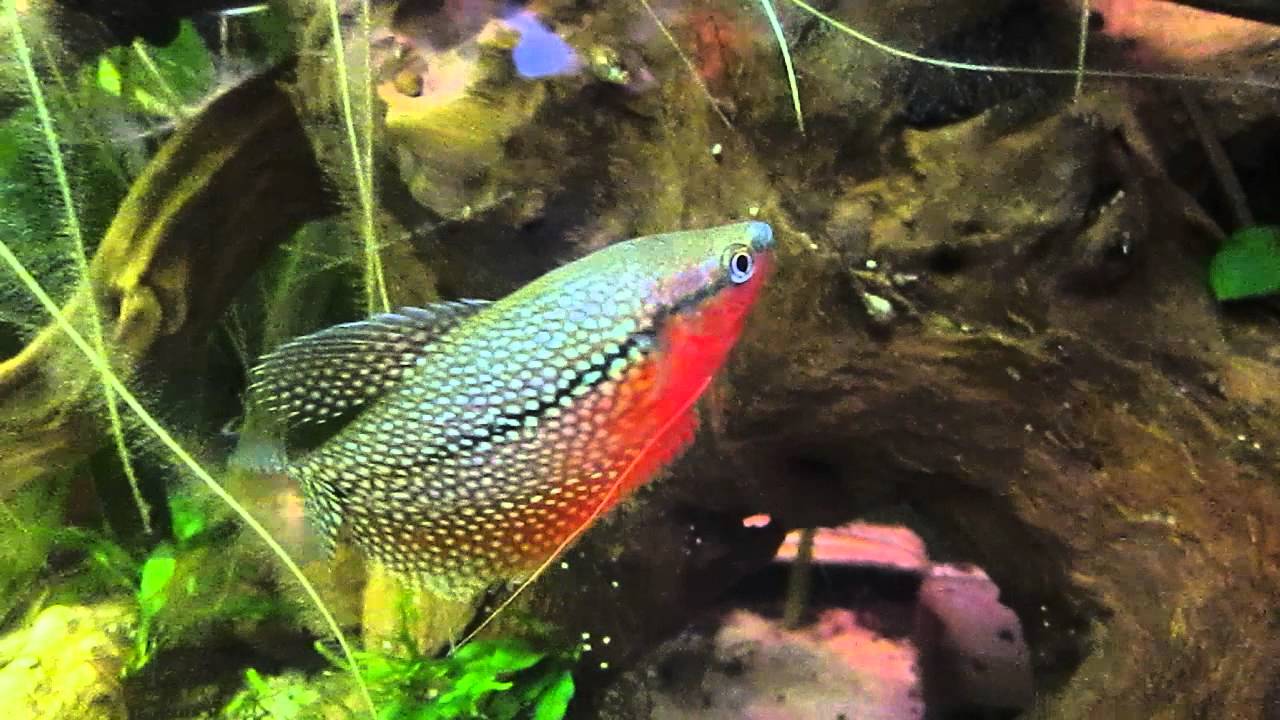
The species name leerii is in honor of Mr. Leer, a collector who brought the species to Europe. Their common name is Pearl Gourami, a name that refers to the numerous small white dots scattered across the fish’s flank and fins. These dots give the fish a dazzling appearance, as if it were studded with pearls.
Other scientific synonyms that have been used for this species over time are Trichogaster leerii and Trichopus leerii. The Pearl Gourami belongs to the family of Labyrinth Fish (Osphronemidae), a group of fish known for their ability to breathe atmospheric air thanks to a special organ, the labyrinth organ.
Description
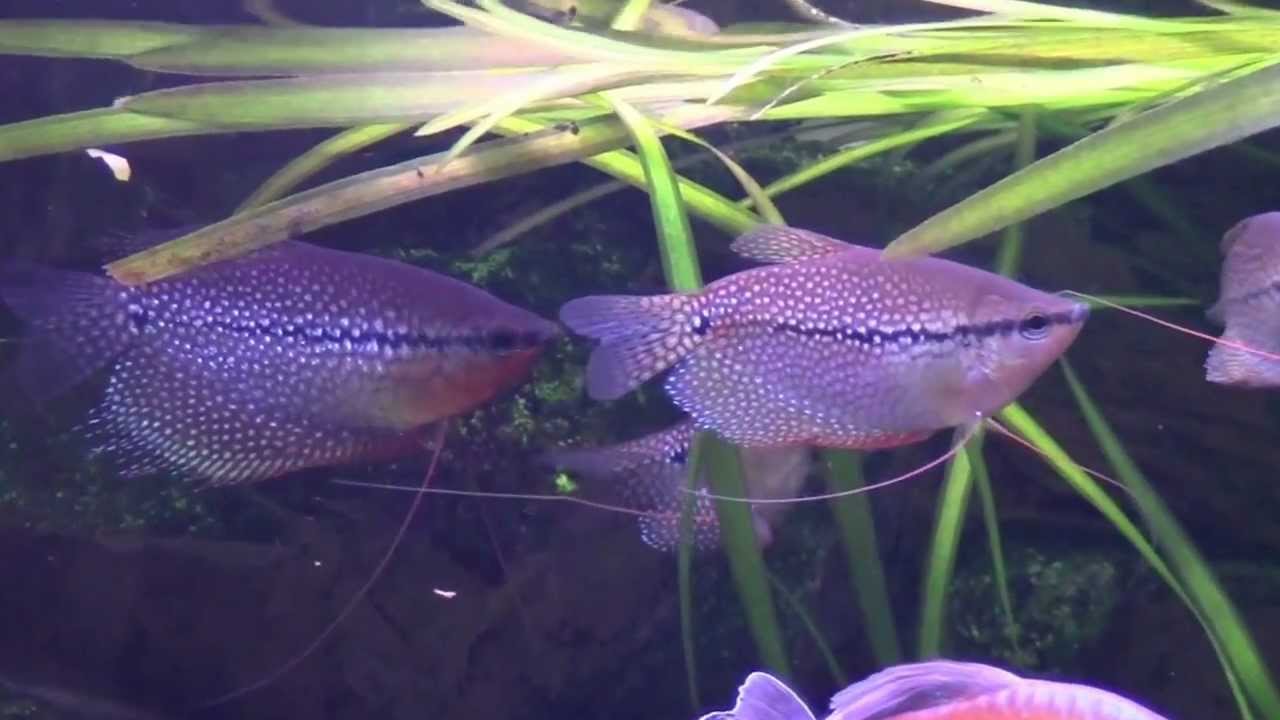
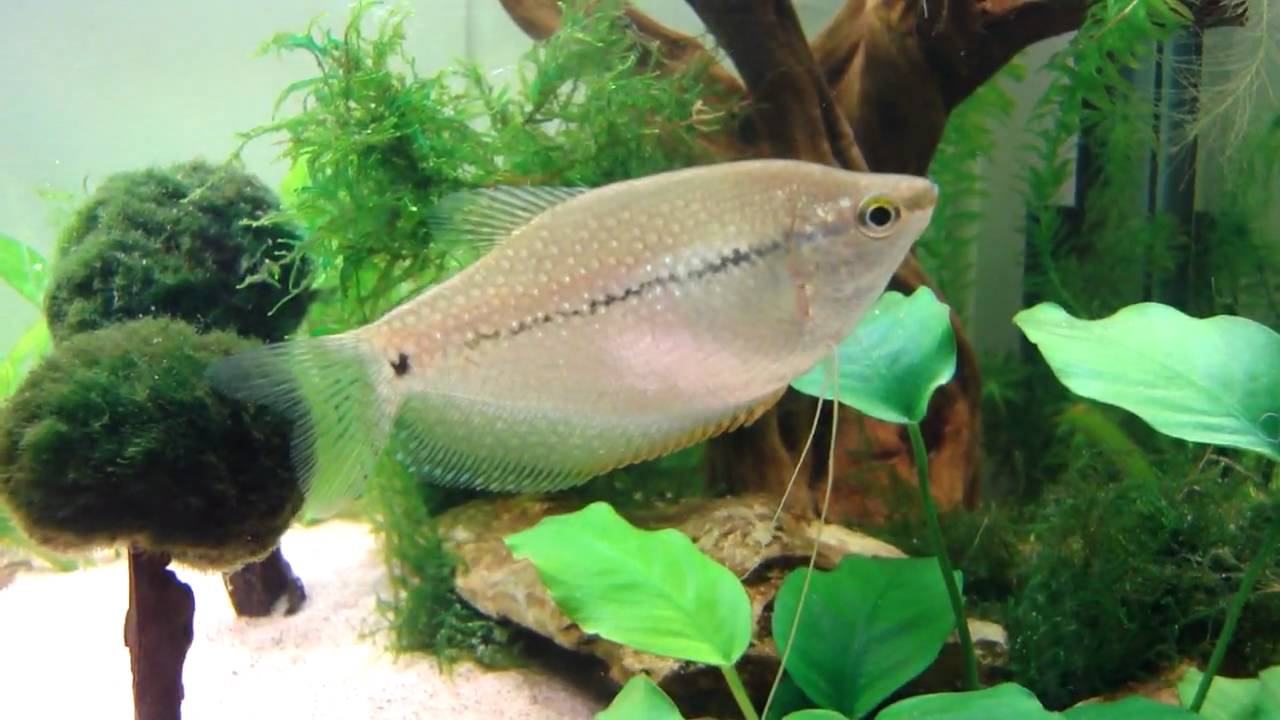
The Pearl Gourami is a fish that can reach a maximum length of about 12 centimeters. From the nose to the tail root runs a row of dark spots that, especially in adult animals, can form a distinct black stripe. Characteristic of this species are the many small white dots scattered across the entire body and fins. These dots give the fish its common name, Pearl Gourami, because they resemble small pearls.
Like many other gouramis, the pectoral fins of the Pearl Gourami have been transformed into two long, thread-like structures. These fins are used to explore and feel the environment.
There are clear differences between males and females. The male is generally more colorful than the female. He often has an orange or red glow on his throat and lower abdomen. In addition, the male’s dorsal and anal fins are longer and more pointed, and they have more “fringes” on the pelvic fins compared to the female. The female is generally smaller and stockier in build, and lacks the pronounced fringes on the pelvic fins.
In terms of temperament and behavior, Pearl Gouramis are very peaceful and relatively calm. This makes them ideal for a community aquarium. However, it is advisable not to combine them with overly busy or aggressive fish species, in order to prevent stress and possible conflicts. They mainly swim in the upper layers of the aquarium. Their life expectancy in the aquarium is estimated at around 5 years.
Labyrinth organ
An important and characteristic feature of the Pearl Gourami is the presence of the labyrinth organ. This is a specialized respiratory adaptation that functions as a lung-like structure, allowing the fish to take oxygen directly from the atmospheric air and store it in a special chamber, in addition to using gills. Thanks to this organ, the species is less dependent on the amount of dissolved oxygen in the water, which explains why these fish are regularly seen at the water’s surface gasping for air.
Biotope
The Pearl Gourami originates from Asia. They are found in countries such as Indonesia (on the islands of Sumatra and Borneo), Malaysia, and Thailand. In their natural habitat, they typically inhabit coastal swamp areas, slow-flowing rivers, lowland swamps, and shallow waters rich in vegetation. The habitat is characterized by warm, soft, and slightly acidic water, often surrounded by dense tropical vegetation. The waters in which they live have a weak current and are often densely vegetated and covered with floating plants.
Diet
The Pearl Gourami is an omnivore. In their natural habitat, they feed on a varied diet consisting of small invertebrates, various types of zooplankton, organic waste, and algae.
In the aquarium, they are not demanding and will accept a wide range of foods. A suitable diet consists of:
- Live food: Such as mosquito larvae, artemia, daphnia, cyclops, tubifex, mysis, and krill. This is an excellent source of nutrients and stimulates the fish’s natural hunting behavior.
- Frozen food: A good alternative to live food, with similar nutritional value.
- Dry food: High-quality granules or flake food specially formulated for ornamental fish
- Plant-based food: Spirulina flakes or food with a high proportion of plant-based ingredients is also suitable and ensures a balanced diet.
It is important to provide sufficient variety in the food to ensure that the fish get all the nutrients they need. An unbalanced diet can lead to health problems.
Common mistakes and how to avoid them:
- Overfeeding: This can lead to water pollution and health problems in the fish. Only feed as much as the fish can eat in a few minutes.
- Unbalanced diet: Feeding only dry food is not ideal. Provide a mix of live/frozen food and plant-based components.
- Forgetting plant-based food: Although they mainly eat insects, they also need plant-based material.

The Aquarium
For the Pearl Gourami, an aquarium of at least 120 centimeters long is recommended. The layout of the aquarium is very important for the well-being of these fish. They thrive best in an aquarium with lots of plants, where dense edge planting and some floating plants are appreciated. Floating plants help to dim the light, which makes the fish feel safer and can reduce stress. Pieces of driftwood, rocks, or branches can also be added to make the environment more natural and provide hiding places.
Gouramis generally do not like strong currents in the water. A filter with a wide outlet, where the water flow disappears fairly quickly, is therefore appreciated. If they want to build a foam nest, which they do at the water surface, the bubbles stay together better with little to no current.
In terms of water values, Diamond Gouramis are not extremely demanding, but the following values are recommended:
- Temperature: 24-28 degrees Celsius.
- pH: 5,5-7,5.
- GH (hardness): 2-16 dGH.
Suitable tank mates for the Diamond Gourami are peaceful and not too active fish species. They can be kept well in a community aquarium. However, it is advisable not to combine them with overly active or aggressive species to avoid conflicts.
Unsuitable tank mates are fish that are too large, too aggressive, or too active, as this can cause stress to the Diamond Gourami. Also avoid other fish species that inhabit the upper layer of the aquarium.
Breeding aquarium and conditioning
For breeding the Pearl Gourami, it is recommended to use a special breeding aquarium. This aquarium does not need to be very large; a capacity of about 30 liters (for example, 40 x 30 x 25 centimeters) is sufficient for a pair. It is important that the water level is not too high; about 12 centimeters is recommended.
The breeding aquarium should be set up in such a way as to stimulate the natural behavior of the fish. Provide plenty of floating plants, which give the fish a sense of security and where the male can build his foam nest. A piece of Styrofoam can provide support for this. It is also advisable to place a pot of Java fern so that the female can hide if she needs to.
The current in the breeding aquarium should not be too strong, as this can disturb the foam nest. The foam nest can sometimes reach a diameter of 25 centimeters! A sponge filter or a hamburger mat filter is recommended so that the young are not sucked up later. Some breeders even turn off the filter to minimize the current.
The water temperature in the breeding aquarium should be around 26 to 28 degrees Celsius. Pearl Gouramis are not very critical when it comes to water values.
Conditioning the parents
Successful breeding of Pearl Gouramis starts with properly conditioning the parent fish. This process can take several weeks to months, depending on whether you are dealing with adult fish or young fish that are still growing.
- Purchase and acclimatization: Purchase semi-adult to adult fish that look healthy. Give them time to acclimatize to tap water and the daily routine in a spacious community aquarium.
- Feeding: Feed the parent fish a rich and varied diet of high-quality live food such as tubifex, artemia, red mosquito larvae, and water fleas. Supplement this with different types of dry food. This ensures excellent condition, more intense colors, and increased vitality.
- Separation: With young fish, separate the male and female a few months before breeding. Give them each their own aquarium. This gives the female peace to develop further and fill up with eggs, while the male remains in top condition.
- Transfer to breeding tank: Once the female is full of eggs and the male is intensely colored, they can be transferred to the specially equipped breeding aquarium.
The spawn
When the parent fish are well conditioned and placed in the breeding aquarium, the male will start building a foam nest at the water surface. This nest is often built under floating plants or under a piece of Styrofoam, which provides the nest with some support and stability. The male will actively defend the nest against the female and other intruders.
The male’s courtship behavior is striking. He will become intensely colored, with the throat and belly in particular taking on an orange or red glow. He swims around the female, spreads his fins, and tries to lead her to the nest. Sometimes the male may also chase the female a little, which is normal behavior during courtship.
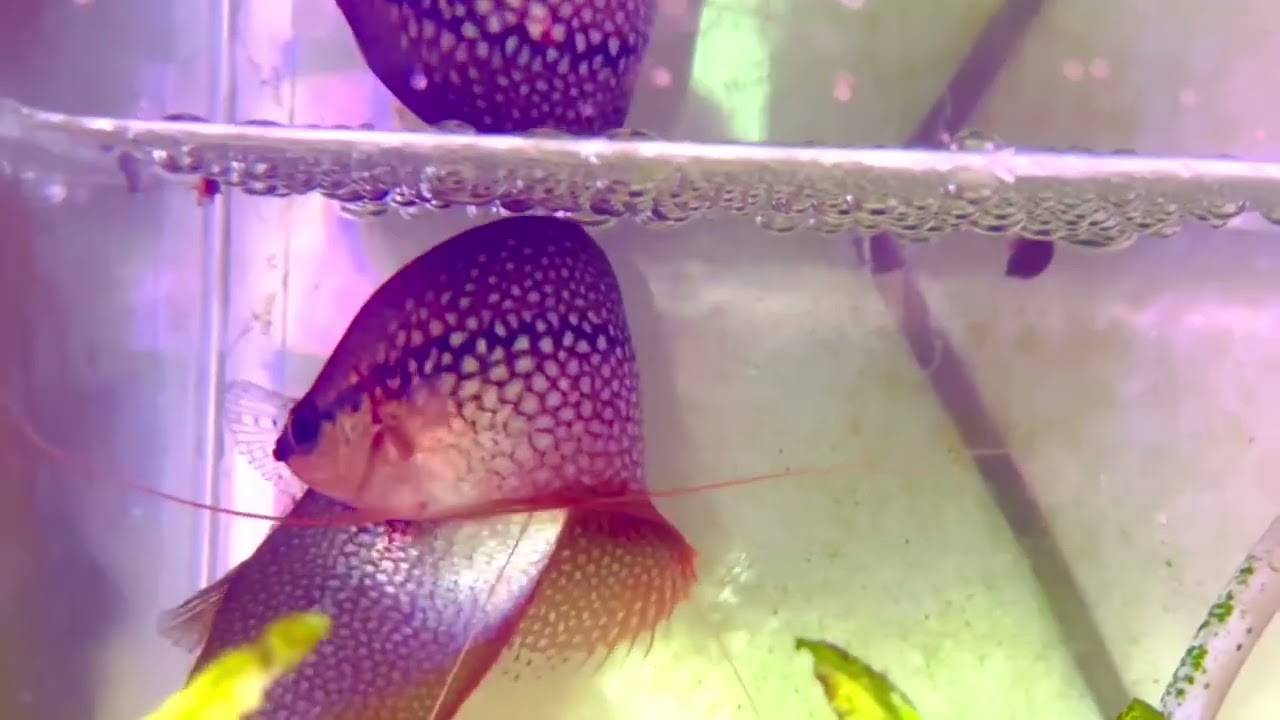
The spawning time can vary, but once the nest is ready and the male has convinced the female, the actual spawning takes place. The male embraces the female, releasing the eggs and sperm at the same time. The fertilized eggs are then placed in the foam nest by the pair, or mainly by the male.
The number of eggs can be considerable, with estimates ranging from several hundred to as many as 500 eggs at a time. The eggs are small and light yellow in color.
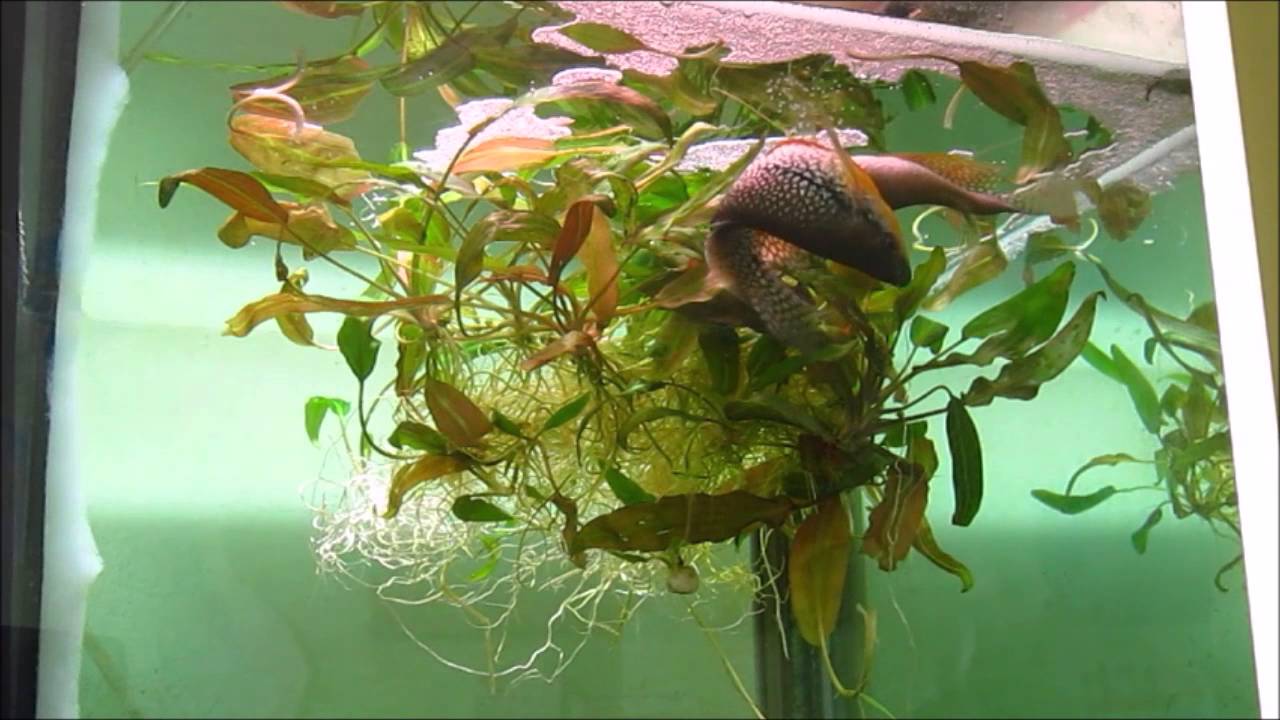
The embracing and releasing of the eggs is repeated until all the eggs have been released. This is around 200 to 500 eggs. As soon as the female stops releasing eggs, she is chased away by the male.
Now remove the female Pearl Gourami and place her back in the normal aquarium. The male protects the nest from other fish, including the female. He can be quite aggressive in doing so.
Raising the fry
The eggs of the Pearl Gourami usually hatch within a day and a half after being laid (within 20 to 30 hours). The newly hatched larvae remain motionless for the first few days, just below the foam nest. Only after three to four days do they begin to swim freely.
In most cases, the male stays with the nest to care for the eggs and later the young. He guards the nest and returns any eggs or young that fall out of the nest to the foam. We recommend removing the male as soon as the young begin to swim freely, to avoid any risk of predation.
First feeding
As soon as the young begin to swim freely, it is important to start feeding them immediately. The first feed must be microscopic, as the young are still very small (about 2 millimeters). An excellent first feeding is paramecium (infusoria). This can be given twice a day in generous amounts, because the fry eat small amounts continuously and overfeeding is therefore not likely to be a problem.
After about a week, you can start offering very fine powdered food and small amounts of newly hatched artemia. Although not all fry will eat this immediately, some will make the transition. After one to two weeks, the majority of the fry will switch to artemia, which significantly accelerates their growth rate.
Rearing and further care
Once the fry are eating brine shrimp well, the chance of problems decreases. Care then focuses mainly on frequent feeding and ensuring stable water quality.
- Water quality: Regular, small water changes are essential for consistent water quality, which promotes rapid growth in the fry. An automatic water change system can help with this.
- Feeding: Feeding artemia at least three times a day and slowly introducing dry food ensures steady growth. After four to six weeks, the fry can be about one centimeter in size.
- Transferring: As the group grows, they will need more space and can be transferred to larger aquariums.
The survival tips are therefore: start immediately with the right microscopic food as soon as the fry are swimming freely, ensure good water quality through regular water changes, and feed frequently and variedly.
Particularities
Trichopodus leerii is a fish that, despite being relatively easy to breed, can still present some challenges. Some breeders need several attempts before they are successful, often because the male is too aggressive or the female is not yet ready to spawn. An alternative approach, whereby the female is first placed in the breeding tank on her own to acclimatize and calm down before the male is added, can help. This can lead to successful breeding with hundreds of fry.
The Pearl Gourami is a popular fish in the aquarium hobby, partly due to its attractive appearance and peaceful nature. They are mainly sold as captive-bred specimens, which means that there is no need to catch specimens from the wild for trade. This contributes to the conservation of natural populations.
Conclusion
Trichopodus leerii is a beautiful and peaceful fish that is a real asset to any community aquarium. With their beautiful, diamond-like spots and calm behavior, they are sure to attract attention. They mainly inhabit the upper water layers and usually leave other fish alone, provided they are not combined with overly busy or aggressive species. A well-designed aquarium with lots of plants and little current is essential for their well-being.
Although breeding Pearl Gouramis can be somewhat challenging, especially due to the aggression of the male during courtship, it is doable with the right preparation and patience. Careful conditioning of the parent fish, an appropriate setup of the breeding aquarium, and a tailored approach to pairing the couple can lead to successful breeding with hundreds of young. This makes the Diamond Gourami an accessible species for hobbyists looking for a challenge and a beautiful result.
See also the breeding reports Breeding Trichopodus leerii and Trichopodus leerii (Pearl Goerami) Breeding Report
Video
How big does a Pearl Gourami get?
The Pearl Gourami can reach a maximum length of approximately 12 centimeters.
How do I see the difference between a male and a female?
There are clear differences. The male is more colorful, often with an orange or red glow on the throat and belly. Its dorsal fin and anal fin are longer and more pointed, and it has more “fringes” on the ventral fins. The female is smaller, stockier and lacks these distinctive fringes.
Is the Pearl Gourami aggressive?
In general, they are very peaceful and calm, making them suitable for a community aquarium. However, during the breeding season, the male actively defends his foam nest and can be aggressive towards the female and other fish.
How large should the aquarium be for the Pearl Gourami?
For the Pearl Gourami an aquarium of at least 120 centimeters long is recommended.
What does the Pearl Gourami eat?
They are omnivorous. They accept live food (such as mosquito larvae and artemia), frozen food, dry food (granules or flakes) and vegetable food. Variety is important for their health.
How do you breed the Pearl Gourami?
Preferably use a separate breeding aquarium with a low water level (approx. 12 cm), lots of floating plants, and little current. After proper conditioning, the male builds a foam nest on the surface. Mating takes place under this nest via an embrace, during which the eggs are released and fertilized.
Authors

Since I bought my first second-hand aquarium when I was twelve, I have always had one or more aquariums. I even converted a garage into a breeding room where I had 50 aquariums containing around 10,000 liters of water. At the moment, I have two aquariums: a 1,250-liter Tanganyika aquarium and a 250-liter community aquarium with plants. For the past 10 years, I have been working on this website as a writer and photographer.
Copyright images
John de Lange