


Shinnersia rivularis – Mexican Oak Leaf
Shinnersia rivularis was first described by Asa Gray in 1849 as Trichocoronis rivularis. Their common name is Mexican Oak Leaf. The plant belongs to the family Asteraceae (composite family). King and Robinson reclassified the species in 1970 into the genus Shinnersia.
The genus name Shinnersia is a tribute to the American botanist Lloyd Herbert Shinners (1918-1971), who made important contributions to the study of Texas flora. The species name rivularis is derived from the Latin word “rivulus,” meaning “of a small stream or brook,” referring to the plant’s preferred habitat.
Description
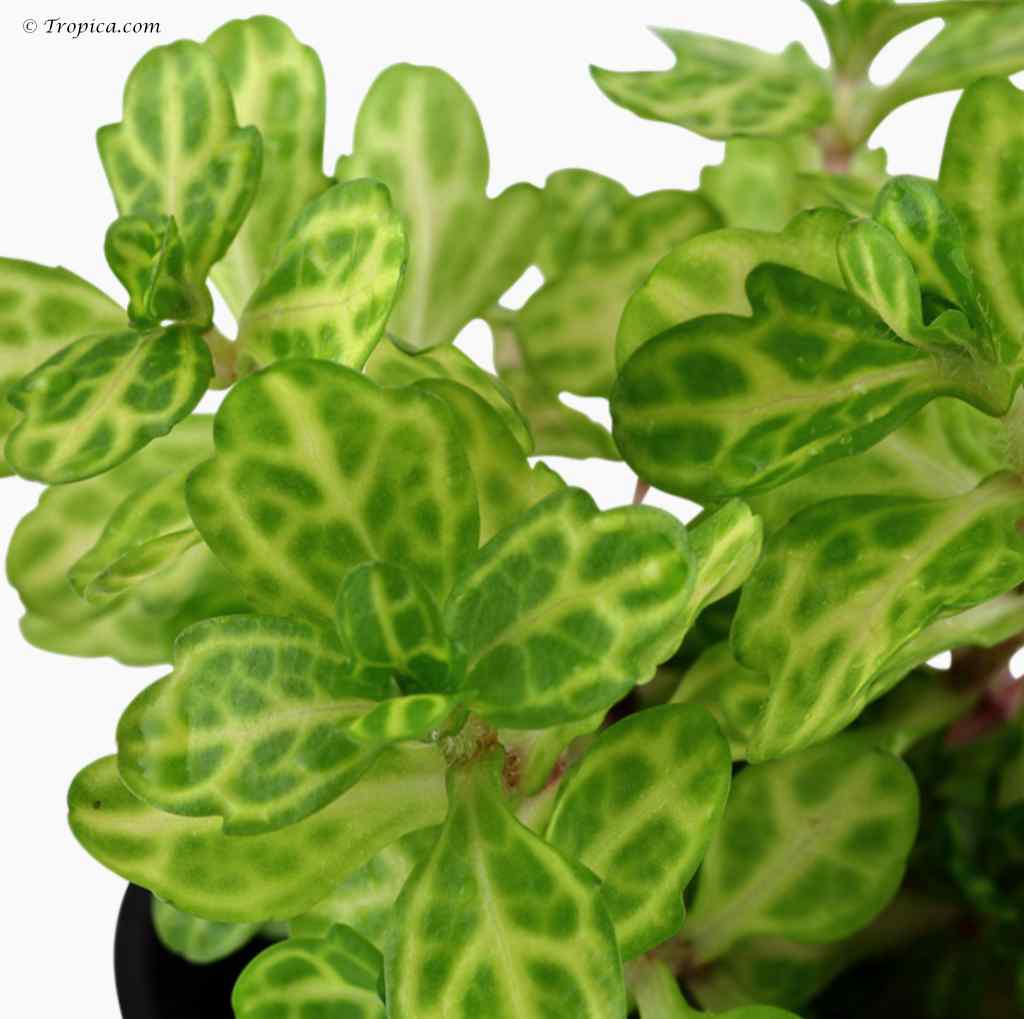
Shinnersia rivularis is a perennial, long-stemmed plant that can grow both submerged (in aquaria) and partially above water (in paludariums). The leaves are opposite each other on the stem and are broadly lanceolate to three-lobed, coarsely toothed or wavy, with a shape similar to oak leaves. The leaves are 2-4 cm long and up to 2 cm wide. The color ranges from light green to brownish red in bright light, with occasional white veins under optimal light conditions. The plant can reach a height of 15-30 cm in aquaria, but can grow up to 1 meter tall in the wild.
The plant blooms with small, white flowers (about 2 mm long) above the water surface. The flowering period is year-round, but peaks in March-May.

Biotope
In nature, Shinnersia rivularis occurs in Mexico and in a few locations in Texas, specifically in northern Coahuila and northern Nuevo León in Mexico and in a few locations along the Nueces River in Uvalde County, two locations in Kinney County, as well as San Felipe Springs and San Felipe Creek in Del Rio, Val Verde County in Texas. It grows in shallow, slow-flowing, warm waters of streams, rivers and lakes , such as the Nueces River and San Felipe Creek. The bottom consists of muddy gravel.
The Aquarium
Ideal water values for Shinnersia rivularis in an aquarium are a pH of 5.5-8 and a temperature of 18-30°C. The plant needs nutrients, so soil fertilization is recommended, although it can also absorb nutrients from the water. CO2 addition is not strictly necessary. The plant needs bright lighting. Good lighting promotes growth and the development of the characteristic white veins in the leaves.
Propagation
Shinnersia rivularis propagates vegetatively by cuttings. Take cuttings about 10 cm long, remove the lower leaves and plant the cuttings in the substrate. The plant roots easily and grows quickly. Regular pruning encourages the growth of side shoots, but it is recommended to replant the tops to maintain the large, full leaves.
Particularities
Shinnersia rivularis is the only species in its genus. The plant can be affected by cucumber mosaic virus (CMV), which causes leaf discoloration. A cultivated variety, ‘Weiss-Grün’ or ‘White-Green,’ has variegated leaves due to viral infection. It grows quickly and can overshadow other plants, so regular pruning is essential. It serves as shelter for small fish and invertebrates and helps control nutrients and algae in the aquarium. It was introduced to Europe and has been naturalized in several countries, including Belgium, Germany, Austria, Slovakia and Hungary.
Conclusion
Shinnersia rivularis is a relatively easy aquarium plant to keep, provided one takes into account its rapid growth and the need for regular pruning. It is very suitable for beginners, but requires attention to avoid overshadowing other plants. Its unique leaf shape and ability to form dense vegetation make it an attractive addition to any aquarium. The ‘White-Green’ variety with variegated leaves is a particularly attractive cultivar.
Variants
A number of varieties of Shinnersia rivularis have again been made by selectively propagating it.
Shinnersia rivularis ‘Weiss-Grün’
Shinnersia rivularis ‘Weiss-Grün’ is a variety distinguished from the others by the white veins on the leaves. The naturally already present white veins have become much more pronounced due to a viral infection. This variety grows about 30 to 60 centimeters tall with stems that grow about 10 centimeters wide.


Author
John de Lange
Copyright images
Tropica.com
Carlos G Velazco-Macias – CC BY-NC 4.0
Petzenbär – CC BY-NC 4.0

