

Paracyprichromis nigripinnis
Parachromis nigripinnis was first described by Boulenger in 1901. The genus Paracyprichromis has only two species: brieni and nigripinnis. These species previously belonged to Cyprichromis, but due to differences in their skeletons and mating habits, they have been classified in a new genus.
The name can be roughly translated as: para – resembles; Cyprinus – carp-like; chromis means color, thus indicating that they resemble Cyprichromis. In full, this means: resembles a colorful carp-like fish.
Nigripinnis means: with black spots.
Description
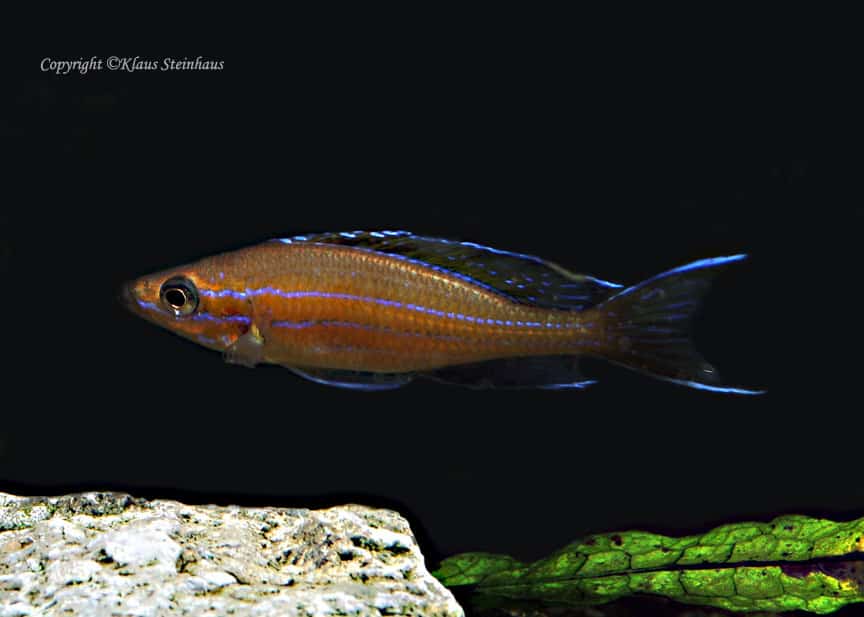
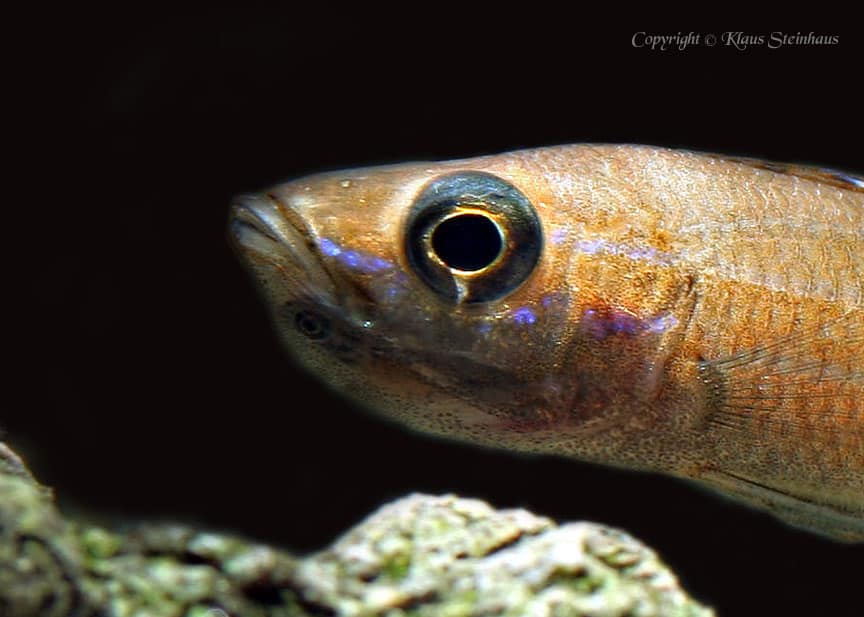
Both the males and females of Paracyprichromis nigripinnis have a reddish-brown base color. In addition, the males have iridescent blue lines across the flank, from the base of the dorsal fin to the rear and across the edges of the fins. The membranes of the dorsal fin and banner-shaped caudal fin also have iridescent spots.
The females are somewhat duller in color and, if you look closely, the blue lines are faintly visible, depending on their mood. The dorsal fin is slightly shorter in females and the caudal fin is not pennate.
The colors of both sexes are best shown to advantage in an aquarium with subdued lighting. They are best kept in a school with at least 2 to 3 females per male. In the wild, they school together in groups that sometimes contain several hundred individuals. The males sometimes occupy a territory around some rocks.
Paracyprichromis nigripinnis is a peaceful species. With sufficient space, you will see a male claim a territory where the females swim above. The males grow to about 12 centimeters long. The females remain somewhat smaller and can grow to about 8 centimeters long.
Biotope
Parachromis nigripinnis can be found Lake Tanganyika. They live at depths of up to about 40 meters. This depth also explains why they prefer more subdued light.
Like the Cyprichromis species, Parachromis nigripinnis feeds on plankton.
The Aquarium
You can keep Paracyprichromis nigripinnis in an aquarium from 100 centimeters in length, but maintain a water height of at least 50 centimeters. Sand is usually used on the bottom of a Tanganyika aquarium. This is not strictly necessary for Paracyprichromis nigripinnis, but it does look more natural than gravel.
Make sure there is an area decorated with rocks and place at least one rock so that there is a sloping or vertical side running from top to bottom. It is also important to have plenty of free swimming space.
The spawn
When a female is ready to spawn, the male chases her until she is separated from the group. He chases her to his territory, which is usually a vertical, slightly sloping piece of rock.
The male swims above the female and releases his sperm. The female swims at a 45-degree angle with her head down and releases her eggs into the cloud of sperm. Swimming backwards, she picks up the eggs and takes the fertilized eggs into her mouth. This ritual is repeated until she has taken all the eggs into her mouth.
The number of eggs produced by Paracyprichromis nigripinnis is not very large. A maximum of about 17 eggs are produced at a time, but usually there are fewer.
Raising the fry
The female incubates the eggs in her throat pouch. After hatching, the fry remain in the throat pouch for quite some time. The female spits out the fry after about 21 to 28 days. The young are then about 1 to 1.3 centimeters long. The female does not eat during incubation.
The young can be fed with finely ground full food and, for example, freshly hatched artemia and cyclops.
The parents do not show any brood care after spitting out the fry. The female does leave the fry alone for the first few hours after releasing the fry.
Conclusion
Paracyprichromis nigripinnis is a beautiful species that is best kept in a special aquarium or at least an aquarium where the lighting has been taken into account. It is best to combine them only with other peaceful species.
Video

Author

Since I bought my first second-hand aquarium when I was twelve, I have always had one or more aquariums. I even converted a garage into a breeding room where I had 50 aquariums containing around 10,000 liters of water. At the moment, I have two aquariums: a 1,250-liter Tanganyika aquarium and a 250-liter community aquarium with plants. For the past 10 years, I have been working on this website as a writer and photographer.
Copyright images
Klaus Steinhaus – www.buntbarsch.ca (original website no longer online)