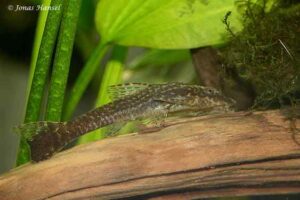


Leporacanthicus joselimai – L264
Leporacanthicus joselimai was described by Isbrücker and Nijssen in 1989. The genus name can be broken into two parts. ‘Leporis’ means ‘hare’ or ‘rabbit,’ a reference to the long stout premaxillary teeth. ‘Acanthicus’ is also a genus name and means ‘spiny’ and refers to the head of Acanticus hystrix which has spiny odontes. Freely translated, Leoparacanthiscus then means hare-like like Acanthicus. The species name joselimai is in honor of ichthyologist José Lima de Figueiredo, working at Museu de Zoologia da Universidade de São Paulo, who drew attention to the “peculiar” species that now make up the genera Leporacanthicus and Hopliancicstrus.
In the trade they are also available under the names Grey Vampire Pleco, Snow Leopard Pleco and L264. Officially, the L number should expire after the official description but many traders, retailers and hobbyists continue to use them.

Description
Like many harness catfish, Leporacanthicus joselimai is a territorial species. They are primarily aggressive toward conspecifics and similar fish. Bottom dwellers with different coloration and/or patterns are generally left alone, although tempers may very well get heated during feeding time.
L264 grow to a maximum size of about 20 to 25.
Origin
South America: Rio Tapajos, Pará, Brazil.

The Aquarium
This medium-sized catfish prefers a dimly lit aquarium with plenty of hiding places, in the form of plants, driftwood, rocks and/or artificial caves. To keep multiple specimens of this species, or to keep this species with other bottom dwellers, an aquarium of 120×50 centimeters is required, as the species can be quite territorial. In the absence of suitable hiding places or too little space, the Sultan Pleco can behave extremely aggressively towards other bottom dwellers. If it is the only bottom dweller in the aquarium, an aquarium of 100×40 centimeters is more than sufficient. Juveniles can be kept temporarily in smaller aquariums without any problems, as long as there are sufficient hiding places.
This species does best in soft, slightly acidic to neutral water, richly oxygenated and with plenty of current. A strong filter is important, as this fish produces a lot of waste given its protein-rich diet.
Water parameters
Temperature: 22–30 degrees Celsius
pH: 5.5–7.5

Diet
This Plecostomus species is a carnivore: a quick look at its teeth says it all: the sharp teeth have earned species ut this genus, Leporacanthicus, the nickname Vampire-Plecos (German: Rüsselzahnwels). Consequently, this species accepts a whole range of meat foods, including things like mosquito larvae, blood worms, krill, shrimp, mussels and even fish meat.
Once acclimated, this species becomes less picky, and in many cases will also ingest plant foods: think food items such as algae, algae tablets, and washed (and possibly blanched) vegetables such as cucumber, lettuce, peas, spinach, eggplant and zucchini.
Besides accepting offered food, this species also seems to actively search for food itself in the aquarium: regularly I can observe my specimen during this activity. Indeed, it seems that in addition to being an unfussy carnivore, the Sultan Pleco is also a kind of “filter feeder”: the animal will scour through the substrate in a rapid forward motion, then slowly move backwards through the trench it has just created. In the process, the huge sucking mouth is used as a net, to suck up swirled material: food is swallowed, inedible material such as pieces of wood or gravel are expelled through the gill openings.
Comments
A species much like the Sultan Pleco is the Leporacanthicus sp. L263. However, it is found in a different area along the Rio Tapajós River, and has fewer black dots and a more caramel gray color.
Authors
Jonas Hansel – Piranha-info.com (original website no longer online)
John de Lange
Copyright images
Jonas Hansel – Piranha-info.com (original website no longer online)