


Cyphotilapia gibberosa
The scientific name of this impressive cichlid is Cyphotilapia gibberosa. This species was first described in 2003 by Tetsumi Takahashi and Kazuhiro Nakaya. Before that, Cyphotilapia frontosa had been the only known representative of the genus Cyphotilapia for almost a century.
Er is geen specifieke Nederlandse naam voor Cyphotilapia gibberosa. De soort wordt gewoonweg aangeduid met de wetenschappelijke naam, eventueel aangevuld met de vangstlocatie, zoals Cyphotilapia gibberosa Blue Zaire Mikula of Cyphotilapia gibberosa Mpimbwe.
Cyphotilapia gibberosa belongs to the family of cichlids (Cichlidae), a family that is common in Lake Tanganyika.
The genus name Cyphotilapia was introduced in 1920 by Regan. The name consists of two parts: “cypho” means “curved” or “hunchbacked” and refers to the striking, convex forehead bump that older specimens of this fish species develop. “Tilapia” is a gelatinized form of the word “!api,” a term from the !Kung language (an African language) that means “fish.” In ichthyology, ’tilapia’ is often used as a collective name for African cichlids. Together, Cyphotilapia literally means ‘hunchbacked fish’, which perfectly matches the appearance of these cichlids with their characteristic forehead bump.
The species name gibberosa is derived from the Latin word gibbus, which means hump. This name therefore refers to the distinctive hump on the front of the fish’s head.

Description
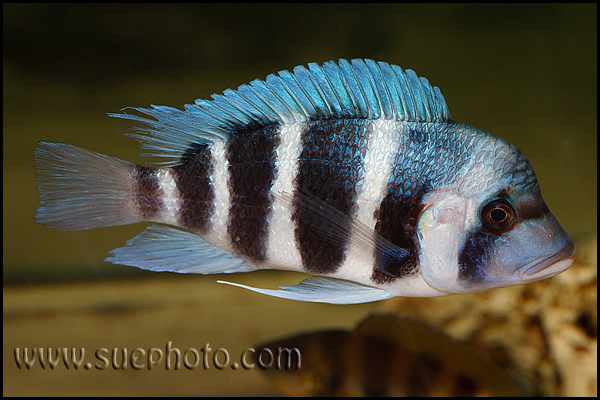
Cyphotilapia gibberosa is a high-backed, laterally flattened cichlid characterized by six dark vertical stripes on a lighter base color on the flanks. These stripes are often less visible in large males. A striking feature, especially in older specimens, is the distinct bump on the forehead, known as the ‘nuchal hump’.
The color of the stripes can vary depending on where they’re caught. Specimens from the coast of Congo and Zambia often have striking blue stripes.
In terms of size, Cyphotilapia gibberosa can reach a maximum length of approximately 35 centimeters in the aquarium. The average size is estimated at 27 centimeters.
Geographical Variants and Morphemes
Within both Cyphotilapia frontosa and Cyphotilapia gibberosa, there are numerous geographical variants, often referred to as “morphs” or “location variants.” These variants are named after the specific catch locations in Lake Tanganyika where they are found. Examples of such variants are:
- Burundi
- Kigoma
- Moba
- Kapampa
These variants may exhibit subtle differences in color pattern, body shape, and the development of the forehead hump.
Distinguishing between these variants is not only of scientific importance, but also important for aquarists who want to maintain the purity of the lines and breed specific forms.
Differences between males and females
It is difficult to accurately sex juvenile specimens. However, adult males grow larger than females and develop a larger forehead bump. Males also have more elongated fins.
Differences between juveniles and adults
As mentioned above, the frontal hump is not yet present or barely present in juveniles and only develops in older, adult specimens.
Behavior and temperament
Cyphotilapia gibberosa is a gregarious (group-living) fish that lives in groups of varying sizes. Within these groups, the fish form a clear dominance hierarchy, with one or more alpha individuals developing, depending on the size of the group and the available space. Unlike many other cichlids, males do not defend clearly defined territories.
This species is described as less shy than the Cyphotilapia species from the northern part of Lake Tanganyika. Although it is a territorial animal that does not appreciate the presence of intruders with similar behavior, Cyphotilapia gibberosa has little problem with non-territorial animals. The fish are active during the day (diurnal) and live at medium depths and near the bottom.
Cyphotilapia gibberosa can eat smaller fish, but can be part of a well-chosen Tanganyika cichlid community, provided the aquarium is large enough.
Life expectancy
The life expectancy of Cyphotilapia gibberosa is estimated to be around 25 years.

Biotope
Cyphotilapia gibberosa is an endemic species, which means that it is found exclusively in Lake Tanganyika in East Africa. The distribution of Cyphotilapia gibberosa is limited to the southern half of Lake Tanganyika, while Cyphotilapia frontosa is mainly found in the northern half of the lake.
Specific collecting areas for Cyphotilapia gibberosa include:
- Tanzania of Zuidelijk Tanzania: Fulwe Rocks (Fulwe), Ikola, Kantalamba, Kasanga, Kipili, Mabilibili, Mpimbwe, Molwe, Samazi/Bismark, Sibwesa, Tanzanite.
- Zambia: Isanga, Chaitika, Nangu, Sumbu.
- Democratic Republic of Congo: Kalumba (captured in Lupota), Kapampa, Kitumba, Moba (captured near M’Toto), Moliro, Tembwe.
The Cyphotilapia gibberosa Mpimbwe variant is caught in the upper part of the southern section of Lake Tanganyika, in two long coastal strips that are not connected to each other. The southern fishing area of the Mpimbwe is located directly opposite the fishing area of the Zaire, with a distance of 80 kilometers between the two areas.
Description of the natural habitat
Cyphotilapia gibberosa is a resident of the rock formations in Lake Tanganyika. Adult specimens live at depths of 40 to 60 meters, and it is believed that they can live at depths of up to 120 meters. Younger fish live in the shallower, sunny waters, while the youngest are believed to stay in the depths between the rocks.
The preference of adult Cyphotilapia for these depths poses a challenge for divers who catch these fish, due to the energy and time required to bring the fish to the surface and the problem of decompression. Fish caught at these depths must be brought to the surface very slowly, similar to divers who must undergo decompression time. This process can take several days and explains the high price of wild-caught specimens.

Diet
Food in the wild: Cyphotilapia gibberosa is a predatory fish that hunts smaller fish in its natural habitat in Lake Tanganyika.
Food in the aquarium: In the aquarium, the predatory nature of Cyphotilapia gibberosa must be taken into account. Smaller fish may be seen as food and eaten.
For young Cyphotilapia gibberosa that have just started swimming freely (approximately 2 cm long), you can start feeding them Artemia or cyclops. As they grow, their diet can be supplemented with finely ground dry food. For adult specimens, a diet of high-quality food, supplemented with live or frozen food that suits their size and predatory nature, is recommended.

The Aquarium
Cyphotilapia gibberosa is a large cichlid that can reach a length of 27 to 35 cm and lives in groups. Therefore, a spacious aquarium is important. Given the size and group behavior of this fish, it is advisable to consider an aquarium of at least 250 cm in length for a group of adult specimens. For a larger group, an even larger aquarium will be needed to provide sufficient swimming space and hiding places and to minimize stress.
Aquarium setup
The natural habitat of Cyphotilapia gibberosa consists of rock formations in Lake Tanganyika. An aquarium for this species should therefore be set up with lots of rocks and stones to mimic a rocky biotope. This creates natural hiding places and structures where the fish can retreat and maintain their hierarchy. Make sure the rocks are stacked stably to prevent collapse.
Sand or fine gravel can be used as substrate, as this mimics the natural soil of Lake Tanganyika. Plants are optional, but if added, choose sturdy varieties that can be attached to rocks or are well-rooted, as cichlids sometimes dig.
Suitable water parameters
Cyphotilapia gibberosa is endemic to Lake Tanganyika, which is known for its very stable and specific water values. Keep the temperature between 22 and 26 degrees Celsius. They live in alkaline water with a pH between 8.5 and 9.0.
It is very important to keep water values consistent, as fluctuations can cause stress in these sensitive fish.
Suitable and unsuitable tankmates
Cyphotilapia gibberosa is a predatory fish that can eat smaller fish. Although it is a territorial animal that does not appreciate the presence of intruders with similar behavior, it has little problem with non-territorial animals.
Suitable tank mates include other large, robust cichlids from Lake Tanganyika that have similar water values and temperaments, but are not too small to serve as prey. You could also consider non-territorial fish that inhabit the deeper water layers and are large enough not to be eaten.
Unsuitable tank mates are small fish that fit into the mouth of the Cyphotilapia gibberosa, as they may be seen as food. Also avoid highly aggressive or extremely shy fish that do not thrive in a group structure with dominant alpha individuals.

Breeding aquarium and conditioning
Common or dedicated breeding aquarium
This is a large cichlid that can reach a length of 27 to 35 cm in the aquarium and lives in groups. A spacious aquarium is therefore necessary for breeding. We recommend an aquarium of preferably more than 1000 liters for 5 or more specimens. This size is also suitable for a breeding group.
A special breeding tank is not strictly necessary if the main tank is large enough and offers sufficient hiding places. However, to increase the survival rate of the young, a separate breeding tank may be considered, especially if there are many other fish in the main tank.
The water values in the breeding aquarium must be identical to those of the natural biotope and the main aquarium: hard, alkaline water with a stable temperature, characteristic of Lake Tanganyika. For the lighting of the main aquarium, “bright but dim light against a dark background” is considered optimal to bring out the colors of the fish. In the breeding aquarium, it may also be slightly more subdued. A well-functioning filter system is important to ensure water quality, which is crucial for successful breeding.
Conditioning
For successful breeding, it is important to bring the fish into optimal condition. Feed the parent fish a varied and high-quality diet of live and frozen food. It is not necessary to separate males and females for breeding. Cyphotilapia gibberosa lives in harems in the wild.
For breeding purposes, it is best to set up a small harem group consisting of one male and three to four females. The ideal size is two males with six to eight females, but this requires a very large aquarium! This mimics the natural group structure and reduces stress for the females, as the male’s attention is divided among several partners.

The Spawn
The spawning of Cyphotilapia gibberosa is a fascinating process, characteristic of maternal mouthbrooders. Cyphotilapia gibberosa is a maternal mouthbrooder, which means that after fertilization, the female immediately takes the eggs into her mouth and incubates them there. The eggs are laid near the bottom, in the rocky biotope that is so characteristic of their natural habitat in Lake Tanganyika. In the aquarium, they will therefore make use of the caves and shelters created by the rocks.
During spawning, the male stays with the female, but his role is limited to this phase. Once the eggs have been laid and fertilized, the female takes full responsibility for caring for them by collecting them in her mouth.
A clutch of Cyphotilapia gibberosa can contain up to 50 eggs. These eggs are relatively large, almost pea-sized. The size of the eggs is an adaptation that suits mouthbrooders, as larger eggs often result in larger, more developed fry that have a better chance of survival when they leave their mother’s mouth.

Raising the Young Fish
The growth of young Cyphotilapia gibberosa is a process in which the mother plays a crucial role as a maternal mouthbrooder. This means that she protects and cares for the eggs and later the young fish in her mouth.
After the eggs have been laid and fertilized, the female immediately takes them into her mouth. She incubates the young and protects them in her mouth for up to 5 weeks. During this time, the young feed on their yolk sac. After this period, when the young are sufficiently developed, they will leave their mother’s mouth and swim freely. The size of a clutch can vary from 3 to 60 young, depending on the catch location and the size of the female.
Parental care is provided entirely by the female. She carries the eggs and young fish in her mouth, which provides effective protection against predators in the aquarium and in the wild. The male is only involved in laying the eggs and plays no further role in the direct care of the brood.
Suitable starter feed
When the young Cyphotilapia gibberosa leave their mother’s mouth and start swimming freely, they need small, nutritious food. Small live food is essential. Think of freshly hatched artemia nauplii or cyclops. This stimulates their natural hunting instinct and provides high nutritional value. In addition to live food, high-quality, finely ground dry food can also be offered. Make sure the food is small enough for the mouths of the young fish.
Feeding frequency and quantity
Young fish grow quickly and need a lot of energy. It is advisable to feed young Cyphotilapia gibberosa several times a day, for example 3 to 5 times, in small portions. Do not feed them more than they can eat within a few minutes to prevent water pollution.

Conclusion
Cyphotilapia gibberosa is an impressive cichlid native to the deep, rocky waters of southern Lake Tanganyika. This species was only scientifically described in 2003, when morphological characteristics such as the number of scale rows and body proportions, as well as their geographical distribution, clearly distinguished it from the closely related Cyphotilapia frontosa. The name gibberosa refers to the characteristic bump on the forehead, which is particularly prominent in older males and contributes to their imposing appearance. Despite their calm appearance, they are predatory fish that hunt smaller fish and invertebrates in the wild, which is an important consideration for other inhabitants of the aquarium.
For aquarium enthusiasts, keeping Cyphotilapia gibberosa requires a spacious aquarium of at least 1,000 liters for a group of 4-5 specimens, with a layout that mimics their natural rocky habitat and subdued lighting. It is important to maintain stable water values that correspond to those of Lake Tanganyika: a temperature of 24-27°C, a pH of 8.0-9.0, and relatively high hardness. They are maternal mouthbrooders, with the female carrying the eggs and young fish in her mouth for up to 5 weeks, after which the young can be fed with small live food such as artemia nauplii. With proper care and respect for their natural needs, Cyphotilapia gibberosa is a spectacular and rewarding addition to the specialized Tanganyika aquarium.

Frequently asked questions – FAQ
What is the main difference between Cyphotilapia gibberosa and Cyphotilapia frontosa?
It is important to distinguish between Cyphotilapia gibberosa and Cyphotilapia frontosa, since the species are often confused with each other in the hobby. Although they strongly resemble each other, there are clear morphological and geographical differences. C. gibberosa has three rows of scales between the upper and lower lateral lines, while C. frontosa has two of them. In addition there are differences in the number of scales in the a46> longitudinal direction and the number of teeth in the upper jaw.
Furthermore has C. gibberosa about the general a deeper body and longer fins in comparison with C. frontosa. Their natural distribution area is also an important distinction: C. gibberosa occurs found in the southern half of Lake Tanganyika, while C. frontosa is limited to the northern half .
How large does a Cyphotilapia gibberosa grow and what is the minimum aquarium size?
Cyphotilapia gibberosa is a large fish that can reach a considerable size and may reach a considerable size, with males reaching a maximum length of up to 35 cm in some cases. Females remain generally slightly smaller. Because of their size and social behavior, whereby they live in groups, a large aquarium is important.
For a group of at least 4 to 5 specimens an minimum 250-centimeter-long aquarium length is recommended. a43> aquarium with a minimum length of 250 centimeters is recommended. As with many large fish, the larger the a53> the aquarium, the better this is for the well-being of the animals.
3. What are the ideal water values and temperature for Cyphotilapia gibberosa?
To successfully keep Cyphotilapia gibberosa, it is important to maintain the a8> specific water values of their natural habitat, the Lake Tanganyika, as accurately possible after to imitate. The water in this lake is alkaline and hard. The ideal parameters for an aquarium are:
Temperature: Between 24°C and 27°C.
pH value: Between 8.0 and 8.5, but a range of 7.8 to 9.0 is tolerated.
Hardness: A total hardness (GH) of 10-20 dGH and a carbonate hardness (KH) of 10-15 dKH are suitable.
Maintaining stable water values is important for the health of these fish.
Which fish can be kept together with Cyphotilapia gibberosa?
When choosing roommates you must take into account their predatory predatory nature of the Cyphotilapia gibberosa; smaller fish are seen as prey and eaten. They are the most suitable for a a28> special aquarium or an aquarium with other large, robust Tanganyika cichlids that are not excessively aggressive .
Suitable tank mates include Altolamprologus species, larger Julidochromis or Neolamprologus species, and large Tanganyika catfish such as Synodontis multipunctatus. Fish that require significantly different water parameters or are small enough to fit in their mouths should be avoided at all costs.
How do you breed Cyphotilapia gibberosa?
Breeding Cyphotilapia gibberosa requires patience and the right conditions. They are maternal mouthbrooders, which means that the female incubates the eggs in her mouth. An ideal breeding group consists of one male with two to three females to share the male’s attention. An aquarium with lots of rock formations and caves is essential for breeding, as the eggs are laid near the bottom.
After fertilization, the female takes up to 50 eggs into her mouth and incubates them for up to 5 weeks. During this period, the female does not eat. Once the young are free-swimming, they are about 2 cm in size and can be fed small live food such as freshly hatched artemia nauplii or cyclops.
What should I feed my Cyphotilapia gibberosa?
Cyphotilapia gibberosa is a carnivore. In their natural habitat, they hunt small fish and invertebrates. In the aquarium, their diet must be adjusted accordingly. A varied and protein-rich diet is essential for their health and color.
The diet can consist of a mix of high-quality frozen food such as mysis, krill, and artemia, supplemented with good-quality dry food in the form of granules or sticks. To get the fish in top condition for breeding, live food such as small shrimp or earthworms can be offered occasionally.
Video

Author

Since I bought my first second-hand aquarium when I was twelve, I have always had one or more aquariums. I even converted a garage into a breeding room where I had 50 aquariums containing around 10,000 liters of water. At the moment, I have two aquariums: a 1,250-liter Tanganyika aquarium and a 250-liter community aquarium with plants. For the past 10 years, I have been working on this website as a writer and photographer.
Copyright images
Mattia Matarrese
AfricanDivingLtd.com – African Diving
Magdalena and Przemyslaw Mirek – Suephoto.com (original website no longer onlineEvert van Ammelrooy