
Aphyosemion australe – Lyretail
Aphyosemion australe was first described by Rachow in 1921. Over the years, many synonyms for this beautiful fish have been created: Haplochilus calliurus australis, Aphyosemion calliurus australis, Aphysemion australe australe, Panchax polychromus, Aphyosemion polychromum, Aphyosemion australe hjerresensii, Aphyosemion hjerresensii, Haplochilus cameronensis.
Their common name is Lyretail.
Origin
The distribution range of Aphyosemion australe extends from the coastal region in northern Gabon across the Congo to northern Angola.
Shape and color pattern
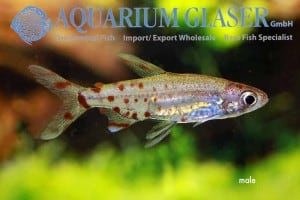
Body elongated, moderately high and slightly compressed laterally. Base color greenish with a strong orange overtone, back light brown, flanks light green, head and tail stem predominantly orange-brown. On the lower jaw and gill covers, there are strong worm-like red stripes and spots, as well as immediately above the pectoral fins. Furthermore, a large number of deep red dots and spots are irregularly scattered over the entire body. The dorsal fin is orange-red with a milky white to light blue edge, underneath which there is a deep red band and a number of randomly arranged red dots. Anal fin orange-yellow with red edge and white tip. Tail fin bluish in the middle zone with irregular red spots and dots. Orange-brown at the base, as is the edge, lower and upper extended fin lobes uniform, yellow-white, separated from the middle zone by a deep red band. Belly fins yellow-orange with red edge. Pectoral fins yellow-orange with red overtone.
Size approx. 6 cm.
The female: rounded fins, duller to greenish brown with inconspicuous red spots on the flanks.
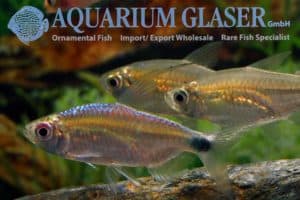
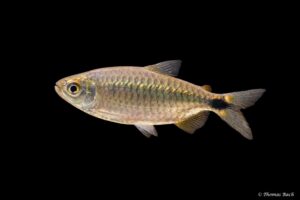
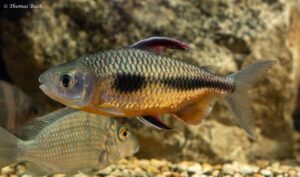
Various breeding varieties are available on the market, including the Aphyosemion australe Gold and Chocolate, which you can see in the photos.
Care
To show their natural zest for life and colorful splendor, the water surface should preferably be densely covered with surface plants that temper the incoming light. In addition, fish like to use hanging roots to lay their eggs.
pH 6 to 6.5, DH 5 to 7. Although fairly high temperatures are measured in natural biotopes, especially during the day, we keep the fish in captivity at 22–24 degrees; higher temperatures shorten their lifespan.
All kinds of aquatic insects and their larvae are suitable as food, but black and white mosquito larvae are preferred, and water fleas are also devoured with gusto. The processing of large amounts of peat and driftwood in the aquarium will cause the water to turn light yellow, which can be further enhanced by permanent filtering over peat.
The aquarium must be properly sealed. They can jump through even the smallest holes. If your aquarium does not have a sealed lid, place cover plates on top. It would be a shame to find these beautiful fish on the floor.
Breeding
These killifish are plant spawners, depositing their eggs among the roots of surface plants and shore vegetation.
They have few requirements in terms of growing conditions. A substrate is usually unnecessary, but if you want to use one, it is best to use well-cooked peat moss. The so-called ‘growing brushes’ are ideal as a substrate; 2 to 3 brushes per tray is sufficient.
Mating can take several weeks. After about 3 weeks, remove the pair from the breeding tank and reduce the water level until the fringes are just hanging in the water, then reduce the temperature to 18 degrees. Keep the breeding tank dark. The eggs will hatch after 10–14 days.
Rearing feed: Artemia nauplii, sieved Cyclops and Daphnia, bloodworms.
Comments
The difference between the sexes can be seen in some specimens after about 8 weeks, but usually only after a few months. Aphyosemion species are usually sexually mature after one year.
Video


Author
BiancaB
Copyright images
Hristo Hristov
John de Lange