Pomacentridae
Pomacentridae
The Pomacentridae family, better known as reef fish and anemone fish, is a large and diverse group of saltwater fish that are often found in tropical coral reefs around the world. They are known for their vibrant colors, active behavior, and relatively small size, making them very popular with aquarium enthusiasts.
Within this family, you will find both fish that live solitarily and species that swim in large groups. Many species are territorial and fiercely defend their territory. The best-known members are probably the anemonefish, which have a special relationship with sea anemones.
Name and meaning
The family name Pomacentridae was first described in 1839 by the famous French zoologist Charles Lucien Bonaparte. The name “Pomacentridae” is derived from the genus Pomacentrus, which in turn is composed of two Greek words:
- “Poma” (πῶμα): meaning “lid” or “operculum” (gill cover).
- “Kentron” (κέντρον): meaning ‘spine’ or “thorn.”
This probably refers to the spiny edge of the gill cover, a feature found in many species within this family. The Pomacentridae family belongs to the order Perciformes, the perch-like fish.
Characteristics
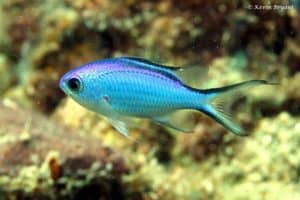
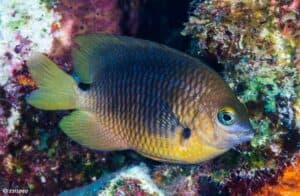
Fish from the Pomacentridae family are generally small to medium-sized fish, with most species growing to between 5 and 15 centimeters in length. However, there are exceptions, such as the larger damselfish species, which can reach up to 35 centimeters. They often have an oval to elongated, laterally flattened body, although some species are rounder and stockier, while others are slimmer.
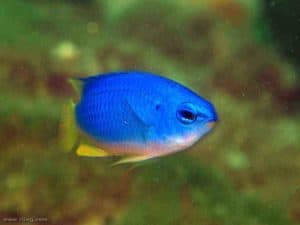
One of their most striking features is their often beautiful and vibrant color palette, ranging from bright blue, yellow, orange, red, black, white, and combinations thereof, often with striking patterns, stripes, or spots. These colors play an important role in communication, camouflage, and deterring predators. They usually have a single continuous dorsal fin with a spiny and a soft section, and a tail fin that is often forked or rounded. The pectoral fins are well developed and are used extensively for precise movements in the water.
The mouth is usually small and located at the front of the head, equipped with small, cone-shaped teeth that are suitable for their diet. Their bodies are covered with relatively large, rough scales, and as the name suggests, many species have a spiny edge on the gill cover, although this is not always prominent. These characteristics make them not only beautiful to look at, but also well adapted to their life in coral reefs.
Origin
The Pomacentridae family is widespread and occurs mainly in the tropical and subtropical waters of the Indian and Pacific Oceans. They are found in abundance in warm, shallow coastal waters, particularly around coral reefs, rocky coasts, and lagoons.
Their range extends from the east coast of Africa, including the Red Sea, through the Indian Ocean, Southeast Asia, and Australia, to the islands of the Pacific Ocean, all the way to the west coast of America. They are true reef dwellers and are highly dependent on the complex structures provided by coral reefs, which offer them not only food, but also shelter from predators and places to establish their territory and reproduce. Some species also live in seagrass beds or among rocks.
The enormous diversity of species within the Pomacentridae family reflects the many different niches they have occupied in these vast and rich marine ecosystems.
Behavior
The behavior of fish from the Pomacentridae family is as diverse as their appearance, but there are some general patterns that can be recognized. In general, they are active and lively fish that are busy throughout the day. Many species within this family are quite territorial, especially the reef basses, and fiercely defend their piece of reef against intruders, which can lead to impressive mock fights and chases. This is an important consideration in an aquarium to prevent stress in other fish.
In terms of social structures, some Pomacentridae live solitarily, while others occur in pairs or even large schools. Clownfish, for example, live in small, hierarchical groups in their host anemone, with a dominant female and smaller males.
They are active during the day, searching for food; their diet varies by species, but many are omnivorous, eating both algae and small invertebrates. They are masters at finding hiding places, with coral reefs offering countless crevices, caves, and cavities where they can quickly retreat in case of danger.
One of the most iconic behaviors is the symbiotic relationship between anemonefish (genus Amphiprion and Premnas) and sea anemones, in which the anemonefish is immune to the anemone’s venom and uses it for protection, while the anemonefish keeps the anemone clean and provides food scraps. Their active and sometimes feisty behavior makes them fascinating to observe, but keeping them in an aquarium requires careful planning.
Care requirements
Keeping fish from the Pomacentridae family in an aquarium can be very rewarding, but it is important to take their specific needs into account. The required aquarium size depends greatly on the species; smaller reef fish and anemone fish can often be kept in aquariums from 60-100 liters, but larger or more territorial species require at least 200-300 liters or more. Always provide sufficient swimming space and hiding places.
A setup that mimics their natural habitat is important, with plenty of live rock with crevices, caves, and overhangs for hiding places and territories. A sandy bottom is often desirable, and they will feel at home in a reef aquarium, although care must be taken as some species can irritate corals.
For anemonefish, a suitable host anemone is a must, and research into the right match and sufficient space and light for the anemone is essential. A moderate to strong water flow is desirable, similar to their natural reef environment, which also helps to disperse food and remove waste.
As saltwater fish, they require stable and good water values, and most Pomacentridae are omnivorous. Here are the most important parameters and feeding guidelines:
- Water values:
- Temperature: Between 24°C and 28°C.
- Salinity: 1.020 – 1.025 SG (specific gravity) or 30-35 ppt (parts per thousand).
- pH value: 8.1 – 8.4.
- Ammonia, Nitrite, Nitrate: Ammonia and nitrite should be 0. Nitrate should be as low as possible, preferably below 20 ppm.
- Regular water changes (10-20% per week or two weeks) are essential to maintain high water quality.
- Feeding:
- Provide a varied diet of high-quality flake food, pellets, frozen food (such as mysis, artemia, krill) and plant-based food (such as spirulina, nori).
- Feed small amounts two to three times a day.
- Ensure they receive sufficient plant material to keep their digestion healthy.
Good preparation and regular maintenance are the keys to success when keeping these beautiful fish.
Reproduction
The reproduction of fish from the Pomacentridae family is fascinating and shows some common patterns, although there are also species-specific differences. Many species can be bred in the aquarium, which makes them extra interesting for hobbyists.
Most Pomacentridae are monogamous pairs or live in harems (one male with several females). Anemonefish are a good example of this; they live in a hierarchical group in an anemone, with the largest individual being the dominant female and the second largest being the dominant male. All other fish in the group are immature males, and if the female dies, the dominant male changes sex and becomes the new female.
They are substrate breeders, which means that the eggs are deposited on a hard surface, such as a flat rock, a piece of coral, the base of an anemone, or even the inside of a shell, with the male often preparing the breeding site. The eggs are usually small, oval-shaped, and laid in clusters, often transparent or light-colored, and attach themselves to the substrate.
Males play an important role in brood care; after the eggs are laid, the male fiercely guards the clutch, fanning his fins to provide the eggs with fresh water and removing any unfertilized or moldy eggs. This behavior can last from several days to a week.
After hatching, the larvae are very small and planktonic, drifting with the current and feeding on microscopic food, which is the most vulnerable phase of their life. After a while, they develop into juveniles and look for a suitable place to settle, often near a reef.
Breeding Pomacentridae in an aquarium often requires a special breeding tank, good water quality, a varied diet for the parent fish, and the rearing of live food for the tiny larvae. It is a challenge, but certainly possible for the dedicated hobbyist. Observing their reproductive behavior is one of the most rewarding aspects of keeping these fish.
Compatibility
The compatibility of fish from the Pomacentridae family in a community aquarium can be challenging due to their often territorial and sometimes aggressive nature. It is important to consider this carefully to avoid stress and conflict in your aquarium.
Many reef fish are notorious for their territoriality and will fiercely defend their chosen spot against intruders, especially if the aquarium is too small or there are insufficient hiding places, which can lead to bullying and even the death of weaker fish. One solution to this is to provide a spacious aquarium with plenty of live rock and hiding places, and to introduce territorial species last. Consider keeping only one specimen of a particularly aggressive species, or a proven pair. Keeping multiple specimens of the same species together can be difficult, especially with the more aggressive reef fish; it is often better to keep only one specimen, unless you have a very large aquarium or a proven pair. Anemonefish can often be kept in a group, provided there is a suitable anemone and sufficient space.
As for other fish, avoid very calm, shy, or slow-swimming fish, as well as fish with long, flowing fins, as these may become victims of bullying or attacks. In general, Pomacentridae do well with other active, robust saltwater fish of similar size and temperament, such as surgeonfish (provided they are large enough), wrasse, and some other reef fish that can defend themselves well. Often introduce the Pomacentridae last, after the other fish are already established, to reduce their territorial behavior.
With regard to invertebrates, most Pomacentridae are “reef-safe” and will leave corals alone, although some species may pick at algae from corals, which can cause irritation. Anemonefish naturally live with anemones. Shrimp and crabs are generally left alone unless they are very small and seen as food, and snails, starfish, and other invertebrates are usually not bothered.
It is always advisable to do specific research on the compatibility of the specific Pomacentridae species you want to keep, as there can be significant differences within the family. A well-planned aquarium with sufficient space and hiding places is the key to success.
Suitable aquariums
Due to their diverse nature and behavior, fish from the Pomacentridae family are suitable for various types of saltwater aquariums, provided the right considerations are made. The most suitable aquariums are:
- Reef Tank: This is the most ideal environment for most Pomacentridae, as it mimics their natural habitat with live rock and corals. It provides plenty of hiding places, territories, and a natural environment, and the stable water parameters required for corals are also perfect for these fish. It is important to ensure sufficient space, especially if you want to keep multiple territorial species. Clownfish are of course perfectly at home here with a suitable host anemone.
- FOWLR aquarium (Fish Only With Live Rock): This type of aquarium focuses on keeping fish with live rock, but without corals. It still offers plenty of hiding places and good biological filtration thanks to the live rock and is often slightly easier to maintain than a full-fledged reef aquarium. However, the water quality must still be high.
- Species Tank: For particularly aggressive or specialized species, an aquarium dedicated solely to them may be the best option. This prevents conflicts with other fish and allows you to focus entirely on the specific needs of that one species or pair. Although it may be less visually diverse, it is ideal for breeding projects or keeping species that are otherwise difficult to combine.
- Nano aquarium (for small species): Some of the smallest reef fish and anemone fish can be kept in a well-set-up nano aquarium (starting at around 60 liters). This takes up less space and can be a beautiful little ecosystem. However, water values are more unstable in smaller aquariums, so very regular maintenance is crucial, and only the smallest and least aggressive species should be chosen.
Regardless of the type of aquarium, it is always important to provide sufficient space to prevent stress and aggression, plenty of hiding places that are essential for their well-being, stable water values as the basis for a healthy saltwater aquarium, and good filtration and flow for a clean and oxygen-rich environment. By choosing the right aquarium and setup, you can create a beautiful and healthy environment for your Pomacentridae.Genera in the database
Below you will find the genera within the family that we have included in our database: