Porcellanidae
Porcellanidae
The Porcellanidae, better known in Dutch as porcelain crabs, is a family of crustaceans that is commonly found in saltwater aquariums. Although their flat, round bodies make them look very similar to ‘real’ crabs, biologically they are more closely related to mantis shrimp and hermit crabs. This family is known for its interesting behavior: instead of hunting, they use special fan-shaped appendages to filter food from the water. Many species are small, peaceful, and often seek protection in symbiosis with anemones or among live rock.
Name and meaning
The scientific name of this family is Porcellanidae. The family was first described in 1825 by the British scientist Haworth.
The name is derived from the word ‘porcelain’ (Latin: porcellana). This name was chosen because of the fragility of these animals. Just like fine porcelain, they are very fragile. If a porcelain crab is attacked or grabbed, it can easily release a leg or claw (autotomy) to escape its attacker. Fortunately, such a lost limb grows back over time during the next molt. In addition, many species have a smooth, shiny, and hard shell that also resembles porcelain in appearance.
In Dutch, we logically call them porseleinkrabben (porcelain crabs).
Characteristics
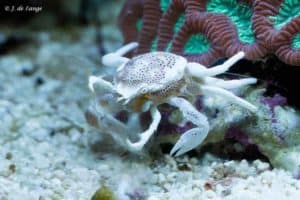
Porcelain crabs have a unique and fascinating appearance. At first glance, they look very similar to ordinary crabs, but if you look closely, you will see a few clear differences that reveal that they are related to hermit crabs and jumping crabs.
Body structure:
They have a very flat and often round or oval body. This flat shape is ideal for their lifestyle, as it allows them to easily hide in narrow crevices between rocks or under stones.
Legs (the big difference):
This is the easiest distinguishing feature. A ‘real’ crab has four pairs of walking legs. A porcelain crab, however, only has three pairs. The fourth pair is very small and folded against the body, often hidden under the carapace. These small legs are not useless; they are very flexible and are used to keep the body and gills clean.
Chelae:
The chelae are often very large and flat in relation to the body. Despite their impressive size, they rarely use them to catch prey, but rather to defend their territory against conspecifics or to deter predators.
Antennae:
Unlike true crabs, which have short antennae between their eyes, porcelain crabs have strikingly long antennae that are located on the outside of their eyes.
Fan-like hands:
The most beloved feature for aquarists are the mouthparts. These have been transformed into a kind of ‘fan’ (maxillipeds) covered with long, fine hairs. They can eject these fans into the current to filter plankton and suspended debris from the water.
Tail:
The tail (abdomen) is folded under the belly, just like in crabs. The difference is that a porcelain crab can still move its tail. In emergency situations, they can flap their tail to swim backwards quickly, something that real crabs cannot do.
As the name suggests, these animals are very fragile. When stressed or in danger, they can easily detach a leg or claw (autotomy) to escape a predator. These will grow back later.
Origin
Porcelain crabs are true citizens of the world. They are found in almost all the world’s oceans, from tropical to temperate regions, although they prefer warm water. The greatest variety of species is found in the Indo-West Pacific (the vast area between the Indian Ocean and the western Pacific Ocean) and along the east coast of the Pacific Ocean. They are also found in the Atlantic Ocean, but there are fewer different species there.
In nature, these crabs usually live in shallow water, often in the intertidal zone. This is the part of the coast that falls dry at low tide and is submerged again at high tide. Because they are so flat, they can hide perfectly under rocks, in narrow crevices or among dead coral. They do this to prevent themselves from drying out at low tide and to stay safe from predators.
Some species need a specific place to live. They do not just live among the rocks, but live together (in symbiosis) with other marine animals. For example, there are porcelain crabs that seek protection among the spines of sea urchins, or live safely among the tentacles of sea anemones and soft corals.
Behavior
The behavior of porcelain crabs is what makes them so popular with aquarium owners. They are generally calm but fascinating animals to watch.
Filtering:
They spend most of their time gathering food. They find a spot in the current and cast their fan-shaped mouthparts (maxillipeds) out like a kind of net. They use these to catch plankton and floating debris from the water, which they then bring to their mouths. It is an almost mesmerizing sight to see them ‘waving’ rhythmically.
Movement:
When they move, you can clearly see that they are not ‘real’ crabs. Whereas ordinary crabs are known for their sideways walk, porcelain crabs often walk backwards or forwards. When they are really panicked or need to flee, they can even flap their tail (the abdomen) to swim backwards. This is something an ordinary crab will never do.
Shyness:
They are naturally quite shy animals. They lead a hidden existence under rocks or in crevices. If you turn over a rock in nature where they are hiding, they will quickly crawl to the shady side of the rock to hide again. In the aquarium, they seek out a fixed spot; if there is enough current and food, they can stay in exactly the same place for months.
Defense:
Although they have enormous claws, they rarely use them to fight or kill prey. The claws mainly serve as a deterrent (intimidation) and to block the entrance to their burrow. If they are attacked by a predator, they will easily drop a leg or claw to distract the enemy so that they can escape. So always be careful when you get close to the crab during maintenance!