
Channa
Channa
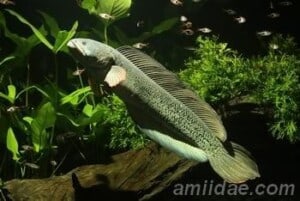
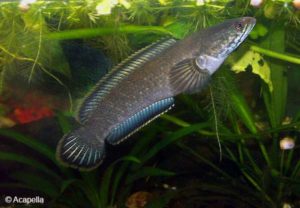
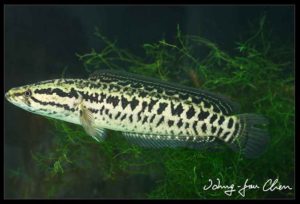
The genus Channa, better known as snakehead fish, is a group of predatory fish that originated in Asia. They belong to the family Channidae. These fish are immediately recognizable by their elongated body and distinctive head, which, due to its shape and large scales, is strongly reminiscent of a snake.
Snakehead fish are particularly intelligent and exhibit interesting behavior, which often leads them to be regarded as genuine pets. A unique feature is that, in addition to gills, they also have an extra respiratory organ. This allows them to breathe atmospheric air and survive in water that contains almost no oxygen. In the aquarium, they require specific care: they often need a spacious aquarium, are excellent jumpers (a tight-fitting lid is mandatory!), and usually cannot be kept with smaller fish because they see them as food.
Name and meaning
The scientific name Channa was officially made available in 1777 by the Italian naturalist Scopoli. The family name Channidae is derived from this. However, the genus name goes back even further, to the work of the Dutch ichthyologist (fish expert) Gronow from 1763.
The exact meaning or origin of the name Channa is unknown, but there are two interesting theories:
The Greek connection: It may come from channe or channos. This was a Greek name for a sea fish with a wide mouth. Given the large mouth of the snakehead fish, this is a logical explanation.
The Sri Lankan connection: A more recent theory suggests that Channa is a Dutchized spelling of kanaya. This is the local name in Sri Lanka for small snakehead fish. Because Sri Lanka was under Dutch rule at the time and Gronow was Dutch, this seems plausible. However, critics point out that we pronounce Channa with a ‘G’ sound and not a ‘K’, making this less likely.
The genus Channa comprises the Asian species within the family Channidae. The African species are classified in the genus Parachanna (described by Teugels & Daget in 1984).
Characteristics
When you see a Channa, you immediately understand where the English name ‘snakehead fish’ comes from. Yet this fish is biologically very ingenious. Here are the most important characteristics:
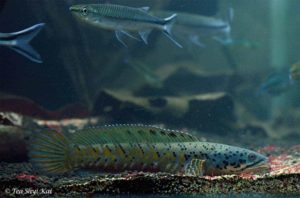
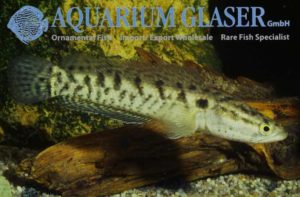
- Body structure and appearance: Snakehead fish have an elongated, muscular body with a dorsal fin that runs almost the entire length of the back. The head is broad and flat and covered with large scales, just like a snake. Their mouth is large and filled with sharp teeth, which reveals that they are true predatory fish.
- Breathing (Vital!): This is the most unique feature of the Channa. In addition to normal gills, they have a special organ (suprabranchial cavities) at the back of their head. This allows them to breathe atmospheric air. In fact, they have to gulp air at the surface, otherwise they will drown! Thanks to this system, they can survive in warm, stagnant water with very little oxygen.
- Size: The length varies greatly depending on the species, which is important to know before you buy them. Some species remain relatively small (up to about 25 cm), such as Channa bleheri and Channa andrao. These are the species most suitable for aquariums. Species such as Channa micropeltes and Channa argus can grow to 100 centimeters or larger. These are not really suitable for a standard home aquarium.
- Color change: Pay close attention when purchasing: young fish are often beautifully brightly colored and have attractive patterns (e.g., red or orange). As they age, many species lose these colors and take on a duller, gray or brown camouflage color. Some aquarium owners lose interest because of this, so know what you are buying!
Origin
The Channa is a true globetrotter within Asia. Its distribution area is enormous, which immediately explains why there are so many different species, all with slightly different requirements.
In the wild, Channa species can be found throughout much of Asia. This ranges from southeastern Iran and Afghanistan all the way east through India, Pakistan, and Thailand to China, Korea, and even parts of Siberia. They are also abundant in Indonesia and the Philippines.
These fish have been around for a long time. Fossils dating back 50 million years have been found in the southern Himalayas. Scientists believe that this is where they originated. About 15 million years ago, when the climate was warmer, they spread. They used to swim around in Europe, but they have since become extinct there.
Because they occur in such a large area, they live in three different climate zones:
- Tropical: Constantly warm water.
- Subtropical: Warm summers and milder winters.
- Temperate: Areas where the water cools down considerably in winter (such as in Siberia or northern China). This means that not every snakehead fish needs heating; some actually need a cooler period to stay healthy.
Behavior
Snakehead fish are known for their character. Many owners even describe them as “water dogs” because they are so intelligent and interactive. This makes them very different from the average aquarium fish that just swims around in circles.
Hunting instinct
They are basically predatory fish. Most species are so-called ‘lurking hunters’. They can lie motionless among the plants or on the bottom for hours. As soon as prey (fish or insects) passes by, they shoot forward at explosive speed to strike. Some more active dwarf species swim around the aquarium more often.
Interaction with the owner
Once accustomed to their environment, they are not shy at all. They quickly learn to recognize their caregiver. Many Channa come swimming to the front window when you enter the room and will even ‘beg’ for food. They often follow your finger along the glass.
Aggression
Although they are curious towards humans, they can be very aggressive towards other fish. They fiercely protect their territory from other members of their species. Unless you have a proven pair, most species should therefore be kept solitary (alone). Anything that fits in their mouth is considered food.
Gasping for air
You will regularly see the fish swimming to the surface of the water to take a breath of air. This is natural behavior. After gasping, they often sink back down calmly.
Jumpers
It is important to know that Channas are masters of escape. In nature, they sometimes crawl over land to another pool. In the aquarium, this means that they can jump out through the smallest hole in the light cover.
Channa species
Below you will find the Channa species that we have added to our database:

Showing all 16 results









Showing all 16 results


