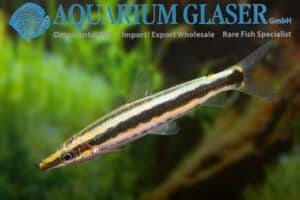
Anostomus
Anostomus
The genus Anostomus consists of a group of striking fish that we often refer to as “headstanders” in the aquarium hobby. They owe this name to their unique way of swimming and resting: they often hang at an angle with their heads down among plants or rocks. They originate from the warm rivers of South America and are loved for their elongated, cigar-shaped bodies and beautiful patterns, often with longitudinal stripes and red accents. Although they are very beautiful to look at, they do require a spacious aquarium and the right tank mates, as they can sometimes be territorial.
Name and meaning
The genus Anostomus was officially recorded by naturalist Giovanni Antonio Scopoli in 1777 (based on earlier work by Gronovius from 1763). This group of fish belongs to the Anostomidae family, better known in the Netherlands as the catfish family.
The name Anostomus comes from ancient Greek and accurately describes an important characteristic of the fish. It is a combination of two words:
- Ana: this means ‘up’.
- Stoma: this means ‘mouth’ or ‘beak’.
Literally translated, the name means “mouth pointing upwards.” When you look at these fish in the aquarium, you can immediately see that this is true. The mouth is in a so-called superior position, i.e., clearly pointing upwards. This is not only a physical characteristic, but also tells us a lot about how they obtain their food in nature.
Characteristics
Fish from the Anostomus genus have a very recognizable appearance. Even as a beginner, you can easily pick them out in the aquarium store. Below you can read what makes these fish so special:
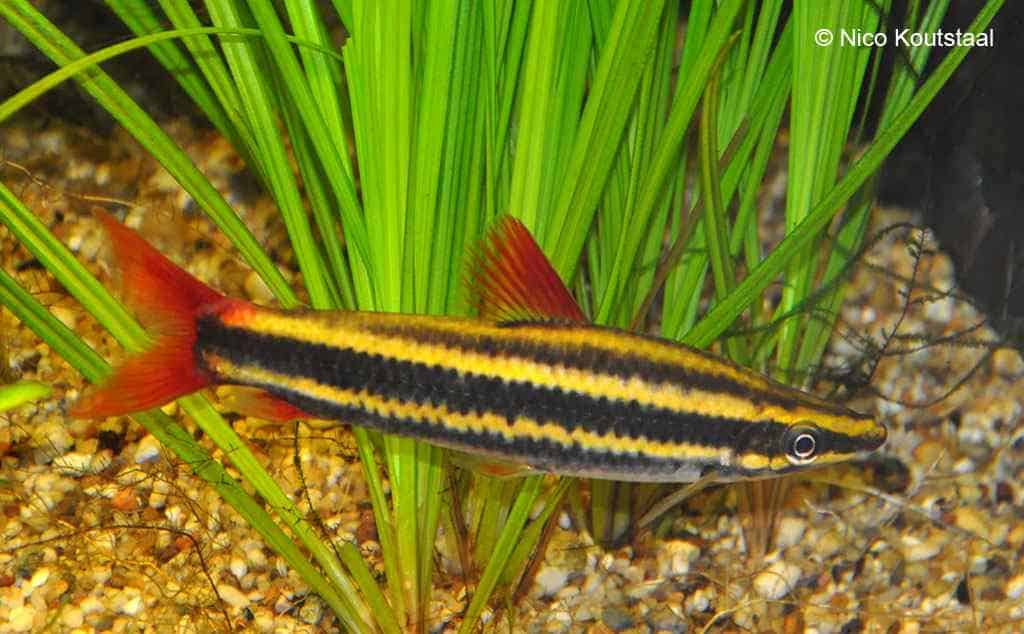
They have an elongated body that resembles a cigar or a torpedo. This allows them to move easily through the water and between densely growing plants. As the name suggests, the small mouth points clearly upwards. The lips are often somewhat thicker and ribbed.
The most striking feature is, of course, their posture. They often swim and rest at a 45-degree angle or even steeper, with their heads pointing downwards. They do this to search for food between crevices and leaves.
Most species, such as the well-known Prachtkopstaander (Anostomus anostomus), have striking longitudinal stripes across their entire body. These are often dark (black) stripes on a golden or beige background. Many species also have beautiful, bright red fins that contrast nicely with the body. There are also species with dots or spots, such as the Anostomus ternetzi, but the elongated shape remains the same. Don’t be fooled when they are young and small in the store. An adult Anostomus grows quite large for a community tank. On average, they grow to between 12 and 18 centimeters long.
It is very difficult to tell the difference between males and females from the outside. There are no clear differences in color or fins. Only in adult animals can you sometimes see that the female is slightly fuller and rounder in build than the slimmer male.
Origin
Fish of the genus Anostomus originate from the warm, tropical waters of South America. Their distribution area is enormous. They can be found in the vast river systems of the Amazon and the Orinoco. They occur in the wild in countries such as Brazil, Venezuela, Colombia, and Peru, but also closer to home in the rivers of Suriname and Guyana.
In nature, these fish have a specific preference for their habitat. They often live in rivers with a strong current. They are strong swimmers that have no trouble with fast-flowing water.
They are usually found in places where there are many large stones, rocks, and sunken tree trunks. This rocky environment is important to them because it supports the growth of algae. With their heads down, they can perfectly extract the algae and small creatures from between the crevices of the stones.
Because their habitat is so large, they are accustomed to different types of water, but in general they come from soft and acidic to neutral water that is rich in oxygen.
Behavior
The behavior of Anostomus species is interesting, but does require some attention from the owner. They are active fish that are very present in the aquarium.
As mentioned earlier, you will often see these fish swimming or hanging upside down. They constantly search the bottom, stones, and leaves for something edible. Although you often see them in groups, they can be quite aggressive towards each other. They have a clear hierarchy (pecking order). If you keep too few of them together (for example, 2 or 3), there is a good chance that the strongest fish will constantly chase and bully the weaker fish. It is therefore best to keep either a single specimen or a large group of at least 6 to 8 specimens. In a larger group, the aggression is distributed and the weaker fish have more peace.
They are usually peaceful towards other fish species and leave them alone. However, they are large and active, so very small or shy fish may feel uncomfortable in their presence. There is one important drawback: some Anostomus fish can be mischievous and nibble on the long fins of other fish (fin biting). Therefore, it is best not to keep them together with slow-moving fish with veil fins, such as angelfish or gouramis.
Anostomus species
Below you will find the Anostomus species that we have added to our database:
Showing all 2 results