
Utaka
Utaka: The Kings of the Open Water in Lake Malawi
Welcome to the fascinating world of Malawi cichlids! While many immediately think of the brightly colored, rock-dwelling Mbuna, there is another, equally fascinating and diverse group that dominates the open waters: the Utaka. This group includes not only the elegant plankton eaters, but also the impressive predators of the lake.
Are you ready to delve into these beautiful fish? This comprehensive guide is intended to be the best online reference and covers everything you need to know to successfully understand and keep Utaka, whether you are a novice enthusiast or a seasoned Malawi expert.
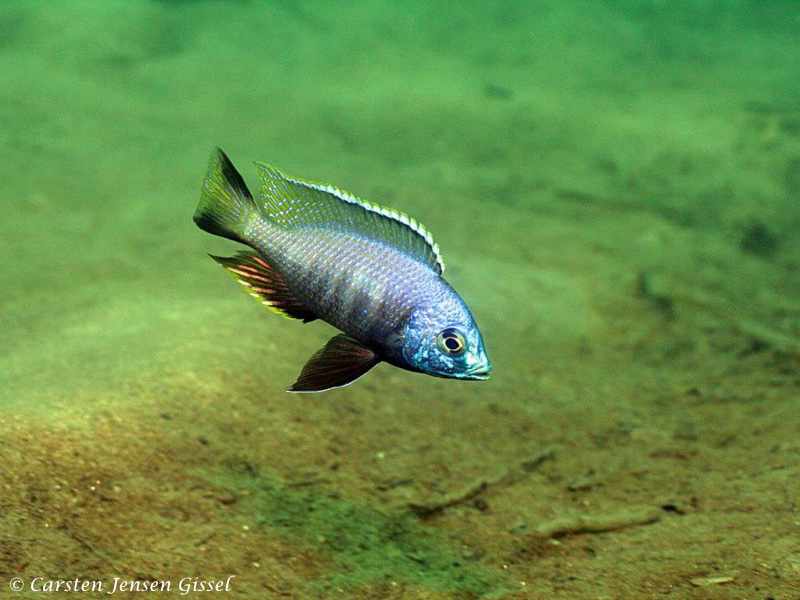
What exactly are Utaka? A diverse group
The term ‘Utaka’ is a broad collective name for cichlids that, unlike the rock-dwelling Mbuna, live in the open water column and above sandy plains. Their lifestyle, and not just their diet, defines them. Within this group, we find two important subgroups:
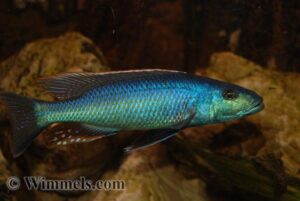
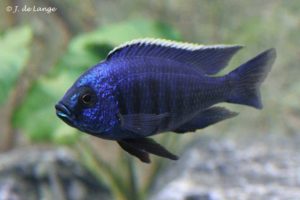
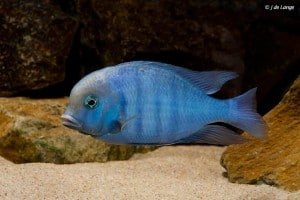
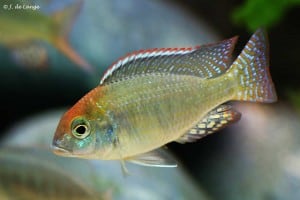
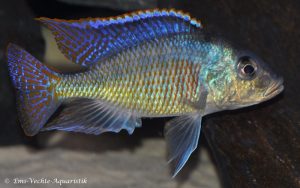
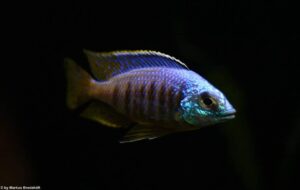
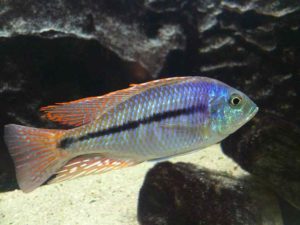
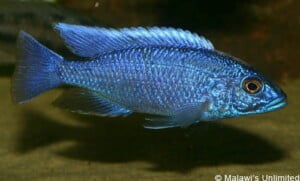
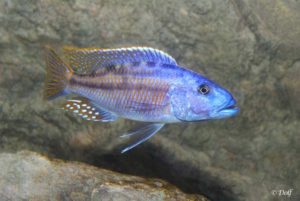
- The Plankton Eaters: These are the classic Utaka. They often live in huge schools and feed by ‘plucking’ zooplankton from the water. They have a streamlined, torpedo-like body shape for efficient swimming. The females are often silvery in color, while the males develop spectacular colors.
- Main genera: Copadichromis, Mchenga, Nyassachromis.
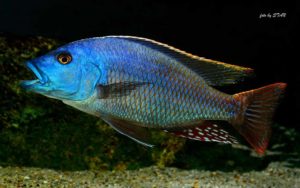
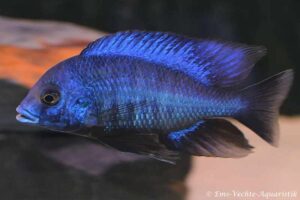
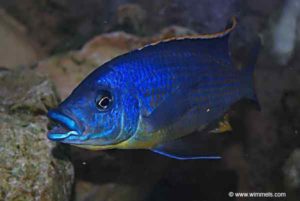
- The Predators (Piscivores): These are the larger, hunting cichlids that prey on small fish. Despite their different diet, they are classified as Utaka because they share the same open habitat. They are often solitary and use cunning hunting techniques.
- Main genera: Nimbochromis, Dimidiochromis, Sciaenochromis, Tyrannochromis.
The Ideal Utaka Aquarium
Replicating the open waters of Lake Malawi is the key to success. An Utaka aquarium is therefore quite different from a typical Mbuna aquarium filled with rocks.
- Aquarium size: This is non-negotiable. Due to their active swimming behavior and the size of many species, a minimum aquarium length of 150-160 cm (approximately 500 liters) is absolutely necessary. For keeping the larger predators, an aquarium of 200 cm or more is required.
- Decoration: The golden rule is: provide maximum open swimming space. Place tall rock formations on the sides and against the back wall. This provides hiding places and marks territories without taking away the crucial swimming space in the middle of the tank. A fine sand substrate is essential.
- Water values: Stability is crucial. Stick to the typical Malawi parameters:
- pH: 7.5 – 8.5
- GH: 12 – 16
- Temperature: 22 – 26°C Ensure a powerful filter and regular, large water changes.
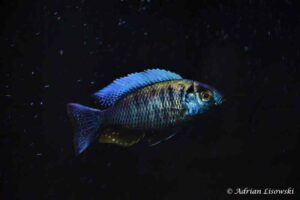
- Combining with Other Fish: Combine Utaka species of similar size and temperament. Peaceful plankton eaters often do well with Aulonocara. Be careful when combining large predators with much smaller fish.

Sciaenochromis fryeri – Male Feeding and Diet: A Crucial Difference
The diet depends on the subgroup. An incorrect diet can lead to serious health problems. The diet for plankton eaters must be rich in animal proteins. A high-quality dry food for carnivores, supplemented with frozen food such as mysis, krill, and artemia, is ideal.
Predators need larger and more substantial food. In addition to high-quality pellets, they can be fed pieces of fish fillet, shrimp, and larger prey animals.
Breeding and Behavior: Maternal Mouthbrooders
The vast majority of Utaka are maternal mouthbrooders. This is a fascinating form of brood care with the following characteristics:
- Definition: The term ‘maternal’ means that the female (mother) takes full responsibility for the eggs and young.
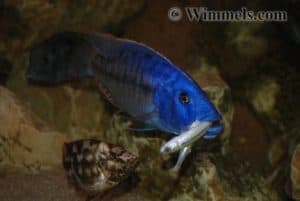
- The Process: After depositing and fertilizing the eggs on a substrate (such as a piece of sand or a flat stone), the female immediately takes the eggs into her mouth .
- Brood care: She incubates the eggs in her mouth and protects the young fish from danger. Even after the young are first released, the mother will take them back into her safe mouth for some time if danger threatens.
This behavior is a spectacular sight and one of the highlights of keeping these cichlids.
Conclusion: An Asset for the Right Enthusiast
The Utaka group, in all its diversity from peaceful plankton eaters to imposing predators, offers a unique insight into life in Lake Malawi. They require space, a proper diet, and a stable environment. For the enthusiast who can offer them this, Utaka are an endless source of fascination and a beautiful, living representation of the open waters of the majestic Lake Malawi.
Utaka species
Below you will find the Utaka species that we have included in our database:
Showing all 57 results


















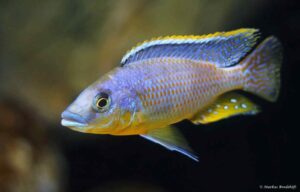


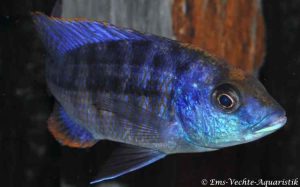
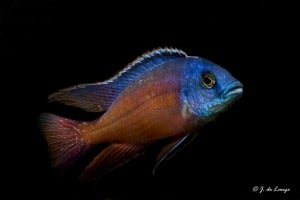
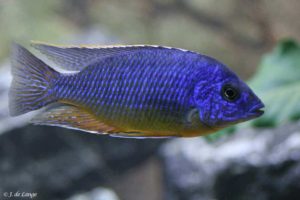


Showing all 57 results


