
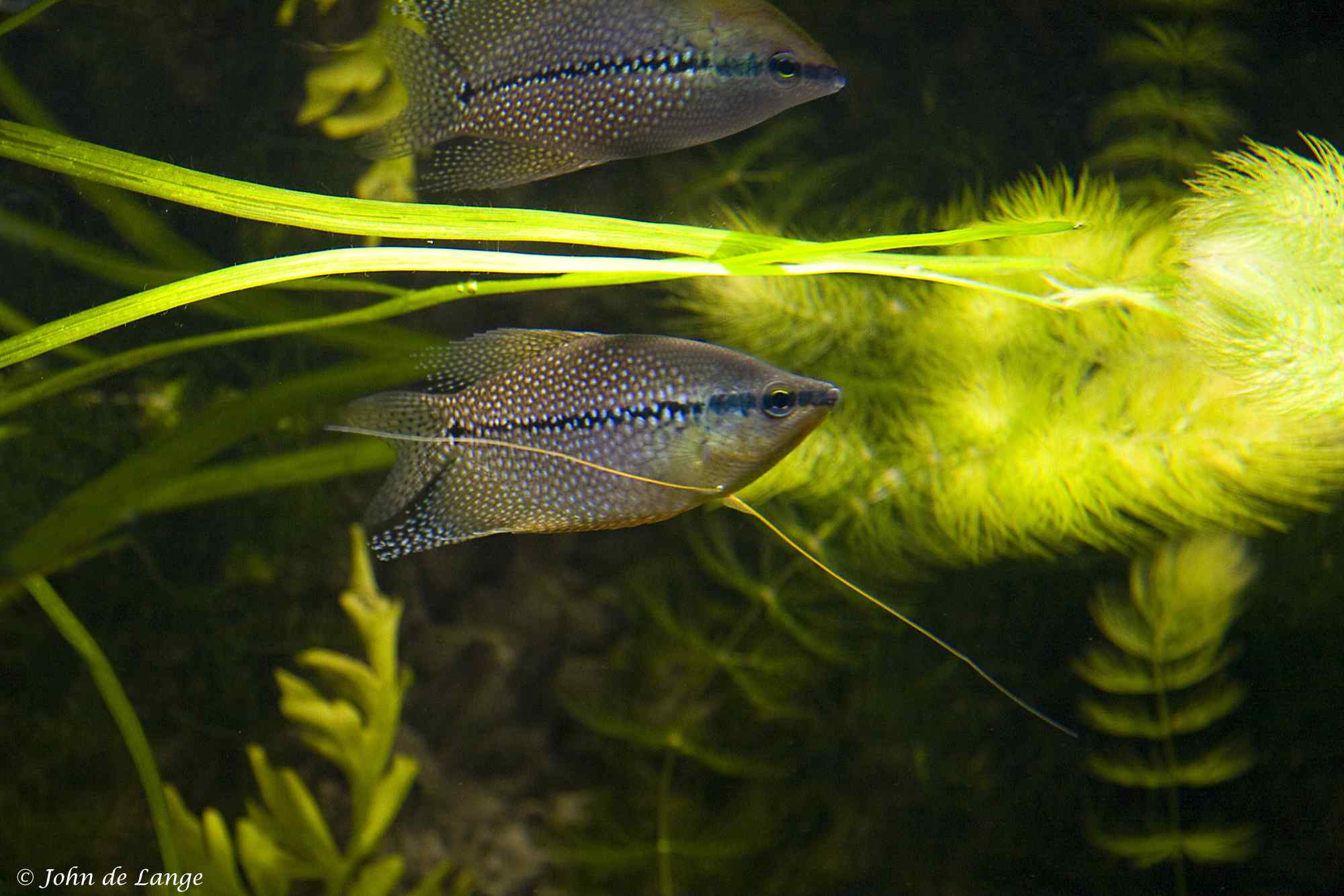
Breeding report Trichopodus leerii (Pearl Gourami)
Breeding aquarium fish has been my greatest passion for years. Especially the species where you really have to make an effort attract me the most. I look for the challenge in breeding fish that are not obvious or simple, because perseverance gives me the most satisfaction. Over the years I have bred more than fifty different species, from numerous tetras in the Hyphessobrycon family to various rainbowfish, Pseudomugil species and even more difficult species such as dwarf pufferfish.
Breeding Trichopodus leeri, better known as the Pearl Gourami or Diamond Gourami, was such a challenge for me. Although the species is often described as relatively easy to breed, my first attempts were not without problems. That actually motivated me to persist. Ultimately this project produced a beautiful result with hundreds of fry, but more importantly: valuable experience that I am happy to share with other aquarium enthusiasts.
In this report I take you step by step through my approach: from preparation and conditioning of the parents, to the setup of the breeding tank, the breeding process itself and rearing the fry. I also share my personal experiences, what went well, and which choices I might make differently next time.
Preparation for breeding
A successful breeding of Trichopodus leeri starts with careful preparation. For me this is perhaps the most important part of the whole process. It is precisely the weeks or even months before the actual breeding in which the foundation for success is laid. Healthy, mature parents that are well fed and conditioned make the difference between failure and success.
Acquiring the pair
I bought my pair of Pearl Gouramis somewhat spontaneously. It was an impulsive purchase with the thought: “I also want to try these.” They were subadult to adult fish that already looked nice at purchase, but that became noticeably fuller and stronger at home with good feeding. Especially the female developed visibly: she gained a round belly full of eggs. Because I only had one pair, there was nothing to select from a group, but that turned out not to be a problem.

Conditioning the parents
After purchase the fish were first given time to get used to my tap water and my daily routine. That patient process is a fixed part of my working method: I do not put new fish directly into breeding, but give them months of rest and abundant feeding in a spacious community aquarium.
The diet mainly consisted of live food such as tubifex, artemia, red mosquito larvae and Daphnia. In addition I provided various types of dry food so they would stay accustomed to that as well. This combination not only produced excellent condition, but also more intense colors and a clear increase in vitality.
Separating male and female
A few months before breeding I separated the pair. Both the male and the female received their own aquarium, together with other fish I wanted to breed later. This had two important advantages: the female got rest and the chance to develop further without pressure from a male, while both fish could be fed liberally individually.
After two to three months the result was clearly visible. The female was full of eggs and the male was intensely colored and in top condition. For me that was the sign they were ready to move to the breeding tank.
Water parameters during preparation
Unlike many other species that require acidified RO water, such as most tetras, Diamond Gouramis are notably undemanding. I kept my breeders in tap water with a pH of about 8, a TDS around 200 and a temperature of 24 degrees Celsius. The fact that they developed well under these conditions makes this species accessible to a wide group of aquarists.

The breeding aquarium
For breeding Trichopodus leerii (Pearl Gourami) I set up a dedicated breeding aquarium. This tank had a volume of about 30 liters (40 x 30 x 25 centimeters) and provided enough space for a pair to display courtship behavior and build a foam nest properly. I consciously chose a separate aquarium so the fish could breed undisturbed and there would be no disruption from other tank inhabitants.
Layout and arrangement
I kept the arrangement fairly simple, because that works better for breeding gouramis. I placed a pot with Java fern so the female could hide a bit. In the corner of the aquarium I placed a piece of polystyrene foam of 15 x 15 centimeters. This provides subdued light, which gives the fish a sense of security and prevents stress. The polystyrene is used by the male as support under his foam nest. The foam gives the nest some support.
Water parameters and flow
Diamond Gouramis are not very critical about water parameters. The temperature was around 24 degrees Celsius. For pH I simply used tap water with a pH of 8.0 and a TDS of 200.
An important aspect was the flow. Gouramis are labyrinth fish that live in nature in slow-flowing or standing water. The foam nest would be quickly damaged by too strong a water current. The aquarium is equipped with a sponge filter but to avoid disturbing the foam nest I switched the filter off.

The breeding process
I was not successful on the first attempt for this successful breeding. I had already had three failed attempts beforehand. Each time it failed because the male became so aggressive in his breeding drive that he chased the female away immediately. It always seemed that the conditions were right, but that the female simply was not ready to spawn.
A different approach
After these experiences I decided to try a different approach. I first gave the pair a few weeks of rest and then placed only the female in the breeding tank. She was given two days to acclimate to the environment and calm down. Only then did I add the male. As expected he almost immediately began building his foam nest and chased the female away, but this time it happened much less aggressively. I decided not to intervene and left them alone. It soon became clear that the female this time showed more interest: she regularly returned to the male’s nest. In hindsight I think that in the earlier attempts she simply was not mature enough to spawn.
The mating
A few hours later when I checked the tank, it happened: the pair was clearly mating. The whole process went remarkably smoothly. I saw only one embrace, and within fifteen minutes the spawning was over. Shortly after, the female was chased away by the male and he took full care of the nest. With a flashlight I saw eggs in the foam nest. At that moment I removed the female to prevent further aggression.
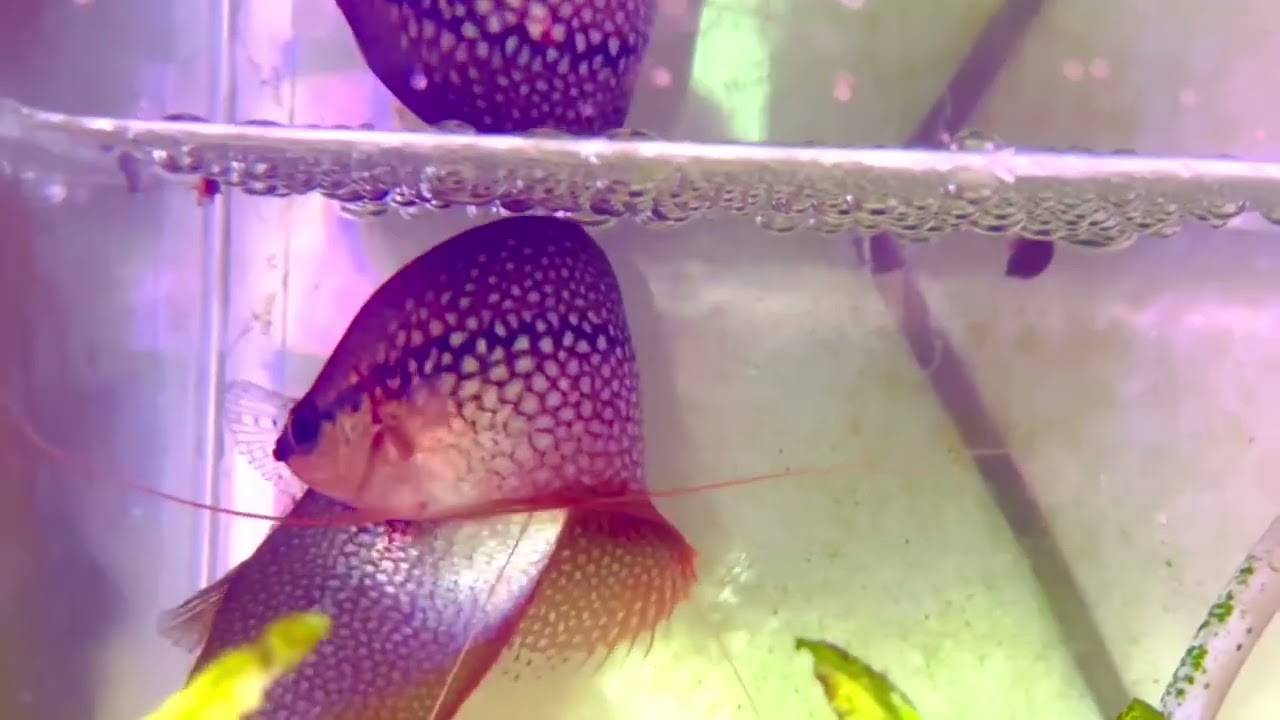
The foam nest and the eggs
The foam nest itself was about the same size as the piece of polystyrene in the tank: roughly 15 by 15 centimeters. The male used only foam for construction, without adding plant material. In total I estimate that between 500 and 600 eggs were laid. Remarkably, they were all fertilized: I did not find any white or moldy eggs.
Hatching and raising the fry
The eggs hatched fairly quickly: within one and a half days after spawning the first little dots appeared at the water surface. The larvae remained motionless for the first days, just below the foam nest. Only after three to four days did they start to swim freely cautiously.
Because I thought the male occasionally ate fry, I removed him, perhaps somewhat unjustly. Normally I leave the male with the nest until that point, but this time I did not want to take any risks. From that moment the full care for the fry was up to me.
First feeding
As soon as the fry began free swimming, I started feeding immediately. I always keep a culture of paramecium (infusoria) ready for moments like this. From day one I fed a generous amount twice a day. The advantage of paramecium is that you can’t really give too much: the fry continuously eat small bits, so overfeeding is not a problem.
In addition to feeding, I gently switched the sponge filter back on. This created a slight water circulation without endangering the fry. This helped keep the water clear and healthy.

Transition to other food
The fry were still very small when they started free swimming, about 2 millimeters. So they really needed microscopically small food in the first days. After a week I started occasionally offering very fine powdered food and small amounts of newly hatched artemia. Although most could not use that at first, there is always a brave individual that switches early. After one to two weeks the majority of the group really switched from paramecium to artemia, which was immediately visible in their growth rate.
Rearing and further care
Once the fry passed the first vulnerable phase and took artemia well, I noticed the chance of problems became minimal. From that point care mainly consisted of frequent feeding and maintaining stable water quality.
Water quality and care
In my aquarium room all tanks are connected to an automatic water change system. This makes it possible to change small amounts of water daily without disturbing the fry too much. The fresh water contributes to consistent water quality, which is essential for the rapid growth of young Pearl Gouramis.
Feeding and growth phase
Once the fry had fully switched to artemia, I fed them at least three times a day. The rich diet ensured steady growth and after four to six weeks they reached a length of about one centimeter. In this phase I slowly introduced some dry food so they could get used to other food types. Sex differentiation, however, only became apparent much later, almost at maturity.
Moving to larger tanks
As the group grew they needed more space. I therefore transferred the fry to a larger aquarium of one hundred centimeters where they could continue to grow. The entire group of an estimated five hundred fry developed remarkably evenly: there were no major differences in growth or survival.

Result and distribution
When the fish were large enough, I sold the entire group. That completed this breeding successfully: about 500 healthy young Diamond Gouramis, without noteworthy losses or problems along the way. For me this project was successful and it was time to look for the next challenge.
Tips and personal reflection
According to my experience, successfully breeding Trichopodus leeri mainly requires patience and preparation. I usually buy my fish as young adults and then spend months conditioning them well. During that period I do nothing but feed them liberally with live food and let them get used to my water and care routine. Only when the fish are adult, healthy and well fed do I start the actual breeding attempt.
Importance of food and infusoria
An important lesson reaffirmed during this breeding is that you cannot start without a reliable food source for the young fry. Infusoria, and in my case especially paramecium, are indispensable. From the moment the fry free swim I fed a generous dose of paramecium twice a day. That is safe, because you really cannot overfeed. Dry powdered food can be a supplement, but the risk of losses is considerably greater. After a week or two most fry switch to artemia, which significantly accelerates their growth. In my experience it is hardly possible to raise Leerii fry without these two foods.

Patience and timing
Another tip is to separate male and female for a few weeks before bringing them together. This increases the chances that the female is well filled with eggs and ready for mating. I have noticed that trying too early often leads to failed attempts, where the male may become aggressive and repel the female. In hindsight I would have waited even longer to spawn until the female’s belly was clearly full of eggs.
Most beautiful moment and lessons learned
For me personally the most beautiful moment during this breeding was seeing the first fry. Because this was the pair’s first nest, I initially doubted whether the eggs would be fertilized. When the little dots appeared at the surface, that was a special reward for the previous attempts and the time I had invested.
Comparison with other species
Although I had to try three times before it worked, I ultimately find the Pearl Gourami a reasonably accessible species to breed. Compared to some tetras or dwarf pufferfish, Leerii are clearly easier. It does require perseverance and the right preparation, but the chance of success is high if you follow the basic rules. For comparison: breeding cardinal tetras cost me more than twenty attempts and a year and a half of experimenting before I found a stable method. Now that works very well, with more than a thousand fry per breeding. The Leerii on the other hand produced about five hundred fry in this attempt.
Copyright photos
John de Lange

Ik ben Frank en al jarenlang gepassioneerd bezig met het kweken van aquariumvissen. Het liefst stort ik me op de wat uitdagendere soorten – het geeft me een kick als het na veel proberen uiteindelijk lukt. Door de jaren heen heb ik meer dan 50 verschillende soorten succesvol gekweekt. Recent werkte ik onder andere aan projecten met de Red Muzel Tetra, Boraras brigittae, bijtjes en natuurlijk de Trichopodus leeri. Mijn ervaringen deel ik graag, zodat andere liefhebbers er ook van kunnen leren.


