Breeding report Labidochromis caeruleus (Yellow)
Introduction
Since my youth I have been passionately involved in the aquarium hobby. As the son of a renowned breeder of Pterophyllum scalare (angelfish) I was practically raised with fish breeding from an early age. Over the years I have gained experience with numerous fish species from different parts of the world, but one of the most fascinating groups for me has always been the cichlids from Lake Malawi.
Within this group the Labidochromis caeruleus, commonly called the “Yellow Lab”, has especially drawn my attention. This fish is known for its vivid yellow color, friendly character and relative ease of breeding. This accessibility makes the species popular among both beginner and advanced aquarists. At the same time it is a species I worry about: in the commercial aquarium world the original color and morphological purity have often been lost due to selective breeding and crossbreeding. My personal motivation to breed this species was therefore clear: to preserve and reinforce the natural characteristics of Labidochromis caeruleus.
In this report I will take you step by step through the process of successfully breeding this beautiful species. From setting up the aquarium to caring for the fry — all based on personal experience, with practical tips I have gained from years of dedication to this fascinating hobby.
Natural Habitat and Behavior
The Labidochromis caeruleus originates from Lake Malawi in East Africa, one of the largest and most impressive freshwater lakes in the world. This lake is known for its incredible biodiversity, especially among cichlids. The Yellow Lab is mainly found in the rocky coastal areas, where it seeks shelter among crevices and overhanging stones.
The water in Lake Malawi is crystal clear, mineral-rich and has a relatively high alkalinity. The conditions are stable: the water is hard, with a pH that typically ranges between 7.8 and 8.5. Temperatures usually fluctuate between 24 and 28°C. In this environment Labidochromis species are adapted to life among the rocks, where they search for food and hide from predators.
Behavior plays a large role in their daily life and in the breeding process. Despite their bright color they are relatively peaceful cichlids, especially compared to many other Malawi species. During courtship the male displays more intense colors. He often selects a spot in the sand where the eggs will be deposited.
Another typical behavior relevant to breeding is their method of brooding. Labidochromis caeruleus is a mouthbrooder: after fertilization the female takes the fertilized eggs into her mouth, where they hatch and grow until the fry can swim independently. During this period the female often eats little or not at all, thereby protecting her offspring.
Understanding these natural behaviors is essential for successful breeding. By mimicking the right environment and carefully observing their behavior, you not only increase the chances of successful reproduction, but also contribute to the welfare and natural expression of this beautiful fish.
Aquarium Setup and Water Parameters
To keep and breed Labidochromis caeruleus successfully it is essential to replicate their natural environment as closely as possible. These fish feel most comfortable in an aquarium that offers stability, hiding places and sufficient swimming space. For my breeding I used an aquarium one meter in length, set up with sand as substrate and a substantial amount of rockwork.
Sand is not a random choice. Unlike coarse gravel, which can be sharp and unsuitable for sand-sifting species, sand allows the fish to show their natural behavior without damaging gills or mouth. A fine sand substrate also contributes to a natural-looking layout and helps with egg deposition, which often occurs on or near the sand.
The rock structure in the aquarium is both functional and aesthetic. The stones created numerous hiding places, resting spots and territories for the fish. That is important: although the Yellow Lab is a relatively peaceful Malawi cichlid, tensions arise during courtship and brooding, especially between the male and females or between rival males. A well-built rock formation prevents stress and injuries by allowing fish to retreat quickly.
As for plants I chose Anubias, one of the few plants resistant to the digging behavior and water hardness typical of a Malawi setup. The sturdy leaves of this plant are usually left alone and can grow well on rocks or wood without rooting in the substrate.
Regarding water parameters I used the following settings:
- Temperature: 25–26°C
- pH: 7.5–8.0
- KH (carbonate hardness): 7
- GH (total hardness): high, corresponding to tap water from areas with calcareous substrate
For filtration I used an external canister filter, mainly because of the higher capacity and the fact that these filters are less visible in the aquarium. This contributes to a natural appearance and stable water quality. The combination of a centrally heated room, weekly water changes (about one third), and a well-running filtration system provided optimal conditions in which the fish quickly felt at ease.
I do not add bacterial cultures or startup additives. Instead I introduce the first fish into the aquarium after 24 hours. This accelerates the development of a natural bacterial culture fed by the fish waste. By gradually building up the fish stock — adding a few new inhabitants every two days — a stable ecosystem is formed, without nitrite spikes or dependence on artificial products.
This approach may deviate from common startup advice, but it has proven effective for me for years in practice — also in the successful rearing of Labidochromis caeruleus.
Feeding and Preparation for Breeding
Healthy nutrition forms the basis of any successful breeding. For Labidochromis caeruleus this is no different. Nutrition plays a crucial role for both the welfare of the adult fish and the development of the offspring — before, during and after the breeding process.
In the lead-up to breeding I give the adult fish a varied diet. They receive a combination of high-quality flake food and live or frozen food, including red mosquito larvae, daphnia and occasional fresh Artemia. This variation provides sufficient nutrients, stimulates natural behavior and keeps the fish in top condition. Live food in particular appears to increase the drive to reproduce; it mimics the situation in the wild where peaks in food availability during the rainy season act as a natural trigger for spawning.
I adjust the diet during this period by feeding more frequently, in smaller portions and with greater variety. This promotes egg production in the female and increases the vitality of the male, which becomes more active in his courtship behavior. A strong, colorful male attracts the female’s attention, and she will only pair if she is in good condition.
Once the female has taken the eggs into her mouth, I still feed her — but cautiously. Some mouthbrooding females stop eating entirely during this period, others take an occasional small bite. Therefore I offer easily digestible food, such as fine powdered food or Artemia nauplii, in very small amounts. It is important not to overburden her; overfeeding can harm water quality, while underfeeding weakens the mother.
After placing the female in a separate breeding tank she remains there for about 2.5 weeks, until the fry begin to swim around. During that time I feed her carefully and ensure a calm environment. After releasing the fry she stays with them for three days, after which I separate her again to recover. During that period I feed her generously so she can regain strength for a possible next breeding round.
I start feeding the fry immediately with fresh Artemia nauplii and fine powdered food. This energy-rich food is perfectly matched to the needs of young fish. As they grow, the diet is gradually expanded with crushed flakes, frozen food and live food — all depending on the size of the fry. This careful nutritional development ensures the fry grow strong and fast, with a healthy build and color.
In short: nutrition is not a side issue but an indispensable link in the entire breeding process. By feeding with care and attention you lay the foundation for healthy parents and strong offspring.
Breeding Process and Brood Care
The reproduction of Labidochromis caeruleus proceeds in a fascinating and relatively straightforward manner — especially for those familiar with the behavior of mouthbrooding cichlids. Still, there are subtle signals and important actions that make the difference between a successful and a failed breeding.
Courtship and Pair Formation
The breeding process begins with the male’s courtship behavior. This behavior is easy to recognize: he displays conspicuously with intensified colors, increased activity and by excavating or cleaning a spot among the stones on the sand. This spot functions as the breeding site and must attract the female’s interest.
When the female is ready to spawn she approaches the male and a circular dance follows. The female lays one or several eggs on the cleaned spot, after which the male immediately swims over them to fertilize them. Immediately afterwards the female takes the fertilized eggs into her mouth. This action is repeated several times until all eggs are laid and collected. An average clutch consists of about 10 to 30 eggs, depending on the age and health of the female.
Mouthbrooding and Separation
After spawning I usually catch the female within a day and place her in a separate breeding tank. This provides peace, prevents stress from persistent males and protects her from possible aggression or curious tankmates. Mouthbrooding is an exhausting period during which the female withdraws completely. In this phase she eats hardly or not at all and must conserve her energy to care for the eggs properly.
During brooding the eggs are constantly rolled in her mouth, which improves oxygen supply and prevents fungal growth. This intensive care lasts about 2.5 weeks. Near the end of this period the fry become visible in the mouth — small fish with a yolk sac, which shortly thereafter begin to swim independently.
Release and Aftercare
When the fry are freely swimming the female releases them. She stays close to her brood for the first few days and may occasionally take them back into her mouth if danger threatens. After about three days I remove the female. By placing her separately in a quiet tank she can recover and regain strength for another round. Good nutrition during this period is important for her recovery.
The young fish remain in the breeding tank and are fed several times a day: fresh Artemia nauplii, powdered food and, after some time, finely crushed flakes. The first weeks are crucial. Regular feeding and a clean, stable environment contribute to low mortality and rapid growth.
Once the fry are about 2 centimeters long, I move them to a grow-out tank of 1.20 meters. Here they have more space to grow and further develop into adult fish. At a length of 5 to 6 centimeters — typically after 2.5 months — they are strong enough to be sold or rehomed.
Raising and Growth of the Fry
Raising young Labidochromis caeruleus is a process that requires precision, regularity and patience. Although this species is known as relatively easy to breed, long-term success strongly depends on the care given to the fry in the first weeks and months of their lives.
Early life stage
As soon as the mother releases the fry they are already noticeably independent. They swim freely, have largely absorbed the yolk sac and almost immediately begin searching for food. This is the moment when a good starter diet is essential. In the first days I feed the fry several times a day with fresh Artemia nauplii and fine powdered food. Artemia not only provides the necessary proteins but also stimulates the hunting instinct and keeps the fry active.
Good water quality is now crucial. Because a lot of feeding occurs and the fry are sensitive to poor water conditions, I change one third of the water weekly. An air-driven sponge filter provides sufficient oxygen and a gentle flow, without pulling the fry or stressing them.
Transition to other food
After about two weeks, when the fry have grown and become more active, I begin gradually introducing other food. Crushed flake food is slowly introduced, alternated with frozen foods such as finely chopped red mosquito larvae or cyclops. I watch carefully to see whether all fry are eating; differences in size and feeding behavior can already become visible at this stage. If necessary I separate the largest fry to reduce competition with the smaller ones.
Growth and relocation
Around 2 centimeters the young fish are strong enough to be transferred to a larger grow-out tank of 1.20 meters. This transition gives them more swimming space, promotes muscle development and reduces stress from lack of space. At this stage they become somewhat more robust, but it remains important to feed consistently and perform weekly water changes.
Growth proceeds well with this setup. With a good feeding schedule, sufficient space and stable water values the fry usually reach a length of 5 to 6 centimeters within 2.5 months. That is the moment when they can be sold or placed into a larger rearing group. With this approach I achieved a high survival rate and produced quality strong fish — an important reason why my rearing was once popular with specialty stores.
Observation and selection
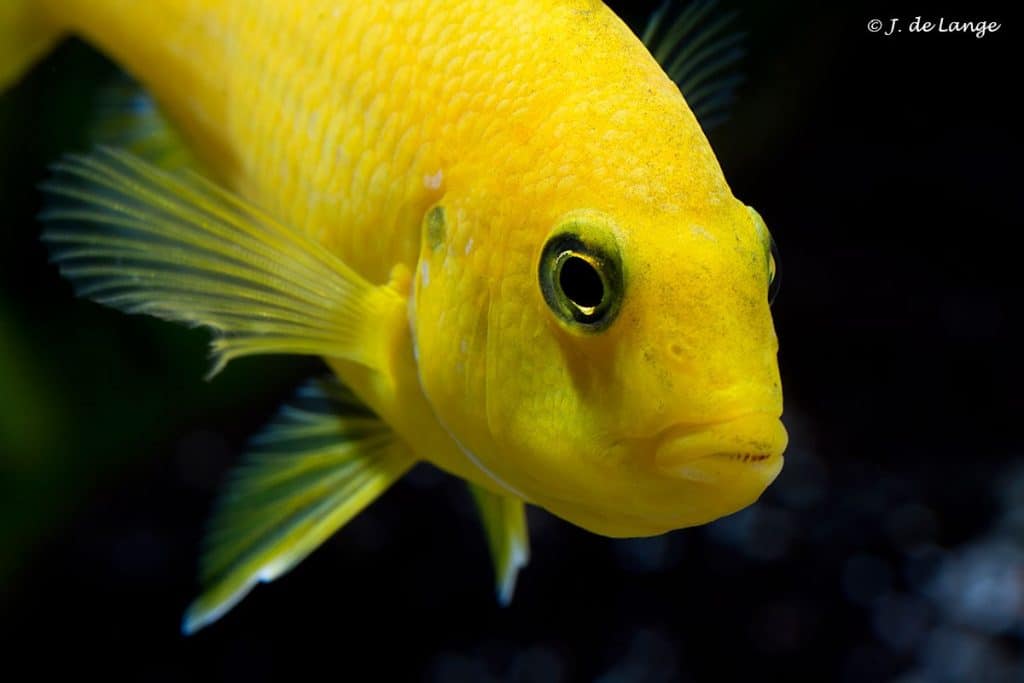
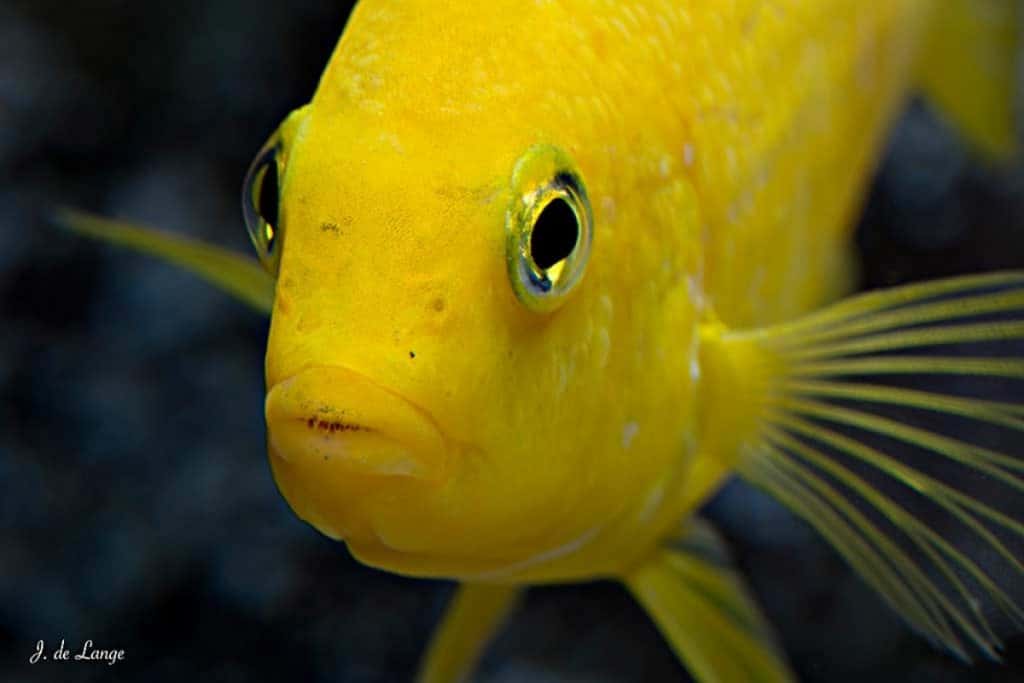
During raising I also closely monitor the appearance of the fish. Labidochromis caeruleus is unfortunately known for the huge variation in color purity as a result of generations of inbreeding. I select the fry for a deep, even yellow color without a washed-out haze or black spots in unwanted places. I keep only the strongest and most attractive specimens for my own stock or sale, in order to keep my line as pure as possible.
Results and Experiences
Breeding Labidochromis caeruleus in natural color form has always been for me a combination of passion, discipline and a clear mission. The final result of this specific breeding round confirmed once again that it is possible to preserve quality and color purity, provided you select deliberately and work patiently.
Yield and survival
From the original clutch ultimately more than 90% of the fry reached adulthood. I attribute this high survival rate to a good starter diet, consistent water changes and timely separation of mother and fry. By giving the fry sufficient space in a separate grow-out tank and feeding them a varied diet they were able to develop quickly and strongly.
After 2.5 months most fish had reached a length of 5 to 6 centimeters, which is the ideal size to transfer them to a new owner or shop. In total I kept dozens of healthy fry that in both behavior and color matched my goal: preserving the original characteristics of this species.
Experiences and personal view
What struck me most in this process was how strongly genetics are reflected in color and form. Despite careful selection of the parent fish I still observed slight deviations in some fry: a paler yellow color, a black edge that extends too far, or a slightly different body shape. This confirms my suspicion that even apparently “pure” parent fish often have many generations of breeding behind them.
This experience underlined my conviction that breeding in the hobby carries a responsibility. Too often striking color forms or crossbreeds are chosen purely for sales. My aim was instead to return to the natural beauty of this species: a deep yellow fish with a compact build and characteristic behavior.
The most enjoyable part of the breeding process for me was observing the behavior of the mother and fry. The moment when a female after weeks of brooding cautiously releases her fry and within a few hours you see dozens of miniature versions scurrying about remains magical. It is a small miracle that takes place underwater, and it never fails to fill me with the same wonder as when I saw my first brood grow up as a child.
In conclusion
Although I am now less active in Malawi breeding, this species remains for me a symbolic example of how a popular aquarium fish can be both promising and vulnerable. With patience, knowledge and respect for the original form we as hobbyists can contribute to the preservation of genetically strong and pure lines. And that, I believe, is what keeping aquaria should be about.