
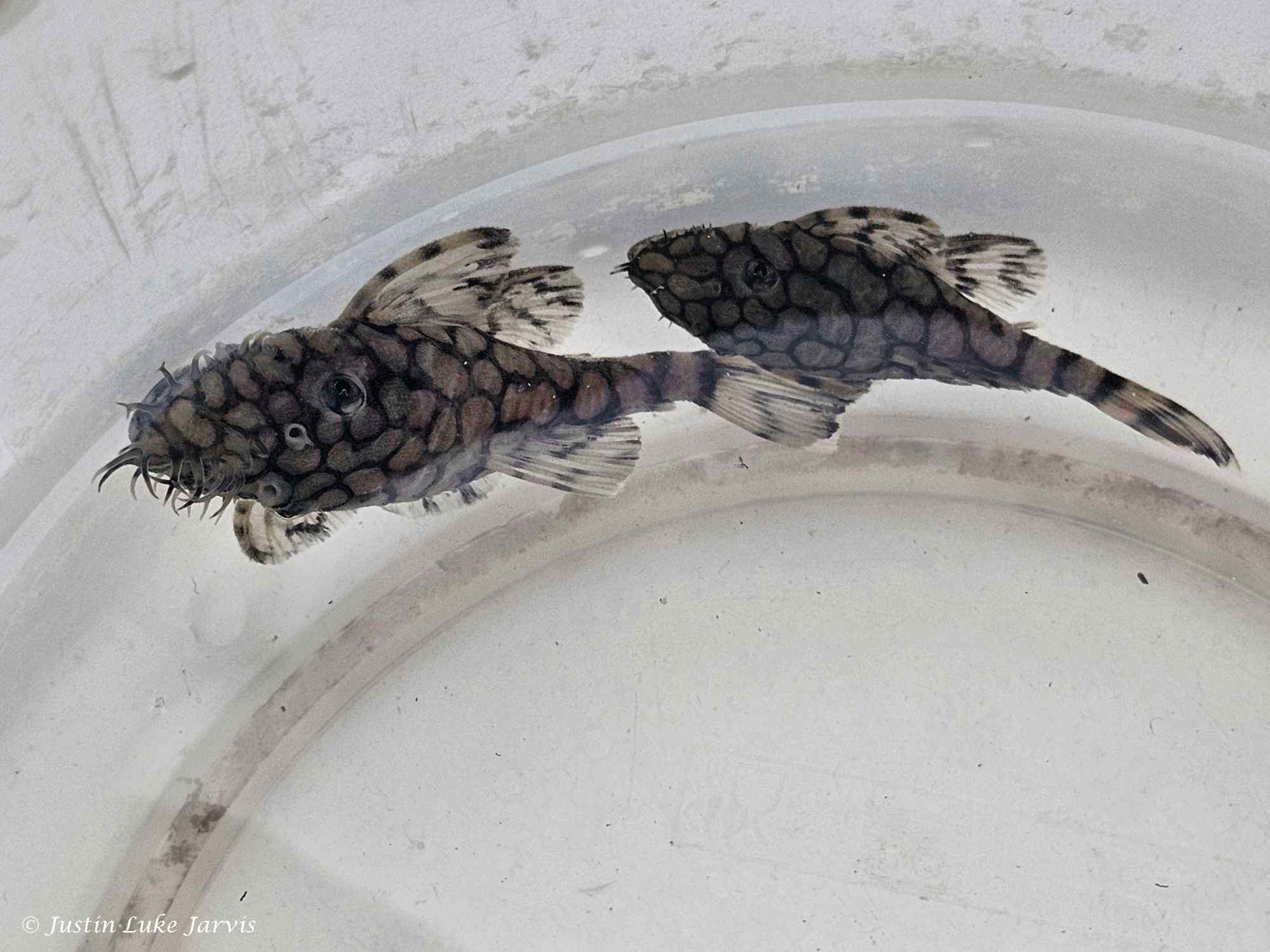
Breeding Report – Ancistrus sp. “L519 Kiefner”
I’ve been breeding Ancistrus sp. “L519 Kiefner” for a few months now, and I’ve had two successful spawns from my single pair, one male and one female, both F1s. In this report, I’ll walk you through my setup, the way I care for them, and how I’ve managed to breed and raise their fry without needing fancy equipment or testing every water parameter.
Natural Behavior and Origin
From what I understand, this species comes from the Rio Guaporé (Rio Itenez in Spanich) region in Brazil. They’re used to warm, clean, fast-flowing water with rocks and crevices where they can hide and breed. I’ve found that in the aquarium, they behave very similarly to other Ancistrus. The male is territorial over his cave, and when the female is ready to breed, she’ll push her way in and the process begins.

My Aquarium Setup
The breeding tank is 1.5 feet long and 1 foot wide. I keep it really simple; bare glass bottom, one small aquarium plant, and five pleco caves. That’s it. I use a regular filter and a small air pump with an airstone to keep the water oxygenated. The water temperature stays between 27 and 28°C (around 80–82°F) with the help of a heater.
For water changes, I do two buckets per week. I don’t measure how many liters that is exactly, but it seems to keep the water clean enough. I replace the filter media about every four weeks. I don’t test for pH, GH, KH, or TDS. I just use tap water treated with tap-safe, and I keep things consistent.
Lighting is basic: just a standard white aquarium light.
Feeding Adults and Fry
I feed the adults once a day with a high-protein food, and I add a little bit of spirulina now and then. I don’t change their diet to try and trigger breeding. Just regular feeding and clean water seems to be enough.
For the fry, I use crushed spirulina flakes as their first food. I feed them daily, and when they reach about 1 inch in length, I start introducing other foods.

Breeding Behavior
They tend to spawn about every 3 to 4 weeks. I can tell when the female is ready. She becomes more active and starts checking out the caves. She’ll push her way into the back of the male’s cave, and he’ll trap her there for a day or two.
Once she lays the eggs, he pushes her out and takes over. He stays in the cave with the eggs, fanning them and guarding them. Sometimes, though, he kicks the eggs out. If that happens, I collect them and move them to an egg tumbler.
The eggs usually start hatching after about 6 to 7 days.

Raising the Fry
Once the fry are free-swimming, I move them into a breeding box to give them some space and keep them safe. After that, I transfer them to a grow-out tank that’s 2 feet by 1 foot. I keep that tank simple too—same kind of caves for hiding, a sponge filter, a heater, and a few plants.
The fry grow slowly, but as long as I feed them every day, they do well. Depending on the spawn, I’ve had between 20 and 30 fry survive. It mostly depends on how many eggs were laid and how well the male looked after them at first.

Challenges and Tips
The only real issue I’ve run into is when the male kicks out the eggs early. When that happens, using an egg tumbler is the best way to save them. Other than that, I haven’t had big problems—no egg-eating or aggression.
Sexing them is pretty easy. The males have a lot of bristles on their nose, while the females have just a few.
Final Thoughts
I try to keep things as simple as possible—clean water, regular feeding, and a basic setup. I don’t test the water, and I don’t use any fancy gear. Just caves, clean conditions, and consistency. That’s worked for me, and I hope this helps others who are thinking about breeding L519s.


