Neolamprologus buescheri
Neolamprologus buescheri was first described by Staeck in 1983. The name Lamprologus buescheri is used as a synonym. The name buescheri refers to the discoverer of the species, Hans Büscher.
They inhabit the southern part of Lake Tanganyika.
Description
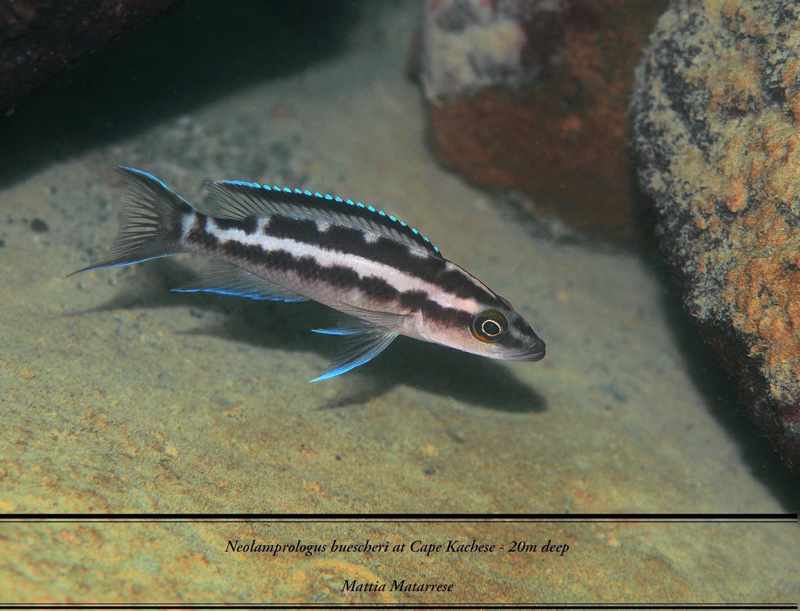
Due to local variations, the pattern may differ slightly from location to location. Basically, the Neolamprologus buescheri has a light base color with dark brown spots. In local variants, the brown may predominate, causing the white of the body to be reduced to just a few spots.
The dorsal, ventral, caudal, and anal fins are transparent, the edges of the fins are edged with a black band, and the tips of the fins have an iridescent blue color. There is a yellow band above and below the eye.
The shape of the Neolamprologus buescheri is elongated, like a torpedo. Their shape allows them to easily hide in the crevices and cracks between rocks. A small hole is enough for them to retreat between the rocks.
The males can reach a length of about 8 centimeters. The females of the Neolamprologus buescheri remain somewhat smaller. The difference between the sexes can only be seen with certainty by the difference in the genital papilla.

Biotope
The natural habitat of Neolamprologus buescheri consists of rubble. They live in the southern part of Lake Tanganyika between the rocks and rock faces. They can be found at a depth of 15 to 50 meters; they only inhabit the southern part of the lake between Mobo in Congo and Samazi in Tanzania.
Diet
In the wild, Neolamprologus buescheri feeds mainly on small invertebrates. In the aquarium, they will often eat any food offered. If they do not start eating immediately, offer them live food and slowly transition them to a combination of live and dry food.
The Aquarium
A pair of Neolamprologus buescheri can be kept in an aquarium measuring at least 80 centimeters in length. If the aquarium is large enough, you can keep several females. Because the males are very territorial, a very large aquarium is needed to keep two males. Think of a length of at least 250 centimeters.
The most important thing when setting up the aquarium is the use of rocks. Make sure there are plenty of crevices and cracks between the rocks where the Neolamprologus buescheri can hide. In a Tanganyika aquarium, it is common to use sand on the bottom.
Be careful when combining them with other species. They are very aggressive towards other Neolamprologus species. It may be better to combine them with species that do not seek out the same places among the rocks.
Breeding aquarium and conditioning
A special breeding aquarium is not immediately necessary for Neolamprologus buescheri. In an aquarium with multiple species, the female will claim and protect her own cave. It is not uncommon for one male to have multiple nests with different females.
A high pH of around 8.5 gives better breeding results. They are fairly productive animals, and no special measures are required in terms of food or water changes.
You will not often see the eggs being laid. Because the eggs are laid in their cave, the entire ritual of courtship and laying actually takes place in secret.

The Spawn
The eggs are laid in a burrow against a wall or the roof and fertilized. Sometimes a modest clutch of 3 to 10 eggs is laid every two weeks, sometimes a clutch of up to 70 eggs every five weeks. The eggs hatch after about two days. The male guards the area around the burrow, while the female stays closer to the eggs.
Raising the fry
The young feed on their egg yolk for the first few days. About 10 days after hatching, they can swim freely. In the vicinity of their cave, you can see them feeding on algae and small floating particles. This is often the first time you see that the pair has a nest.
The female guards the young. The male usually does not interfere with the young other than seeing them as a snack. Sometimes he leaves them alone until they are about 1.5 centimeters long and then hunts them down. If you want to keep the young, it is important to catch them before that time.
After hatching, the young can be fed with freshly hatched artemia or micro worms.
Conclusion
De Neolamprologus buescheri is een leuke rotsbewonende Tanganyika cichlide. Door zijn agressieve gedrag is het aan te raden om slechts 1 man en een vrouw (of meerdere vrouwen bij een groter aquarium) te houden.
Video

Author

Since I bought my first second-hand aquarium when I was twelve, I have always had one or more aquariums. I even converted a garage into a breeding room where I had 50 aquariums containing around 10,000 liters of water. At the moment, I have two aquariums: a 1,250-liter Tanganyika aquarium and a 250-liter community aquarium with plants. For the past 10 years, I have been working on this website as a writer and photographer.
Copyright images
Sue – Suephoto.com (Original website no longer online)
Mattia Matarrese
Evert van Ammelrooy