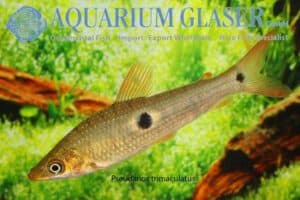
Leporinus desmotes
Leporinus desmoteswas first described scientifically by Fowler in 1914. The species has not (yet) received a common name.
The species name Leporinus desmotes Fowler 1914 has an interesting etymology. The genus Leporinus is derived from the Latin word “lepus, leporis,” meaning “hare.” This probably refers to the elongated incisors of species such as Leporinus novemfasciatus (now L. fasciatus), which are reminiscent of the teeth of lagomorphs.
The species name desmotes (Gr. δεσμώτης) means “prisoner.” This name was chosen because of the multiple dark transverse bands on the fish’s body, which are “reminiscent of prison clothing,” or the striped uniforms worn by American prisoners in the 19th and early 20th centuries.
Description
Leporinus desmotes is a species of fish with a striking appearance and lively behavior, making it an interesting inhabitant of a spacious aquarium.
Appearance
Leporinus desmotes has a streamlined and elongated body, which is slightly flattened at the sides. The body shape is described as spindle-shaped (fusiform), meaning that the body tapers at both ends, similar to a torpedo. The deepest and widest point of the body is at the attachment of the dorsal fin. The head is conical in shape, slightly flattened at the top and more so at the bottom, with a rounded snout tip.
In terms of size, Leporinus desmotes is generally considered a medium-sized fish. In the wild, it can reach about 15 to 18 centimeters in length (total length). However, in an aquarium with too much and too vigorous feeding, they can reach a size of about 22 centimeters. So make sure not to overfeed!
The basic body color is usually gray-green, with black spots scattered throughout the body. The fins are remarkably bright yellow in color. In addition to this general description, Leporinus desmotes is also known for its distinctive pattern of dark vertical bars. This species belongs to a group of Leporinus fishes that, as adults, possess nine dark vertical bars on the head and body. Some of these bars may split at the top or bottom, and the fifth bar often continues on the dorsal and ventral fins. The lips are generally yellow, with a dark border at the upper lip and black spots on both sides of the upper lip.
The teeth of Leporinus desmotes are also a remarkable feature; the upper teeth are angled forward, while the lower teeth protrude almost horizontally, with the teeth in the middle of the lower jaw forming an elongated, laterally flattened “tusk” that fits under the upper teeth. This is where the genus name “Leporinus” (hare-like) comes from.
Behavior and temperament
Leporinus desmotes is a very active fish known for its lively behavior. They can swim fast and have even been observed jumping out of the water, especially when they are looking for food or during reproduction.
These fish are naturally gregarious, meaning they are social and tend to live in large groups or dense schools. This group behavior is important for their well-being. Although their behavior is described as “pleasant,” it is important to note that Leporinus desmotes can be aggressive toward other fish species, especially smaller specimens. Therefore, they should be kept with fish of similar or larger sizes to avoid conflicts. They actively swim through the middle and upper water layers of the aquarium.
Biotope
This species of fish is native to various parts of South America. They are mainly found in the countries of Guyana and in the broader region of the Amazon Specifically, they inhabit the rivers and lakes of the Amazon and Rio Paraná basin.
Water type and habitat
Leporinus desmotes is a typical inhabitant of both rivers and lakes in its natural range. This means they adapt to different flow conditions, from slow-flowing lakes to faster-moving river sections.
Climate and seasonal influences
Leporinus desmotes lives in a tropical climate, evidenced by the recommended water temperature of 21-27 °C for aquarium housing. This type of climate is characterized by relatively constant high temperatures throughout the year.
Diet
Leporinus desmotes is een vissoort met een gevarieerd dieet, wat hem tot een omnivoor maakt. Dit betekent dat hij zowel plantaardig als dierlijk materiaal consumeert.
Dieet in het wild: In zijn natuurlijke habitat in de rivieren en meren van Zuid-Amerika voedt de Leporinus desmotes zich voornamelijk met een combinatie van waterplanten, micro-organismen en insecten. Deze brede voedselkeuze stelt hem in staat om te profiteren van verschillende voedselbronnen die in zijn leefgebied beschikbaar zijn. Het is echter belangrijk op te merken dat Leporinus desmotes ook kleine vissen kan eten als hij deze in zijn omgeving aantreft Dit onderstreept zijn opportunistische aard en zijn rol als een actieve jager in zijn ecosysteem.
Voeding in het aquarium: Gezien zijn omnivore aard en zijn neiging om planten te eten in het wild, is het belangrijk om Leporinus desmotes in het aquarium een gevarieerd en uitgebalanceerd dieet aan te bieden. Ze staan erom bekend dat ze aquariumplanten eten. Dit betekent dat als je levende planten in het aquarium wilt houden, je soorten moet kiezen die robuust genoeg zijn om de knabbelneigingen van deze vis te weerstaan, of dat je voldoende plantaardig voedsel aanbiedt om hun aandacht af te leiden.
A suitable diet in the aquarium includes:
- High quality flakes or pellets: These form the basis of the diet and should be specially formulated for omnivorous fish.
- Plant foods: This is of great importance. Consider algae wafers, spirulina flakes, blanched vegetables such as spinach, zucchini, peas or broccoli.
- Meaty foods: Live or frozen foods such as mosquito larvae, artemia, daphnia, and small pieces of fish or shrimp can be given as supplements. This provides protein requirements and stimulates their natural hunting instinct.
It is advisable to feed small portions several times a day rather than one large meal, to promote digestion and minimize water pollution. A varied diet will contribute to the health, vitality and beautiful colors of Leporinus desmotes in your aquarium.
The Aquarium
Creating a suitable habitat for the Leporinus desmotes requires attention to detail, taking into account its natural behavior and needs.
Aquarium size
Leporinus desmotes is an active fish that can normally reach an adult length of about 15 to 18 centimeters in an aquarium. Given its size and lively behavior, where it swims quickly and can even jump out of the water, this fish requires considerable swimming space. Based on its adult size and active nature, a spacious aquarium at least 150 centimeters in length is recommended for a small group. Because it is a gregarious animal that tends to live in large groups or dense schools, keeping a minimum of 6 or 7 specimens is recommended. To keep a larger group, an even larger aquarium is necessary to provide adequate space and minimize aggression.
The Aquarium
Aquarium setup should mimic the natural habitat of Leporinus desmotes while meeting its specific needs. The fish needs a well planted aquarium with sufficient swimming space and hiding places.
- Plants: Although Leporinus desmotes eats aquatic plants in the wild, plants in the aquarium are important for hiding places and a natural look. Choose very sturdy plants and roots that resist nibbling, such as Anubias, Java fern or other sturdy species that can be attached to wood or rocks. Be sure to leave plenty of open swimming space, especially in the middle and upper water layers, where these fish are active.
- Wood and rocks: Drift and drift wood, as well as smooth rocks, can be used to create hiding places and mimic the natural environment. These elements also contribute to the structure of the aquarium and can help delineate territories, should the need arise.
- Substrate: A bottom consisting of sand or gravel is suitable for this species. Make sure the gravel is not too sharp to avoid possible injuries when the fish scour the bottom.
Water parameters
For optimal health of Leporinus desmotes in the aquarium, stable water values are very important. This fish thrives best in tropical freshwater with a temperature between 21°C and 27°C, a pH of 6.5 to 7.0, and a water hardness (dH) between 5 and 18. Regular water changes and good filtration are essential to maintain water quality.
Suitable tankmates
Leporinus desmotes is a gregarious animal that lives in groups and exhibits pleasant behavior. However, it is important to note that this fish can be aggressive towards other fish species, especially the smaller ones. Therefore, Leporinus desmotes should be kept with fish of similar or larger sizes.
Suitable co-inhabitants are usually other robust, medium to large South American cichlids, large catfish, or other active, non-aggressive characids of similar size. Avoid small, peaceful fish that may be seen as prey
Breeding Leporinus desmotes
About breeding Leporinus desmotes in the aquarium not much is known.
Particularities
- One of the most striking peculiarities of Leporinus desmotes is its unique tooth structure. In 1914, Fowler proposed classifying L. desmotes as the type of a new subgenus called Myocharax specifically because of this unusual tooth morphology. The upper teeth of this fish are angled forward, while the lower teeth protrude almost horizontally. The teeth in the middle of the lower jaw form an elongated, laterally flattened “tusk” that fits exactly under the upper teeth. This is a highly specialized adaptation, probably related to its diet and the way it gathers food.
- In addition, Leporinus desmotes is part of a complex of closely related species known as the Leporinus desmotes species complex. Recent research has even led to the description of two new species within this complex, and research is ongoing to determine the taxonomic status of other populations, such as Amazonian Leporinus jatuncochi, which may be a synonym of L. desmotes or a separate species. This means that the diversity within this group is greater than previously thought and that there may be additional undiscovered species.
- An interesting feature of the Leporinus desmotes is the presence of an unusual variation in the number of scales around the tail root. Some specimens have 14 scales, while others have 16, and even one specimen with 15 scales has been observed . This anomaly may indicate the presence of two different species within what is now called Leporinus desmotes, or it is a unique characteristic of the species itself. This phenomenon underscores the complexity of species identification and the ongoing evolution within this fish group.
Video

Author

Since I bought my first second-hand aquarium when I was twelve, I have always had one or more aquariums. I even converted a garage into a breeding room where I had 50 aquariums containing around 10,000 liters of water. At the moment, I have two aquariums: a 1,250-liter Tanganyika aquarium and a 250-liter community aquarium with plants. For the past 10 years, I have been working on this website as a writer and photographer.
Copyright image