


Gramma loreto – Fairy Basslet
The Fairy Basslet or Gramma loreto belongs to the Grammatidae family. These deep-water fish originate from the Western Atlantic Ocean and the Caribbean Sea. They inhabit steep reef slopes at depths between 5 and 75 meters. When they feel threatened, they instinctively seek shelter in the reef for protection. It is not uncommon to see them swimming upside down when they feel completely at ease in their environment. They are active during the day and retreat into the reef at dusk.
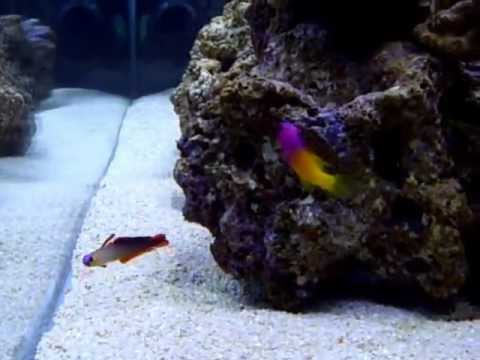
The Fairy Basslet has a slender torpedo-like body. Their bright tricolor palette makes them a popular species among saltwater aquarists. These fish have a regal purple front body that fades into a reddish band halfway down the body. The rear and tail fin are bright yellow. This is one of the smaller species, reaching a mature length of about 10 centimeters. On average, they live for 3 to 5 years. The Gramma loreto is also called the Royal Gramma because of its royal purple color.
The Aquarium
This species is considered easy to moderately difficult to keep. They are perfect for the amateur aquarist. This is a docile to timid species and should not be kept with larger or aggressive species. They inhabit the middle to lower part of the aquarium and need plenty of hiding places. A lack of hiding places can cause them to become territorial with regard to their favorite hiding place. They are not considered territorial towards other species. However, they do display territorial behavior towards other grammas. Therefore, keep only one species of gramma per aquarium unless the aquarium is large enough to set territorial boundaries. They are good candidates for reef aquariums but tend to view smaller crustaceans such as hermit crabs and mollusks such as turban snails as a source of food.
Behavior
In nature, this is a schooling species, which should not be confused with a shoaling fish. Schooling fish are usually of similar size, lack a social hierarchy, and travel in the same direction, much like a herd of cattle. Aggregating fish vary in size, have a hierarchy based on size and dominance, and do not move in a uniform manner with each other. Both rely on the safety of numbers. King grammas can gather in groups of several thousand in their natural environment.
Diet
Gramma loreto are primarily carnivorous. In the wild, they mainly eat parasites that infect other species. In captivity, they can easily be converted to a normal varied aquarium diet. They accept flake food fairly quickly, but it is definitely advisable to give them a more varied diet to maintain their bright and beautiful colors. A diet of artemia enriched with vitamins, frozen aquarium food for carnivores, or chopped crustaceans such as uncooked shrimp from your local fishmonger will keep them healthy and happy. Lots of live rock is recommended. Not only does it provide them with good hiding places, but it also supplements their diet. Tiny crustaceans live in the live rock and are a natural source of protein.
Purchase
It is becoming increasingly common to find commercially bred Gramma loreto in stores. Aquarium-bred marine fish are always preferable to wild-caught fish. Species raised in aquariums do not have to make the transition to an environment in captivity. They are also more resistant to disease, as they have already been exposed to the increased bacteria levels in a closed environment. In addition, the ocean does not need to be further depleted of fish.
These are harem fish. Harem fish typically function in a communal environment with a hierarchical structure. The harems of the King Gramma consist of one male and several females. A second, less dominant male can live peacefully within the harem if there is sufficient space to prevent territorial problems. The closer the female swims to the dominant male, the higher she is in the pecking order.
Breeding Gramma loreto
Gramma loreto are protogynous hermaphrodites. They are all born female. If a group consisting solely of females is released into an aquarium, the largest and most dominant female will undergo a morphological sex change. The death of the male of a harem will also trigger this hormonal transformation. This is the natural way in which this species reproduces. There will always be males in the harem to ensure future generations. King grammas are also sexually dimorphic. Males are much more colorful and larger than females. Females have shorter pelvic fins and lack the double coloring of the males.
These fish are commonly bred in home aquariums. A high-protein diet helps to stimulate the breeding cycle. They are accustomed to breeding among the crevices and cracks of tropical reefs. A similar environment must be provided for them to breed. A cave-like structure or hollow decor is sufficient.
The male’s color palette darkens when he is ready to mate with his harem. He performs a dance to court them before they mate.
Author
Copyright images
John de Lange
Hristo Hristov

