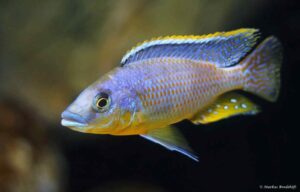


Geophagus altifrons
Recently, Geophagus species have become very popular among enthusiasts. You often see them offered in stores. Including the beautiful, graceful Geophagus altifrons. Through this article I want to share some more information about these beautiful fish and especially help people keep them.
The name Geophagus can be divided into two parts: Geo means Earth and Phagos means to eat. Together they make earth-eater. This is a reference to their behavior where they dig into the substrate. Altifrons comes from Latin, Alto means High or Long and Frons means Forehead or Front. This refers to the high forehead of this species.
Origin/Appearance
This species comes from South America and inhabits the Rio Tapajos, Rio Xingu, Rio Trombetas, Rio Tocantins rivers, among others, each river has its own variant that differs in soil color and structure. For example, the Tocantins variant from the state of Tocantins will be quite tall and also much larger than the Rio Tapajos variant from Brazil.
The Geophagus altifrons is a species that likes to sift sand, they also do this behavior in nature, which they are also happy to show in the aquarium. They dig into the substrate which they sift for food particles. This also shows that the substrate should certainly not be too coarse, otherwise we would not see this beautiful behavior in the aquarium.
Telling males from females is not that difficult. Males are larger and they also have a rounder forehead and more color. In my variant, the females have a grayer base color and have more blue glitter between the scales. They are also somewhat rounder.
Care in the aquarium
Geophagus altifrons are easy fish to keep, but some keeping rules must be kept in mind. The rules for keeping Geophagus altifrons and other Geophagus species are simple: A fine sandy bottom, calm tankmates, good water values.
These beautiful fish do best in a group of 8, of course, the tank size must allow a large group!
I would not recommend keeping these fish in pairs. These beautiful fish are not pairs for life. So they will also turn their backs on their partner during mating, something that is also common in other earth-eater species from both South and Central America.
The final size will be around 20 to 25 cm. There are stories that they will get bigger, but I have never seen them bigger myself.
The Aquarium
The decoration of the aquarium is best done as open and fine as possible, so a good fine sand bottom that is thick enough to dig into the sand (so that they do not immediately hit the glass bottom) And some hiding places so that they can hide if they are startled.
kGeophagus-like are not plant destroyers, plants can die but they never do this on purpose but by digging plants uproot quite quickly. A tip for this is to place the plants before the fish and let them take root, possibly with some pebbles at the roots so that the roots can attach themselves to it so that the plant does not rise up as quickly.
The lighting could also be a bit more subdued, it would be even better if the lighting did justice to the colors of the species, so Grolux, Trinton lamps.
To keep these fish comfortably, the minimum tank size should be at least 160 cm x 60 cm x 60 cm. This size allows for a decent group of fish, but it will limit the space available for other tank inhabitants. Ideally, an aquarium measuring at least 200 cm x 60 cm x 60 cm or larger would provide a better environment.
Water parameters
I keep my Geophagus altifrons in water with a pH of 6.5, a KH of 4, and a GH of 8. I achieved these values by filtering the water over peat and adding fresh driftwood, which resulted in these beautiful water conditions. While some people do keep them in harder water, I prefer to maintain a more natural environment for my fish. To be honest, I feel that my water values are still a bit too high.
Tank mates (Character)
Geophagus altifrons is a social fish, so when kept in a group of 8, there is limited space for other inhabitants. They are not aggressive, and their tankmates should also be peaceful.
Suitable cichlids include:
- Heros severus or other related species, such as the efasciatus or the sp. tapajos.
- Hypselecara temporalis and coryphaenoides these species grow large but are very intact.
- Uaru amphiacanthoides, these beautiful, almost discus-like fish, are also very suitable.
- Crenicichla species, the smaller, peaceful species (or the tank must be large)
- Guinacara species can also be good tank mates.
There are many more options to consider when listing all of this. While it may seem excessive, as long as things remain calm and the Geophagus are treated with respect, everything should be fine. For non-cichlid options, one could consider fish similar to salmonids, corydoras, or various types of catfish.
Breeding Geophagus altifrons
Based on my experiences with the Rio Tapajos variant that I care for, I have found that breeding them is not difficult. The male typically seeks out a female and initiates courtship. If the female is receptive, the male may gently nudge her flank. After courting for some time, the pair will search for a suitable location to spawn.
This is often a piece of wood or stone. I have even seen fish deposit eggs on a piece of wood just below the water’s surface without cleaning it! Necessity knows no law, especially with fish.
Many types of fish lay eggs, and hobbyists who are unfamiliar with this process may be surprised by what happens next. After fertilization, the female fish takes the eggs into her mouth, using it as a brood chamber for the developing young. She does not eat the eggs; instead, she protects them until they grow large enough to swim freely, which is typically when they reach a size of about 0.5 to 0.8 cm. Once the yolk sac is used up, the young fish begin to swim on their own, and at that point, the mother fish spits them out.
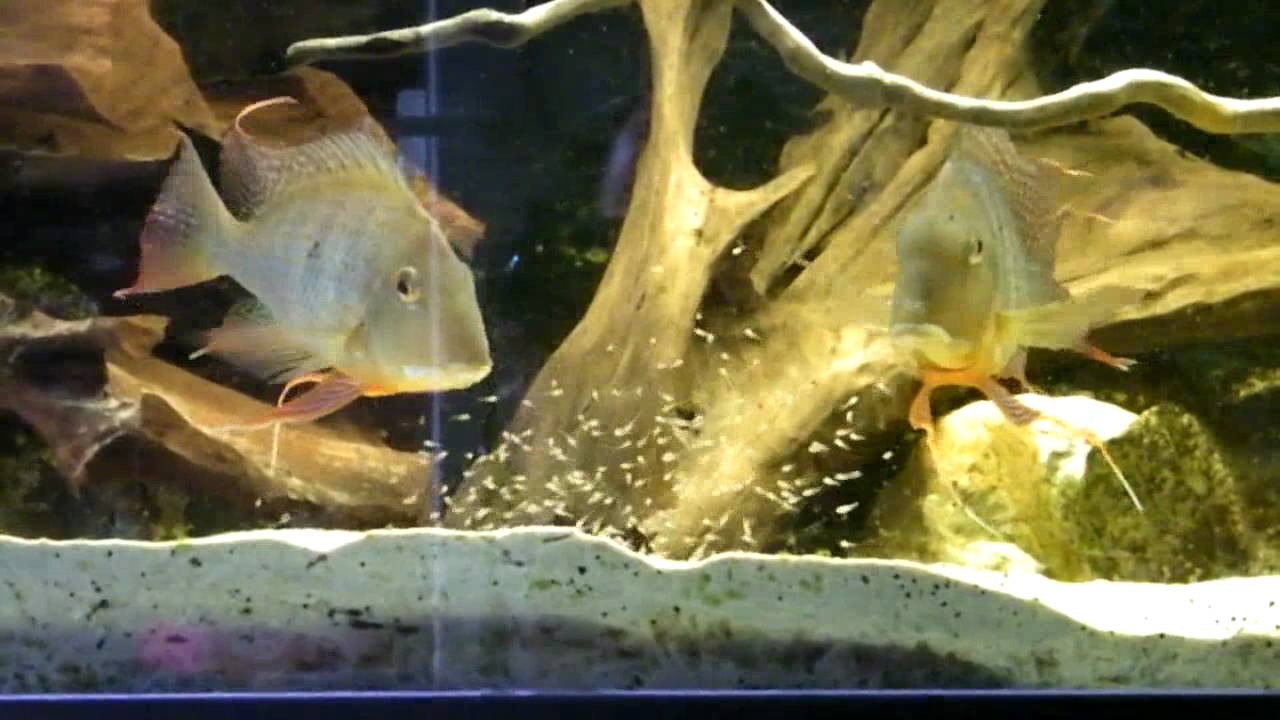
The male will then take care of the defense of the young against the other inhabitants. In a not too busy tank it is a beautiful sight how the young go in and out of the mother’s mouth. During this period from spawning until the young leave her mouth, the female does not eat! She will also not be able to defend herself against other inhabitants and is therefore completely dependent on her male. He keeps the place free of unwanted intruders in their territory.
Raising the young is not difficult; this can be done by feeding them powdered food and newly hatched artemia nauplii, after which you can later switch to coarser food and frozen food
Conclusion
If you’re looking for a beautiful and graceful fish for your aquarium, I highly recommend the Geophagus altifrons. They have stunning colors and a charming personality, making them a joy to keep. Make sure to purchase them from a reputable store, as there are many crossbreeds and other types of altifrons available in the market. I’m very happy with my Geophagus altifrons; they truly are little gems in my aquarium.
Video


Author
Michael
Copyright images
Michael
J. de Lange