

Channa in general
Snakeheads are primitive predatory fish from the family Channidae, a group within the perch family. The exact phylogenetic relationship is unknown, although recent research suggests that snakeheads are closely related to Labyrinth fish and Synbranchus eels (including spiny eels).
The genus Channa comprises 31 species that are widespread in Asia, from southeastern Iran and eastern Afghanistan eastward through Pakistan, India, southern Nepal, Bangladesh, Myanmar, Thailand, Laos, Malaysia, Sumatra, Indonesia, Vietnam, Korea, and China to parts of Siberia. In addition, 3 species of the related Parachanna family are found locally in parts of Africa.

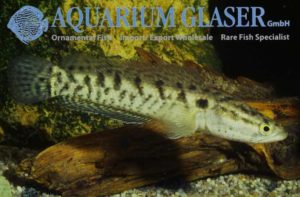
The Channa varieties have large differences in size. The unofficial term Dwarf Snakehead was coined by aquarists to refer to a group of Channa species that do not grow larger than 25 cm: Channa bleheri, Channa cachua, Channa orientalis, Channa andrao. These species are also most suitable for keeping in an aquarium due to their limited size and relatively peaceful character. Most other species grow to a maximum of 30-90 centimeters. Five species (Channa argus, Channa barca, Channa marulius, Channa micropeltes and Channa striata) can even reach 100 centimeters or larger and can be considered monster fish that are hardly suitable for keeping in an aquarium.
Origin
Fossils dating back 50 million years indicate an origin in the southern Himalayas (India and eastern Pakistan). From 15 million years ago, with the expanding intertropical climate zone, they have spread further to parts of Europe, Africa, and a wider area of Asia.

Physical features
Channa have an elongated body and are distinguished by their long dorsal fins large mouths full of teeth. They earn their common name Snakehead because of their flattened shape and the scales on their heads that are reminiscent of the large epidermal scales on snakes.
Channa have gills to breathe water like most other fish. However, subadults and adults can also breathe air to supplement their demand for oxygen. In fact, snakehead fish mainly get oxygen from the air. Without air, they would drown. Unlike many other airbreathing fishes, Channa have a series of cavities in the rear section of their head. These cavities (suprabranchial chambers) are filled with tightly folded sheets. Due to the large contact surface of the sheets, oxygen can be absorbed into their blood. Unlike mammals, they lack a diaphragm and use water to exchange old air with fresh air each time they take a breath. Thus, their ability to breathe air when out of the water is limited. They appear to breathe air more frequently when swimming actively.
The genus Parachanna (from parts of Africa) is recognized as a separate genus because of a more primitive implementation of the breathing apparatus.
Snakehead fish are known for their ability to migrate short distances over land to find other bodies of water, utilizing their ability to breathe air. When moving over land they curve their body in an S shape first, before launching themselves forward by a powerful stretch. In high humidity conditions, Channa are able to survive from 2 up to 4 days out of the water. When placed in direct sunlight, however, they desiccate and perish in minutes to several hours. Contrary to popular belief, snakehead fish don’t just leave the water. They especially know how to find their way back to the water when previously abundant areas dry up again. The only snakeheads that actively leave the water belong to the dwarf species (C. gachau and C. orientalis, C. asiatica, and C. amphibius). Even then there is a clear reason for leaving the water, such as escaping overpopulation.
Snakeheads can be found in a wide variety of waters and water conditions. They are found in tropical, subtropical and temperate regions. Snakehead fish are not dependent on the oxygen level in the water. Many (not all) species can also tolerate widely varying temperatures and water parameters for a period of time. However, they are very vulnerable to sudden changes in water parameters.
Behavior
Snakehead fish are predatory fish that feed on plankton, insects and snails as youngsters. As they grow larger, the larger species switch to a menu consisting mainly of fish, frogs, crabs, shrimps, small aquatic mammals and waterfowl. Young specimens usually hunt in groups. When they reach sexual maturity, they isolate themselves to lead a solitary life or live in pairs. They then develop a higher degree of aggression towards conspecifics and often also towards other fish. Often a couple will not tolerate other fish in the limited space of an aquarium.
Snakeheads are not active swimmers. In addition to hunting, they actively move only to draw air from the surface. Usually, they swim in the middle water layer or rest on the bottom to strike from an ambush. A number of species, however, are pelagic and are more active swimmers. All snakeheads are capable of launching themselves forward from a standstill by briefly curving their muscular body and stretching it forcefully.
Brood care is an important behavioral trait for Snakeheads. All species violently guard and defend their eggs and young. The majority of species lay eggs that rise to the surface and are guarded there. A number of smaller species collect these eggs and store them in a burrow that may or may not have been dug. A number of species are mouthbrooders.
The snakehead is a popular – eccentric – fish among a specialist group of aquarium keepers. Snakeheads are elegant, powerful, alert, and calm fish, with a willful character. The mutual communication, hunting technique and brood care is fascinating. Some aquarium keepers specialize in keeping the largest species and have a pet-like experience. Some rare and variegated species (such as C. barca) are among the most valuable aquarium fish on the market.
Snakeheads often have changing patterns and colors as they grow. With the exception of the dwarf species, the young of most species are much more beautifully marked and colored than the aging fish. With age, they usually get a duller ground color. Some aquarium keepers lose interest in them as they grow. It is therefore wise to do some research before purchasing.

As predators, snakeheads are by nature not a suitable choice for the average community aquarium. They are intolerant and usually soon the only fish. A special aquarium is required for keeping snakeheads. Aquarium keepers have different experiences when it comes to mixing snakeheads with other tankmates. Most species are best kept alone. Combining snakeheads with territorial or aggressive tankmates is not recommended. An intimidated snakehead hides, tries to escape, and refuses to eat. The extent to which other fish are tolerated in the small habitat of an aquarium depends very much on the species, but within that probably also on the individual specimen and the specific situation. There are a number of general experiences per group:
Dwarf species
Due to their small size and relatively mild temperament, most dwarf species pair well with robust, fast fish of a similar size. Provided these fish are not too territorial or aggressive. It should be taken into account that most dwarf snakeheads live in their natural environment in an eco climate zone with seasonal extremes in water temperature and water values. As a result, they cannot be kept at a tropical temperature all year round. A temperature reduction for at least one season per year is necessary to keep them healthy. Co-residents must also be able to cope with this.
Medium sized species
This group contains the most diversity in terms of behavior. Many of the larger species (between 30-60 cm) can be combined with relatively fast and robust fish of a similar size, for example, large cyprinids. General experience is that combining with other fish species works best when the snakehead fish are not yet too big and when the other fish have already settled. Newly introduced fish are often killed immediately. It varies greatly by species and experience. Often the tolerance to other fish is temporary. When a pair of snakeheads is formed, the co-inhabitants (also conspecifics) are usually chased and killed.
Large species (60 – 130 cm)
These snakeheads themselves require an amount of space that most private aquariums are unlikely to be able to provide. Extremely large private aquariums are usually just big enough to hold one fish or a couple. In general, the same applies as with the medium varieties. Fish that grow with them from an early age are often tolerated. Newly introduced fellow residents are often killed immediately.
A number of large species, such as C. argus and C. micropeltes, are important food fish. They are considered highly invasive and destructive to the local ecosystem outside their natural habitat (see also the documentary Invasion of the Snakeheads). After the fish were sighted in several places in the US, import bans and a ban on owning a live specimen are in effect in most states within the US.

Channa pardalis – Leopard Snakehead
Channa pardalis was first described in 2016 by Knight. The Dutch name is Leopard Snakehead, and the English name is Leopard snakehead. They are closely related to Channa stewartti.
The scientific genus name Channa was officially made available in 1777 by the Italian naturalist Scopoli. The family name Channidae is derived from this. However, the genus name goes back even further, to the work of the Dutch ichthyologist (fish expert) Gronow from 1763. The exact meaning or origin of the name Channa is unknown, but there are two interesting theories:
The Greek connection: It may come from channe or channos. This was a Greek name for a sea fish with a wide mouth. Given the large mouth of the snakehead fish, this is a logical explanation.
The Sri Lankan connection: A more recent theory suggests that Channa is a Dutchized spelling of kanaya. This is the local name in Sri Lanka for small snakehead fish. Because Sri Lanka was under Dutch rule at the time and Gronow was Dutch, this seems plausible. However, critics point out that we pronounce Channa with a ‘G’ sound and not a ‘K’, making this less likely.
This is a recently discovered species that was previously known under the names Channa sp. True Blue en Channa sp. Meghalaya. The latter is currently being considered whether it should not also be seen as a separate species.
Description
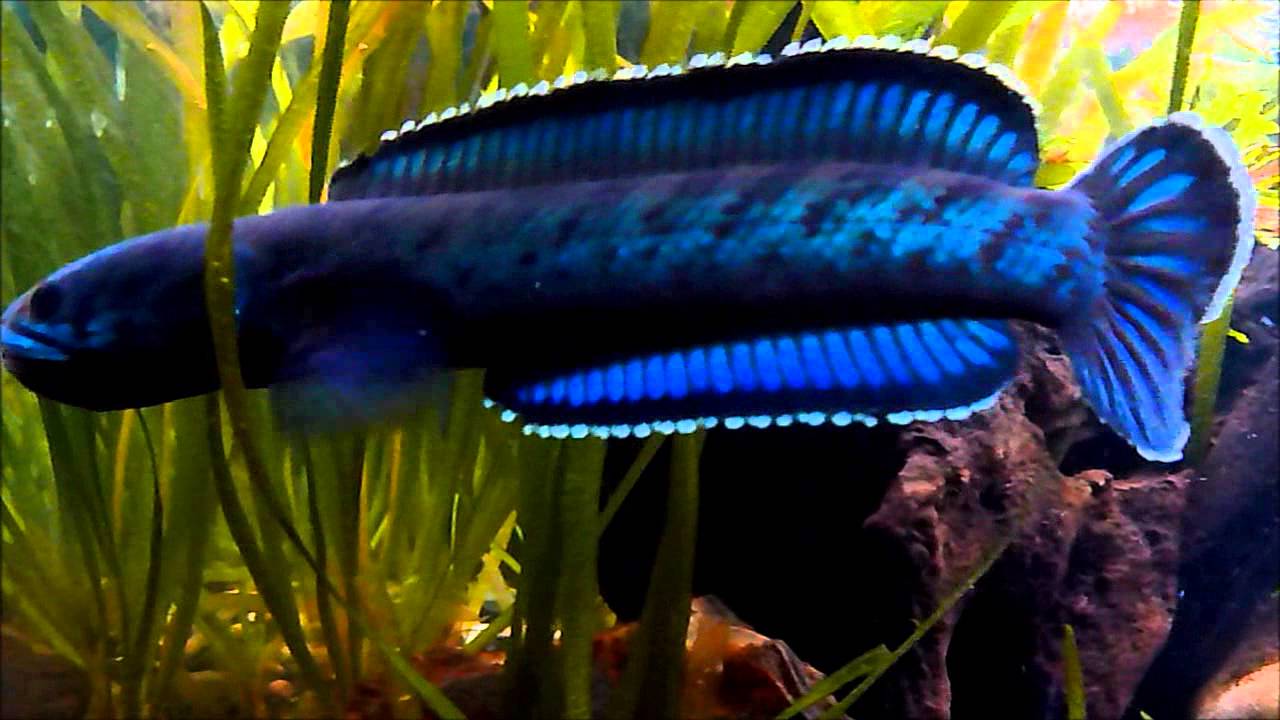
The Leopard Snakehead has an elongated, snake-like body that is flattened laterally at the rear. The head is large, flattened from top to bottom, and resembles that of a snake. The mouth is deeply incised and extends far behind the eyes. The lips are fleshy and the mouth contains numerous powerful, pointed teeth. The fish can reach a maximum total length of about 20 centimeters, with males reaching this length.
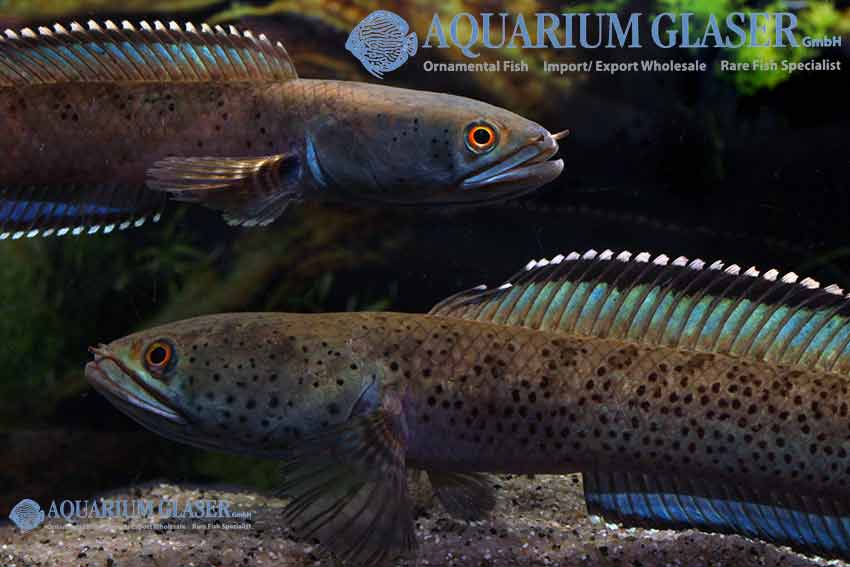
The basic color of the Leopard Snakehead varies from various shades of brown to bluish-brown. Characteristic are the numerous large black spots on the area behind the eyes, on the gill cover, and on the body. These spots can sometimes fade to dark gray. The dorsal, anal, and caudal fins have a broad white and black edge. The pectoral fins are cream-colored with three or four dark gray, semicircular bands. The pelvic fins are gray with a white edge. When alive, the fish is blue-gray with a bright blue head and gill cover. The spots are clearly visible. The pectoral fins have a bright blue spot at the base and alternating light orange and gray bands that fade toward the tip of the fin. The sclera (white of the eye) is dark orange with two orange spots, one at the front edge of the eye socket and one below it.
There are clear differences between the sexes. Males have a more massive and broader head than females, and their dorsal fin is higher. However, these characteristics are not always reliable for determining sex.
Juveniles exhibit group behavior and often hunt together. However, as they mature, they become territorial and more aggressive, especially during mating season. Adult specimens are best kept solitary or as a well-established pair to prevent aggression between conspecifics.
The Leopard Snakehead is an obligate air-breathing fish, which means that it needs atmospheric air to survive. It does this via a suprabranchial organ in the gill cavity.

Biotope
The Leopard Snakehead is native to Asia, specifically northeast India, in the Khasi Hills in the state of Meghalaya. The natural habitat of this fish consists of well-flowing mountain streams.
Diet
In their natural habitat, the mountain streams of the Khasi Hills in India, Channa pardalis feeds mainly on insects and other invertebrates. However, as an opportunistic hunter, the fish will also eat other small aquatic animals that come within its reach.
In the aquarium, the Leopard Snakehead can be fed a varied diet. In addition to live food such as insect larvae and small crustaceans, they can also be accustomed to high-quality dry food, such as sticks for cichlids. It is important to offer a varied diet to ensure that the fish gets all the nutrients it needs.
Common mistakes when feeding this species include offering too little variety in the diet or overfeeding the fish. An unbalanced diet can lead to deficiencies, while overfeeding can lead to health problems and poor water quality. It is advisable to feed the fish in small portions so that all the food is consumed.

The Aquarium
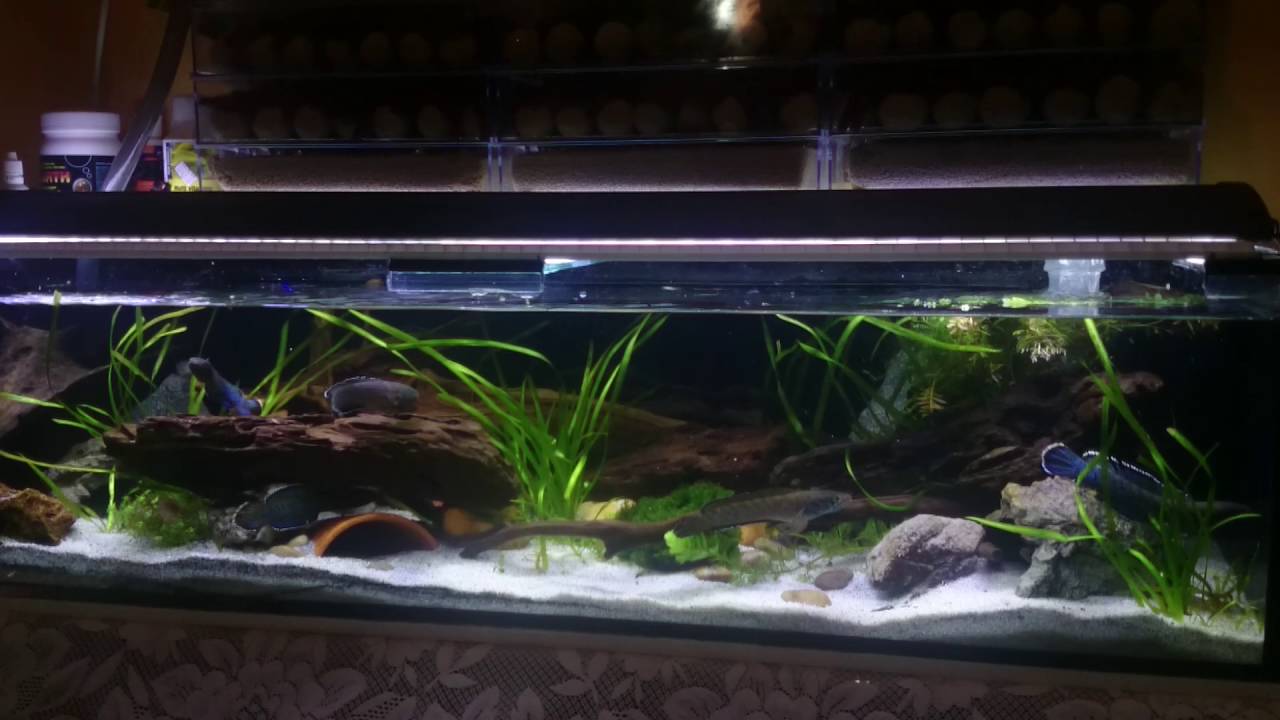
For a single Leopard Snakehead, an aquarium with a minimum size of 120 centimeters long, 50 centimeters wide, and 40-50 centimeters high is recommended. A larger aquarium is always better, given their territorial behavior.
Set up the aquarium with dense planting to provide hiding places and reduce stress. Wood and rocks are also suitable for creating hiding places. There must also be sufficient open swimming space.
The ideal temperature is between 22-24 °C in summer and 18-20 °C in winter. A winter period with lower temperatures is necessary to keep them healthy. The pH should be between 6.0 and 8.0, which means you can usually just use tap water.
Suitable and unsuitable tankmates
The Leopard Snakehead is a predatory and aggressive fish, and is therefore generally not recommended for community aquariums. However, they can coexist with some of the largest cichlids (such as Gars), large catfish, and various large Plecos, provided they are similar in size to adult animals. It is important to choose tank mates carefully and monitor compatibility closely, as this can vary from individual to individual. Introducing new fish into an established aquarium with Channa pardalis can lead to aggression, so this should be done with caution, preferably when the snakehead is still young.
Breeding Aquarium and Conditioning
The Leopard Snakehead is a paternal mouthbrooder, which means that the male carries the eggs in his mouth and incubates them. This makes breeding in a community aquarium challenging, because the male may defend the eggs and young against other fish, but may also become prey himself or become stressed by the presence of other fish. It is therefore recommended to set up a separate breeding aquarium.
A breeding aquarium for Channa pardalis must be at least 300 centimeters long, with a width of 100 centimeters and a height of 50 centimeters. The interior should consist of plenty of hiding places, such as plants, wood, and stones, to give the fish a sense of security and facilitate territory formation.
Breeding Channa pardalis
To stimulate breeding, it is important to condition the parent fish properly. This includes providing a varied and protein-rich diet consisting of live food such as insect larvae, small crustaceans, and small fish. A period of lower temperatures, similar to the winter period in their natural habitat, is essential. During this winter rest period, which ideally lasts from November to February, the fish should not be fed. After this period of rest, the temperature can be gradually increased to stimulate spawning.
During conditioning, a high-quality diet is crucial. After winter rest and when the temperature rises, feeding can be resumed with live food to stimulate the urge to spawn. Regular water changes are important to maintain optimal water quality, especially during the breeding season.

Particularities
An interesting behavior is that juveniles of this species exhibit group behavior and hunt together. However, as they mature, they develop strong territorial and aggressive behavior, especially during the mating season. This makes keeping multiple specimens in the same aquarium challenging and requires careful planning and possibly a separate aquarium for each individual, unless a well-established pair is kept.
Conclusion
The Leopard Snakehead is a fascinating but challenging fish species for aquarium owners. With its unique appearance and behavior, including the ability to breathe air, it attracts the attention of enthusiasts. Due to its strong inner aggression and territorial behavior, this species is not suitable for beginners and requires a spacious aquarium with plenty of hiding places and careful selection of tank mates, if at all possible.
Successfully keeping and possibly breeding the Leopard Snakehead requires specific knowledge about its habitat, diet, and reproductive behavior. A period of winter rest with lower temperatures is essential for health and reproductive stimulation. Although breeding is challenging, it can be a rewarding experience for the experienced aquarist who is willing to make the necessary efforts to meet the specific needs of this remarkable fish.
Video

Frequently asked questions – FAQ
What is the scientific name of the Leopard Snakehead?
The scientific name is Channa pardalis.
Where does the Leopard Snakehead come from?
This species is native to the Khasi Hills in Meghalaya, India.
Is the Leopard Snakehead suitable for a community aquarium?
No, due to their aggressive and territorial nature, they are generally not recommended for community aquariums. They can, however, coexist with large, robust fish of similar size.
What does the Leopard Snakehead fish eat?
In de natuur eten ze insecten en andere ongewervelden. In het aquarium kunnen ze gevoerd worden met insectenlarven, kleine kreeftachtigen, kleine vissen en hoogwaardig droogvoer.
Does the Leopard Snakehead require special care?
Yes, they are obligate air breathers and therefore need access to atmospheric air. A spacious aquarium with plenty of hiding places and a specific temperature cycle with a winter rest period is recommended.
Is de Luipaard Slangenkopvis gevaarlijk voor mensen?
No, the leopard snakehead fish is considered harmless to humans.
What are the main differences between Channa pardalis and Channa sp. Meghalaya?
Although there were rumors of clear differences, the differences in head coloration between Channa pardalis (also known as “True Blue”) and Channa sp. Meghalaya do not appear to be consistent. It is advisable to keep them separate, but clear species-specific differences have not been conclusively established.
Author

Since I bought my first second-hand aquarium when I was twelve, I have always had one or more aquariums. I even converted a garage into a breeding room where I had 50 aquariums containing around 10,000 liters of water. At the moment, I have two aquariums: a 1,250-liter Tanganyika aquarium and a 250-liter community aquarium with plants. For the past 10 years, I have been working on this website as a writer and photographer.
Copyright images
AquariumGlaser.de
Ben Lee, Amiidae.com
References
- Channa pardalis, a new species of snakehead (Teleostei: Channidae) from Meghalaya, northeastern India. Doi: http://dx.doi.org/10.11609/jott.2168.8.3.8583-8589