

Axelrodia stigmatias – Pepper Tetra
Axelrodia stigmatias was first described in 1924 by Fowler. Their common name is Pepper Tetra, and sometimes “White Star Tetra,” which refers to the small black dots scattered across its body, giving it a speckled appearance.
The Pepper Tetra belongs to the family American Tetras (Acestrorhamphidae). The genus Axelrodia was proposed when it was discovered that the species Hyphessobrycon stigmatias had only one row of conical teeth, which meant that it could not belong to the genus Hyphessobrycon.
The genus name Axelrodia is in honor of the American ichthyologist Dr. Herbert R. Axelrod. The species name stigmatias is derived from the Greek word “stigma,” meaning “point” or “spot,” referring to the characteristic black spots on the fish’s body.
Synonyms: Axelrodia stigmatias, Hyphessobrycon stigmatias en Axelrodia fowleri.
Description
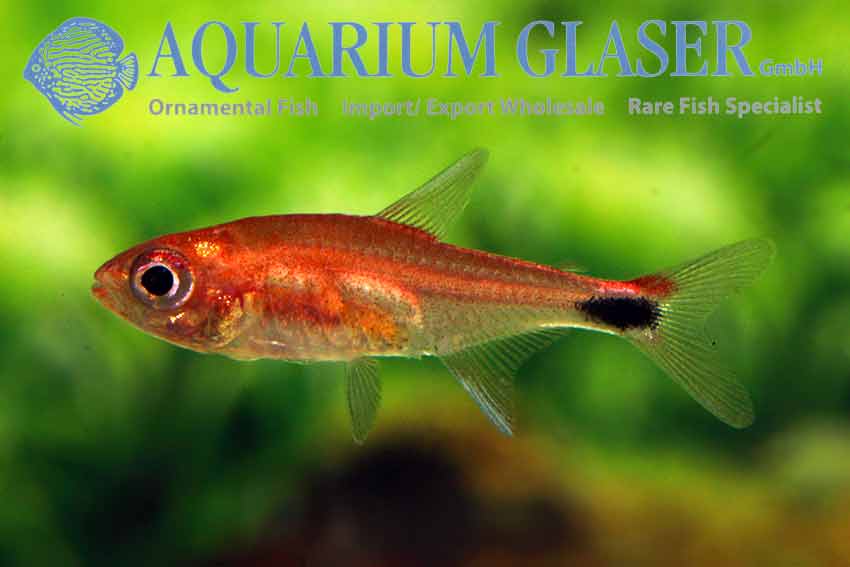
The Pepper Tetra is a small, peaceful schooling fish that reaches a maximum total length of approximately 2.5 to 3 centimeters. Its body is compact and graceful, with a silvery to light green color. It is characterized by small black spots scattered across its body, which give the fish its Dutch name “Peper Tetra” (Pepper Tetra). Sometimes the English name “White Star Tetra” is also used, referring to these spots.
The fins are light yellow to transparent, and in well-fed, adult animals, the front edges of the fins may be white. The eyes have a striking red iris ring. A faint horizontal midline stripe may be present, which becomes stronger towards the tail and ends in a spot on the tail root. Above this spot, a metallic gold dot may be visible, which appears to glow when the fish is in good condition and the light is dim.
There are slight differences between the sexes: females are generally rounder and plumper in build, while males are slimmer and may be more brightly colored. Juveniles resemble the adults, but are smaller and less intensely colored.
The Peper Tetra is an active schooling fish that mainly stays in the middle layer of the aquarium. They are known for their peaceful nature and are therefore suitable for community aquariums, provided they are kept in groups of at least 8-10 specimens. Larger groups are considered more attractive and calmer.
Biotope
Axelrodia stigmatias occurs naturally in South America, specifically in the Amazon and Orinoco basins, with records from Brazil and Peru. They live mainly in slow-flowing rivers, streams, and tributaries. These waters are characterized by dense vegetation and roots, which provide plenty of hiding places. The substrate in their natural habitat is often dark, and the lighting is subdued, which brings out the colors of the fish.
In their natural environment, they are exposed to soft, slightly acidic water. The ideal water values for the Peper Tetra in the aquarium are therefore around a temperature of 22-27 °C, with a pH value between 6.0 and 6.5, and a GH value of 5 to 8.
Diet
In their natural habitat, Peper Tetras feed mainly on small insects, insect larvae, and other small invertebrates, such as water fleas (Daphnia) and Artemia nauplii. They are considered micro-predators, which means they hunt very small prey.
In the aquarium, it is important to mimic this natural diet as closely as possible. Although they will accept dry food of a suitable small size, it is highly recommended to offer small live and frozen foods daily. Good options include Artemia nauplii, Daphnia, Moina, and bloodworms. Providing a varied diet is important for the health and vibrant colors of the Pepper Tetra.
Common mistakes when feeding small tetra species such as the Pepper Tetra are offering food that is too large, which the fish cannot eat and pollutes the water, or feeding them too one-sidedly with only dry food. This can lead to malnutrition, poor growth, and reduced resistance to disease. So make sure the food is small enough and offer a mix of live, frozen, and possibly high-quality dry food.
The Aquarium
For Axelrodia stigmatias, an aquarium with a minimum width of 60 centimeters is recommended, which equates to approximately 54-60 liters. Although they do not require a significant amount of swimming space, a slightly larger aquarium with sufficient length is preferable for a school.
The layout of the aquarium is important for the well-being of these fish. A dark substrate, such as fine sand or dark gravel, is recommended because it brings out the natural colors of the Pepper Tetra. The aquarium should be densely planted, especially at the edges and in the background, to create sufficient hiding places. Floating plants can also help to dim the light, which the fish appreciate. In addition to plants, roots and pieces of driftwood can also serve as hiding places. Make sure that there is sufficient open swimming space in the middle of the aquarium so that the fish can move around freely.
In terms of water values, the Peper Tetra prefers soft, acidic water. The ideal temperature is between 22-27 °C, with a pH value between 6.0 and 6.5. The hardness (GH) should not be too high; a value between 5 and 8 °dGH is recommended. These fish are sensitive to nitrate, so regular water changes of about 20-30% per week and good filtration are important to ensure stable water quality.
The Pepper Tetra is a peaceful schooling fish and can be kept well with other small, peaceful fish such as other small tetra species, Corydoras species, and peaceful barbs. Avoid keeping the Pepper Tetra with large, aggressive, or territorial fish that may chase or eat the small tetras.
Breeding Aquarium and Conditioning
Little detailed information is available about breeding Peper Tetras in aquariums. However, it is possible to breed them successfully, provided the right conditions are created.
Although the Peper Tetra can reproduce in a well-maintained community aquarium, the chances of survival for the eggs and fry are slim. The parents tend to eat their own eggs and any fry. It is therefore strongly recommended to set up a separate breeding aquarium if you specifically want to breed them.
A breeding aquarium of approximately 60-80 liters is sufficient. The layout of the breeding tank should focus on providing spawning sites and hiding places for the young. Dense vegetation, such as Java moss or fine plants such as Cabomba, is ideal because the eggs are laid among them. A spawning grid on the bottom can also help prevent the parent fish from eating the eggs immediately. A dark bottom and subdued lighting promote spawning behavior.
To get the parents in the right condition for breeding, a varied and protein-rich diet is important. This can consist of live and frozen foods such as Artemia, Daphnia, and small water fleas or mosquito larvae. Offering this food for several weeks helps to get the fish in top condition.
In addition to a varied diet, small, regular water changes with softer, slightly more acidic water can stimulate the urge to reproduce. It is important to keep the water values stable, similar to the ideal values for keeping adult fish, but with a focus on soft and acidic water.
The Spawn
Little detailed information is available about the specific courtship behavior and color changes of Axelrodia stigmatias during the mating season.
The eggs are deposited among plants or mosses, such as Java moss. This suggests that the fish prefer a fine-leaved or thread-like substrate to attach their eggs to. It appears that the adults can spawn more or less continuously, with small numbers of fry appearing within a few weeks.
An important point to note during breeding is that the parent fish tend to eat their own eggs. Therefore, as mentioned earlier, it is strongly recommended to remove the parent fish from the breeding aquarium after spawning in order to protect the eggs.
Raising the Young Fish
After the eggs hatch, which usually takes 1 to 2 days, the larvae will first attach themselves to plants or other surfaces in the aquarium. After about 2 to 3 days, they will swim freely and start looking for food.
The first food for young Peper Tetras must be very fine. Live nauplii of Artemia (brine shrimp) are ideal for this purpose. Infusoria or very fine dust food can also be offered. It is important to feed the young several times a day in small portions to provide them with optimal nutrition and not to pollute the water quality.
During the first few weeks, it is crucial to keep the water quality in the breeding aquarium stable. Small, daily water changes of approximately 10-20% with clean, temperature-adjusted water are recommended. This helps to remove waste products and provide the young with clean water. It is important to monitor the water values closely, as young fish are very sensitive to fluctuations.
To increase the survival rate of the young, it is essential to remove the parent fish as soon as possible after spawning, as they will eat their own eggs and young. A densely planted aquarium with plenty of hiding places, such as Java moss, helps the young to feel safe and escape from any predatory tank mates (if present). A stable temperature and water values are also very important. As the young grow larger, the food can gradually be adjusted to slightly larger live and frozen foods, and eventually to fine dry food.
Conclusion
Axelrodia stigmatias is a small, peaceful schooling fish that, with proper care, can be an asset to the aquarium. They require a densely planted aquarium with sufficient hiding places and open swimming space, preferably with subdued lighting and a dark substrate. Stable water parameters, with a focus on soft, acidic water and low nitrate concentrations, are important for their well-being.
This fish is suitable for community aquariums, provided it is kept in groups of at least 8-10 specimens and combined with other small, peaceful species. Although breeding can be challenging due to the tendency of the parent fish to eat their eggs, it is possible in a specially equipped breeding aquarium. With a varied diet of small live and frozen food, these fish can retain their vibrant colors and live a long and healthy life.
Video

Frequently asked questions – FAQ
What are the most important features of the Pepper Tetra (Axelrodia stigmatias)?
The Pepper Tetra (Axelrodia stigmatias) is a small, peaceful schooling fish with a silvery to light green color, distinctive black spots, and a length of approximately 2.5 to 4 cm. They live mainly in the middle water layer.
Which water values are ideal for the Pepper Tetra?
They prefer the soft to sour acidic water with a temperature between 23-27 °C, a pH value between 6.0 and 6.5, and a GH value between 5 and 8 °dGH. They are sensitive to nitrate.
What should I feed the Pepper Tetra?
In the aquarium, a diet of small live food such as Artemia, Daphnia and mosquito larvae to be recommended, supplemented with fine dry food. They are carnivores and eat small insects and crustaceans in the nature.
Is the Pepper Tetra suitable for a community aquarium?
Yes, the Pepper Tetra is a peaceful schooling fish and suitable for community aquariums, provided that kept in groups of at least 8-10 specimens and combined with other small, peaceful fish. They are sensitive to nitrate.
How do I breed the Pepper Tetra?
Breeding is best done in a separate aquarium with densely planted edges (e.g., Java moss) and dim lighting. Parent fish should be removed after spawning to prevent them from eating the eggs. A diet of live food and soft, acidic water promotes breeding.
Author

Since I bought my first second-hand aquarium when I was twelve, I have always had one or more aquariums. I even converted a garage into a breeding room where I had 50 aquariums containing around 10,000 liters of water. At the moment, I have two aquariums: a 1,250-liter Tanganyika aquarium and a 250-liter community aquarium with plants. For the past 10 years, I have been working on this website as a writer and photographer.
Copyright images
Choy Heng Wah
F. Ingemann Hansen – Akvariefotografen.com
Thomas Siems – CC BY-SA 2.0