

17.11.2. Filtration for Discus
I found the key to decorative discus is ultra-crystal-clear water with NO bacteria counts and a HUGE amount of biofiltration. And I mean HUGE! For decorative discus one should ideally have a sump of at least 40% of the aquarium size (a 50 gallon aquarium needs at least a 20 gallon sump). This sump should ideally be filled with one of four arrangements:
- a fluidized bed of K1 type media,
- layer after layer of 20 ppI to 30 ppi Poret Foam
- brightly colored plastic pot scrubbers
- Stationary K1 type media
With decorative discus that is the ONLY filtration method I can recommend. But note many are successful with other methods. These are not “rules”. For instance all my discus tanks also have under-gravel filters in addition to large fluidized bed sumps.
The key for discus is to look down the length of the tank, through four or six feet of water. Are the ornaments and fish four feet away crystal clear and do they look like they are flying in air? Or is everything kind of “dull” and unclear? If it is “dull” there can be a problem. This clear water typically can only be found in over filtered aquariums whose filters have been in operation for more than four months.
The aquarium below has a slight haze to the water. Hopefully this is because the substrate was just disturbed by a water change. If that haze is “normal” these discus are probably going to have some health problems.
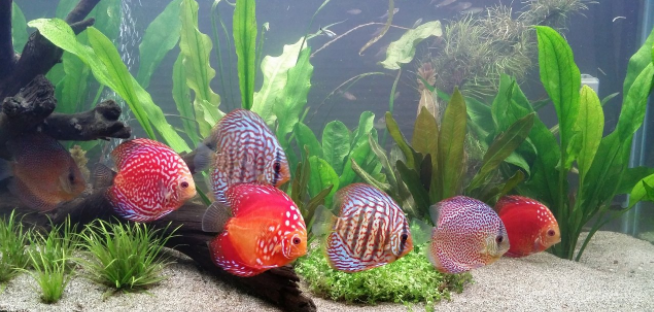
Bacteria free, crystal-clear water is obtained by several factors:
- Over-filtration. Using a very good high surface area filter media in a large filter (preferably foam, K1 or pot scrubbers in a large sump, or a K1 fluidized bed sump, and definitely not a hang-on-back filter) that gives well over 100 square feet of surface area for every pound of fish. Note we only recommend a 2X turn-over through this sump (i.e., a 100 gallon tank with a 30 gallon sump that has only a flow of 260 gallons per hour, or ([100+30] x 2).
- Having a filter which has been established and uncleaned for at least four months. This gets the build-up of beneficial brown gunk to the point where it can be effective.
- Adding a UV Unit which is on 24/7. A UV unit will prevent bad bacteria from reproducing somewhat. But UV doesn’t remove dissolved organic compounds (DOCs) like biofiltration will. So UV should only be an adjunct to very good biofiltration.
- Excellent aeration. Since discus like still water this can present a challenge. I do this aeration in the sump.
Obviously a program which combines any and all of these processes will give the greatest probability of success.

It is important to note that 100 square feet of surface area per pound of fish is just one of four methods that can produce SOMEWHAT clear water. All four methods are:
- 100 square feet of filter media surface area per pound of fish
- A polishing filter media such as Polyfil (polyester fibers), polyester mats (Pinkie Pads) or 40 ppi foam (i.e. “mechanical filtration”).
- A UV setup left on 24/7 kills the bacteria and infusoria in the water column.
- 50% to 100% water changes every day
What is important here is the difference between “somewhat” clear and “crystal” clear. “Somewhat” clear isn’t bacteria free water. It is water where the large visible particles have been filtered out but the microscopic stuff remains. Packed polyester (Polyfil) will filter out 200 micron particles. Most infusoria will be less than 200 microns and bacteria are 2 to 8 microns in size. This “somewhat” clear water can be very unhealthy water.
| Water Contaminant | Biofiltration | Mechanical Filtration | Most Chemical Filtration | Ultraviolet |
|---|---|---|---|---|
| Ammonia and Nitrate | Removes | |||
| Bad Bacteria | Removes | Removes | ||
| Pathogens like ich | Removes | Removes | ||
| Dissolved Organics | Removes | |||
| Feces, Uneaten Food | Removes | Removes | ||
| Floating Algae | Removes | Removes | Removes | |
| Tannic Acid, Dyes, Smells | Removes |
Using 100 square foot of filter media surface area per pound of fish will produce much clearer water than the other three methods as filtration by lots of surface area and flow will eliminate something called “DOCs”, or dissolved organic compounds. Dissolved organic compounds come from food and feces and are what bacteria feed on. Polishing filter media and UV don’t eliminate DOCs so they don’t produce as clear of water. Large scale water changes only eliminate a portion of the dissolved organic compounds as feces and decaying food are producing DOCs 24/7.
To calculate the size of the filter needed for discus one needs to do some math.
For more on how to calculate filter volume go to these articles:
8.8. Filter and Media Design
7.3. Media Volume
7.6. Required Aquarium Filter Media Surface Area
Information on Discus
The following articles will be useful reading if you are contemplating keeping discus:
17.11. Discus
17.11.1. Discus Husbandry
17.11.3. Water for Discus
17.11.4. Food for Discus
17.11.5. Discus Pheromones
17.11.6. Breeding Discus
17.11.7. Discus Aquarium Photos
Startpage Aquariumscience
Source: Aquariumscience.org – David Bogert

The author, David Bogert, is a certified chemist, something that is only useful in the sections on chemicals such as conditioners and fertilizers. He has about 43 patents, mostly in the medical device field, which only helps with some DIY designs. But he also spent much of his life as a scientific researcher working on literature research, data analysis, statistics, and a little-understood field called “experimental design.” This experience is very applicable to ALL fishkeeping science. The author has been keeping all kinds of aquariums and all kinds of fish for over 54 years. He currently has ten large and many small aquariums. But note that he is not an “expert” in all aspects of aquarium keeping. The ecology of an aquarium is far too complex for anyone to be a true “expert” in all the different aspects. One can only search the journals and books for relevant research in each individual subject.

