


Novaculichthys taeniourus – Rockmover Wrasse
Novaculichthys taeniourus was described by Lacépède in 1801. The Dutch name Rendier Lipvis (Reindeer Wrasse) comes from the appearance of this species in its early stages of life. At that stage, they have a “set of antlers” on top of their heads, just like a reindeer.
Description
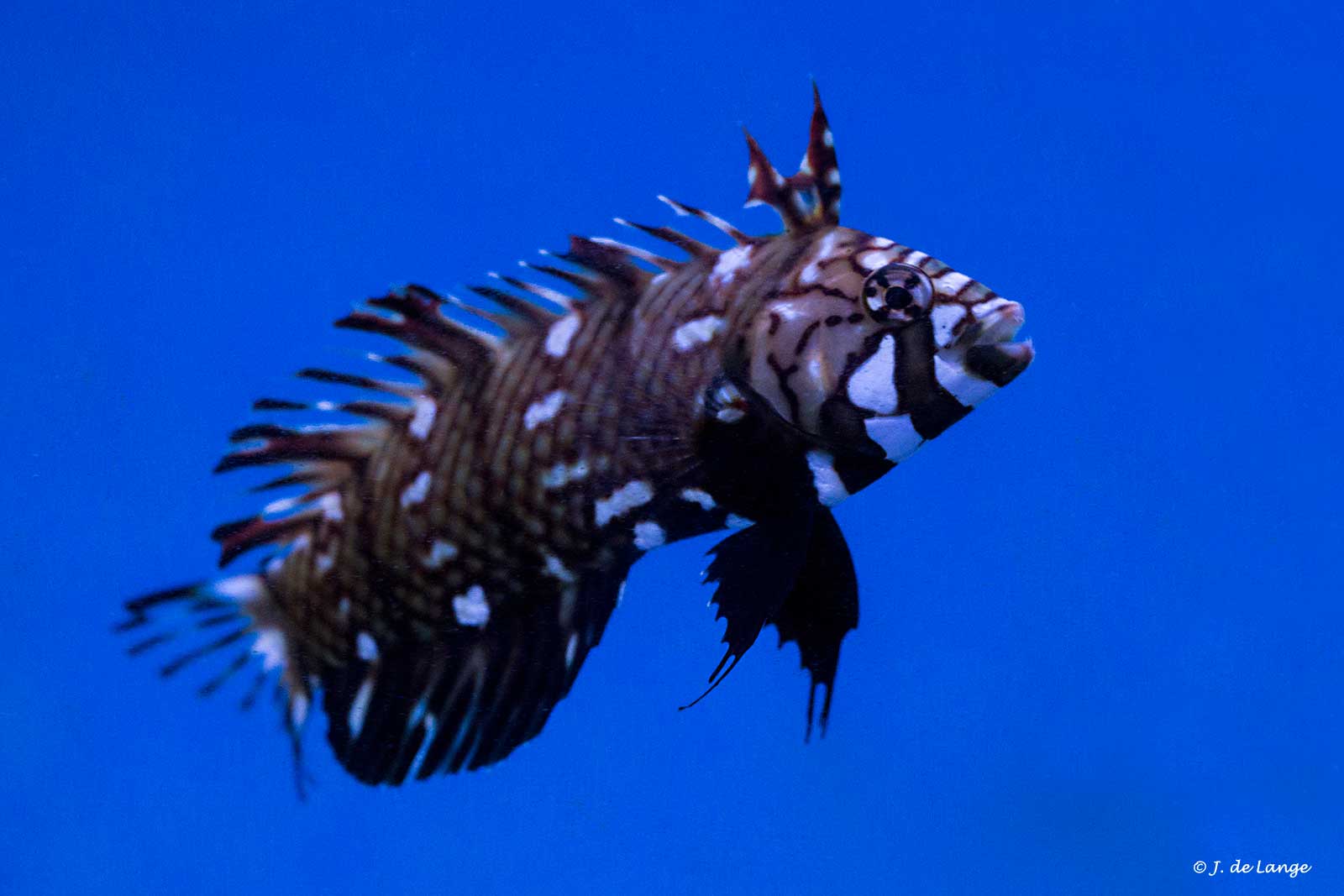
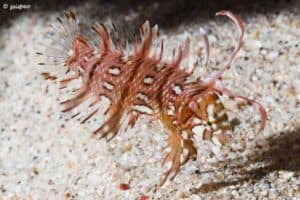
Novaculichthys taeniourus can be found in three different colors. The first color is that of the juvenile animals. These have many protrusions and, depending on their origin, can have two colors. The juveniles around Hawaii are green/white and those from the western Pacific Ocean are brown/burgundy/white. The color and shape of the young animals is actually a form of camouflage. Along the coast, they drift back and forth on the waves among algae, seaweed, and other floating material. Their shape and color make them safe from most predators.
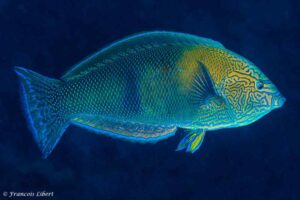
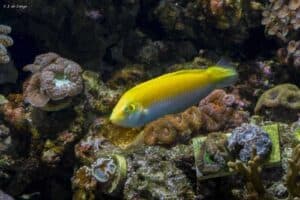
As the fish mature, the protrusions grow into a normal dorsal fin and the color changes from brown or green to black with white. These become adult females. If no males can be found in the area for the females then the largest and strongest female turns into a male. The colors change back a bit to brown. They then also get a little more red on the belly and the beak becomes yellow edged.
Below you can see the progression from juvenile fish to adult male:


The aquarium
If you want to keep Novaculichthys taeniourus in an aquarium, you should definitely consider their behavior. In English they are also called Rock Mover Wrasse. Looking for food, they move garbage but also whole rocks. Therefore, make sure your rocks are well fixed so they cannot knock them over. Also, the aquarium should have a lid. This is because sometimes they jump out. Therefore, an open aquarium is not recommended.
Make sure there is a thick layer of sand on the bottom. When the Reindeer Lipfish is scared or when they go to sleep, they bury themselves in the sand. Therefore, apply a layer of at least five inches so they have enough space.
Copyright images
John de Lange – Courtesy of Maui’s Fish Hatchery
Klaus Stiefel – CC BY-NC 2.0
zsispeo – CC BY-NC-SA 2.0
Resources